
For startups and founders, Twitter (X) plays a critical role in product launches, fundraising, hiring, and brand positioning. However, most early-stage accounts face the same challenge: strong content with limited reach. Tweets rarely escape the existing follower base, making growth slow and unpredictable.
This is where buying Twitter retweets often enters the conversation. When used strategically, retweets can help distribute important tweets to new timelines, increase early visibility, and create momentum that organic reach alone cannot achieve. When used incorrectly, they can waste budget or weaken long-term performance.
This article explains when buying Twitter retweets makes sense, how retweets influence Twitter’s distribution system, the difference between safe and unsafe retweet buying, and how startups can use retweets as a visibility tool—without damaging account health.
What Retweets Actually Do Inside Twitter’s Algorithm?
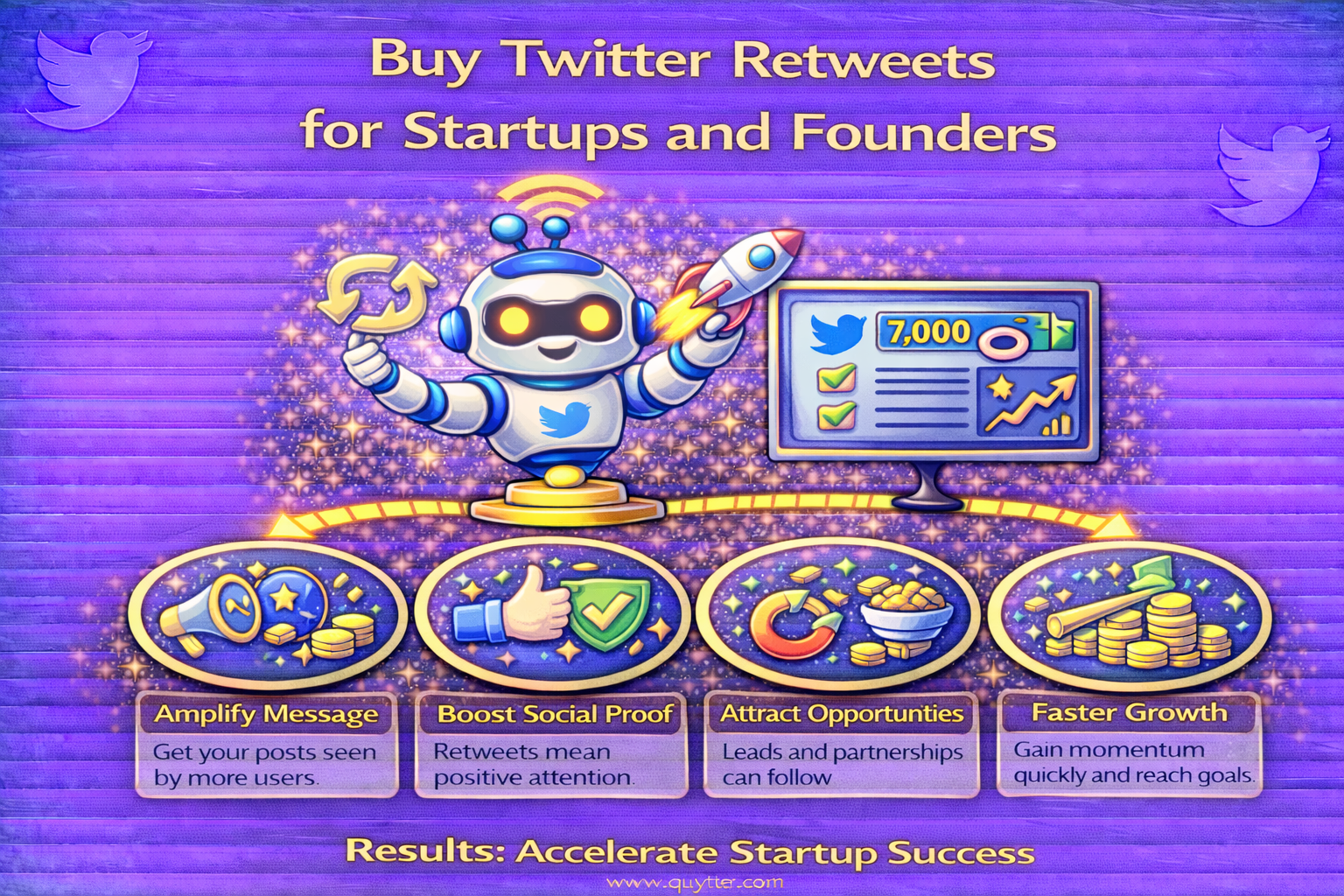
Retweets are not cosmetic metrics inside Twitter’s system. They function as active distribution signals.
When a user retweets your tweet, Twitter treats that action as a public recommendation. Unlike a like, which stays within the original audience, a retweet injects the content into a completely new timeline. This exposes the tweet to users who have no prior relationship with your account, expanding reach beyond follower boundaries.
This secondary exposure is critical because it creates fresh testing conditions. Twitter observes how the new audience reacts: do they pause, reply, click profiles, or continue the chain of sharing? Each retweet opens another opportunity for the algorithm to collect behavioral data outside your existing follower base.
From the algorithm’s perspective, retweets signal confidence. They tell Twitter that a user was willing to associate their own identity and audience with the content. This is a stronger endorsement than a passive reaction, which is why tweets with early retweets are pushed into wider testing pools faster than tweets that only accumulate likes.
In practical terms, retweets accelerate distribution velocity. They shorten the distance between posting and expansion, increasing the likelihood that a tweet enters trending threads, search visibility, or recommendation surfaces. That is why early retweets often determine whether a tweet stalls quietly or continues climbing through successive exposure layers.
Likes measure appreciation. Retweets drive movement. Twitter prioritizes movement.
Why Startups Struggle to Get Retweets Organically?
Early-stage startups struggle to earn retweets not because their content is bad, but because Twitter is a network-driven platform. Retweets require social confidence. People are far more likely to amplify content from accounts that already appear credible, familiar, or embedded in their network. New startups usually lack all three.
With a small follower base, tweets are initially shown to very few users. Even if the message is strong, it often reaches people who are passive readers rather than amplifiers. Without an existing circle of founders, operators, or industry voices who regularly retweet, the tweet dies in the testing phase before it ever reaches users willing to spread it.
There is also a trust gap. Retweeting is a public endorsement. For unknown startups, users hesitate to attach their name to a project they don’t recognize yet. This hesitation suppresses early amplification, even when the insight is valuable. As a result, startups get stuck in a visibility loop: without retweets they don’t gain reach, and without reach they don’t earn retweets.
This is why many startup tweets fail silently. The problem isn’t content quality—it’s the absence of early distribution and social proof needed to trigger organic sharing.
When Buying Twitter Retweets Makes Strategic Sense?
Buying Twitter retweets only works when amplification is applied to content that already has value. Retweets are a force multiplier, not a substitute for substance. If the tweet cannot hold attention on its own, retweets only expose that weakness to more timelines.
Good use cases include:
- Product launches
Retweets help push launch announcements beyond your existing followers so early adopters, journalists, and adjacent founders can see the update. This increases secondary discovery, not just vanity visibility. - Feature announcements
New features often matter to a niche audience. Retweets help the tweet reach users who already care about the problem your product solves, increasing relevant replies and profile visits. - Fundraising news
Funding announcements rely heavily on social proof. Retweets expand credibility signals by showing that others are willing to publicly endorse or amplify the news. - Founder threads with insight
Thoughtful threads gain value when they reach peers and builders outside your follower base. Retweets increase the chance of discussion, quote tweets, and long-tail visibility. - High-quality thought leadership
Insight-driven content benefits from wider exposure because it invites disagreement, discussion, and intellectual engagement — all strong algorithmic signals.
Bad use cases include:
- Low-effort tweets
If the tweet has no hook, insight, or reason to engage, retweets only accelerate disengagement signals. - Promotional spam
Tweets that exist only to sell trigger scroll-past behavior. Retweeting them amplifies negative feedback instead of momentum. - Inconsistent posting
Retweets cannot compensate for accounts that post randomly or disappear for long periods. Twitter expects continuity. - Accounts with no content strategy
Without a clear narrative or audience focus, retweets create exposure without context, which leads to weak downstream behavior.
Retweets work best when they support existing momentum, not when they are used to fake interest. The goal is to help the right people see the tweet earlier — not to make the tweet look popular without substance.
How Retweets Improve Visibility, Credibility, and Reach?
For startups and founders, retweets create three concrete advantages inside Twitter’s distribution system, and each one compounds the next.
Visibility
Retweets push your tweet outside your own follower base and into entirely new timelines. When someone retweets your content, Twitter treats it as a recommendation and exposes the tweet to users who do not follow you. This increases impressions without relying on your account size. For early-stage startups, this matters because organic reach is limited by a small audience. Retweets act as a distribution bridge, allowing good content to escape a closed loop and reach people who would never see it otherwise.
Credibility
Tweets with retweets appear socially validated. When users encounter a tweet that already has retweets, they subconsciously assume it has value or relevance. This reduces hesitation and increases the likelihood of replies, likes, profile visits, and additional sharing. For founders and new brands without established authority, this perceived validation helps overcome low initial trust. The tweet is no longer just “your opinion” — it looks endorsed by others.
Reach Compounding
Each retweet creates the potential for another layer of distribution. A single retweet can lead to replies, quote tweets, or further retweets from secondary audiences. This is how reach compounds over time instead of stopping at one exposure cycle. Unlike likes, which usually end at passive approval, retweets actively extend the life of a tweet by inserting it into new conversations and timelines.
This is why retweets often outperform likes in driving growth. Likes signal appreciation, but retweets create movement. On Twitter, movement is what unlocks visibility, trust, and sustained reach.
Safe vs Unsafe Twitter Retweet Buying
Not all retweet services help your tweet perform better. The difference between safe and unsafe retweet buying is not the action itself, but how that action is delivered and what behavioral patterns it creates inside Twitter’s system.
Unsafe retweet buying usually involves:
- Instant delivery
Retweets arrive all at once, often within minutes. This creates an unnatural spike that does not match how real users discover and share content. - Bot or recycled accounts
Retweets come from low-quality profiles with little posting history, repeated behavior, or obvious network overlap. These accounts rarely generate secondary signals like replies or profile visits. - Identical retweet timing
Multiple retweets land at the same second or in perfectly spaced intervals. Twitter reads this as coordinated behavior, not independent recommendation. - No pacing control
You cannot slow down, spread out, or adapt delivery based on tweet performance. The system is optimized for volume, not safety.
These patterns do not trigger punishment directly. Instead, they teach Twitter that the engagement around your tweet is unreliable, which limits further testing and expansion.
Safer retweet buying focuses on:
- Gradual delivery
Retweets arrive over time, allowing Twitter to process them as natural discovery rather than forced amplification. - Active, real-looking accounts
Retweets come from profiles with varied behavior, timelines, and interests, reducing predictability and increasing credibility. - Natural timing variation
Retweets appear unevenly, reflecting how real users encounter content at different moments. - Retweets aligned with tweet quality
Strong tweets receive more amplification, weak tweets receive less. This mirrors organic behavior instead of overriding it.
Twitter does not judge retweets in isolation. It evaluates patterns. Safe services respect how recommendation signals are supposed to emerge. Unsafe services compress and distort those signals, which is where long-term visibility breaks down.
How Many Retweets Are Enough for Early-Stage Accounts?
There is no magic number of retweets that guarantees reach. What matters is whether the volume of retweets makes sense relative to the account’s size, activity, and existing visibility.
General guidelines:
Small accounts: tens of retweets, not hundreds
For new or early-stage accounts, retweets should act as an initial push, not a takeover. A sudden jump to hundreds of retweets creates a mismatch between audience size and amplification. Twitter expects small accounts to scale slowly. A few dozen retweets is enough to increase exposure without triggering distrust.
Medium accounts: growth should scale with followers
As follower count increases, retweet volume can grow proportionally. The key is alignment. Retweets should feel like a natural extension of existing reach, not an external force overwhelming it. When retweet volume grows alongside followers and impressions, the signals remain coherent.
Retweets should taper, not spike
Healthy distribution looks like a curve, not a wall. Retweets arriving gradually over time signal organic sharing behavior. Large spikes in a short window suggest coordination or automation, which weakens the signal instead of strengthening it.
Engagement should look uneven, not uniform
Not every tweet should receive the same number of retweets. Some content performs better than others. This variation is normal and expected. Uniform engagement patterns across tweets suggest artificial amplification rather than genuine interest.
If retweet volume dramatically exceeds what the account’s size, posting frequency, and engagement history can support, Twitter treats those retweets as background noise. Instead of expanding distribution, the system discounts them, reducing their impact on reach.
Retweets work best when they reinforce existing momentum, not when they attempt to replace it.
Best Practices When Buying Twitter Retweets
To use retweets effectively, the goal is amplification, not artificial inflation. Retweets should help a strong tweet travel further, not try to compensate for weak content.
- Only boost tweets with strong hooks
Retweets work best when the first line already earns attention. If users don’t pause or understand why the tweet matters, retweets won’t convert into replies, profile visits, or further sharing. - Space retweets over time
Retweets should arrive gradually, not all at once. Natural spread looks uneven: some early retweets, a pause, then more as visibility increases. Sudden bursts create artificial patterns that reduce signal quality. - Combine retweets with organic replies
Retweets extend reach, but replies deepen distribution. When replies appear alongside retweets, Twitter sees both recommendation and conversation, which strengthens further testing. - Avoid retweeting every post
Boosting everything flattens performance signals. Strategic retweets should be reserved for tweets worth amplifying, so strong posts stand out from average ones. - Track impressions, not just counts
Retweet numbers alone are meaningless if impressions don’t rise. The real metric is whether retweets lead to wider exposure and secondary engagement.
Retweets are most effective when they support real interaction and discovery. Used carefully, they increase reach without distorting how Twitter evaluates your account.
Why Retweets Should Support, Not Replace, Content Quality?
Retweets only amplify what already exists. They increase exposure, but they do not change how users react once they see the tweet. Twitter still evaluates the same things: do people pause, read, reply, or continue the interaction.
If a tweet lacks a hook, insight, or reason to respond, retweets only create short-term impressions. Users see the tweet, scroll past, and produce no meaningful signals. When that happens, Twitter stops expanding distribution regardless of how many retweets were injected.
This is why retweets cannot compensate for weak content. They can help a strong tweet reach the right timelines faster, but they cannot manufacture interest where none exists. Amplification without engagement simply accelerates failure.
The most effective use of retweets is supportive, not corrective. When content already invites replies or discussion, retweets increase the probability that the right users see it early. That combination—good content plus controlled amplification—is what sustains reach beyond the initial push.
Retweets work best as fuel, not as a substitute for substance.
How Quytter Delivers Twitter Retweets Safely?
Quytter’s Twitter retweet service is built to support distribution, not to inflate numbers artificially. Retweets are delivered from active Twitter accounts, paced gradually to match how organic amplification normally happens.
Instead of instant spikes, Quytter spreads retweets over time so Twitter can interpret them as natural recommendations rather than coordinated behavior. Timing varies, accounts differ, and retweets are not dropped all at once, which prevents the uniform patterns that unsafe services create.
Quytter does not bundle retweets with forced likes, replies, or follows. Retweets act as exposure triggers only. This allows downstream engagement—replies, profile visits, quotes—to happen by choice, preserving signal consistency inside Twitter’s algorithm.
The service is designed for startups, founders, and creators who already publish quality tweets and want to help those tweets reach the right timelines faster. Retweets are used to support momentum, not to fabricate it.
In short, Quytter treats retweets as a distribution accelerator, not a vanity metric—aligning amplification with account health, pacing, and long-term reach.
Final Thought
For startups and founders, buying Twitter retweets is not about faking popularity. It is about solving early-stage distribution problems.
When used carefully, retweets help good content reach the right people faster. When abused, they distort signals and stall growth.
On Twitter, success comes from alignment: Content quality, timing, audience, and distribution working together.
Retweets are just one lever — but pulled correctly, they can move everything else.