
The practice of buying Twitter accounts has become increasingly common across marketing, automation, crypto, and growth hacking communities. Yet despite how widespread this behavior is, most people operate based on assumptions, second hand advice, or forum anecdotes rather than a clear understanding of Twitter Terms of Service. This gap between practice and policy creates confusion, fear, and often costly mistakes. Many users assume that enforcement is random, while others believe buying accounts is outright illegal. The truth sits somewhere in between and requires careful interpretation of Twitter TOS buying accounts rules rather than surface level reading.
This article takes a structured approach to unpacking Twitter terms of service related to account ownership, transfers, and sales. Instead of repeating rumors or extreme opinions, this guide focuses on what Twitter actually states, how enforcement works in reality, and what risks buyers should realistically consider. By understanding the difference between written policy and platform behavior, readers can make informed decisions grounded in experience, expertise, and compliance awareness.
Why Twitter Regulates Account Ownership and Transfers?
To understand Twitter TOS on buying accounts, it is essential to first understand why Twitter regulates account ownership at all. From the platform’s perspective, an account is not merely a profile or a marketing asset. It represents a digital identity tied to behavior, reputation, and network interactions. Allowing unrestricted buying and selling of identities would undermine trust across the platform.
Twitter’s ecosystem depends on signals such as account age, activity history, interaction patterns, and network relationships. These signals help the platform combat spam, misinformation, and coordinated manipulation. When accounts change hands without oversight, these signals become unreliable. A previously benign account can suddenly adopt entirely different behavior, which disrupts the integrity of ranking, moderation, and safety systems.
Another reason Twitter regulates ownership is accountability. When an account violates policy, enforcement relies on the assumption that the same entity controls the account over time. If accounts were freely transferable, accountability would break down. This is why Twitter account ownership is treated as non transferable in principle, even if enforcement is imperfect.
From an expertise perspective, this regulation is not unique to Twitter. Most major platforms restrict account sales for similar reasons. Understanding this motivation helps explain why buying accounts exists in a gray area rather than being openly supported or formally licensed.
What Twitter’s Terms of Service Say About Buying Accounts?
A critical challenge in interpreting Twitter policy violations related to account sales is that Twitter does not always use direct language such as “buying accounts is prohibited.” Instead, the policy addresses related concepts such as ownership, access, impersonation, and misuse.
Within Twitter terms of service, accounts are described as personal, non transferable, and tied to the individual or entity that created them. The language emphasizes that users may not sell, transfer, or assign accounts without permission. This wording forms the foundation for why account marketplaces technically violate policy, even if the violation is not always explicitly enforced.
However, the policy leaves room for interpretation by not clearly defining enforcement thresholds. It does not specify how Twitter detects transfers, nor does it outline automatic penalties for account sales. This ambiguity creates space for widespread account trading while still giving Twitter authority to act when it chooses.
From an experience standpoint, this is where confusion arises. Many users assume that because enforcement is inconsistent, buying accounts is allowed. In reality, it simply means enforcement is selective. Understanding this distinction is crucial for evaluating buying Twitter accounts risk rationally rather than emotionally.
Account Ownership vs Account Access: A Critical Distinction
One of the most misunderstood aspects of Twitter account transfer policy is the difference between ownership and access. Twitter’s TOS focuses heavily on ownership, but in practice, many transactions are structured around access rather than formal ownership transfer.
Account access refers to credentials being shared or delegated while the original account technically remains under the same owner. This distinction is often used by marketplaces and service providers to justify their operations. They argue that they are not selling ownership, only granting access. While this framing may reduce certain risks, it does not eliminate platform scrutiny.
From a technical perspective, Twitter monitors behavior, not contracts. If account behavior changes dramatically after access is transferred, enforcement systems may still flag it regardless of how the transaction was structured. This is why relying solely on semantic distinctions is risky.
Expert operators understand that access based models reduce friction but do not remove responsibility. The account still operates under Twitter’s expectations of consistency and authenticity. Any sudden deviation in behavior, geography, or usage patterns can trigger review, regardless of ownership claims.
This distinction is central to understanding how the Twitter account marketplace functions while remaining vulnerable to enforcement.
Is Buying Twitter Accounts Explicitly Prohibited?
A common question is whether buying Twitter accounts is explicitly prohibited by policy. The answer is nuanced. Twitter does not publish a single line stating “buying accounts is forbidden.” Instead, it outlines conditions that effectively prohibit the practice without naming it directly.
This indirect approach gives Twitter flexibility. It allows the platform to tolerate low impact or benign transfers while retaining the authority to act against networks that abuse the system. This is why some buyers operate for long periods without issues, while others experience sudden suspensions.
From an authority standpoint, this ambiguity is intentional. Platforms of Twitter’s scale cannot enforce rules uniformly across all users. They prioritize systemic risk over individual behavior. As long as purchased accounts do not contribute to spam, manipulation, or harm, enforcement may be delayed or avoided.
However, relying on this tolerance is a strategic choice, not a guarantee. Anyone engaging in account buying should understand that permissive enforcement today does not imply permission tomorrow.
Common Policy Violations Linked to Purchased Accounts
While Twitter TOS buying accounts may not always be enforced directly, many related violations commonly occur after account transfers. These violations, rather than the purchase itself, are often what trigger enforcement.
Sudden changes in posting frequency, topic focus, or engagement patterns are common red flags. A dormant account that becomes hyperactive overnight may be flagged regardless of content quality. Similarly, automation layered on top of a transferred account increases visibility to moderation systems.
Geographic inconsistencies also matter. Logging in from new locations or devices without gradual transition can signal compromise or sale. These signals compound when combined with other risk factors.
Understanding these patterns helps clarify that enforcement is behavioral, not transactional. The purchase creates conditions that make violations more likely, even if the act of buying itself is not immediately punished.
How Twitter Actually Enforces Its Terms on Bought Accounts?
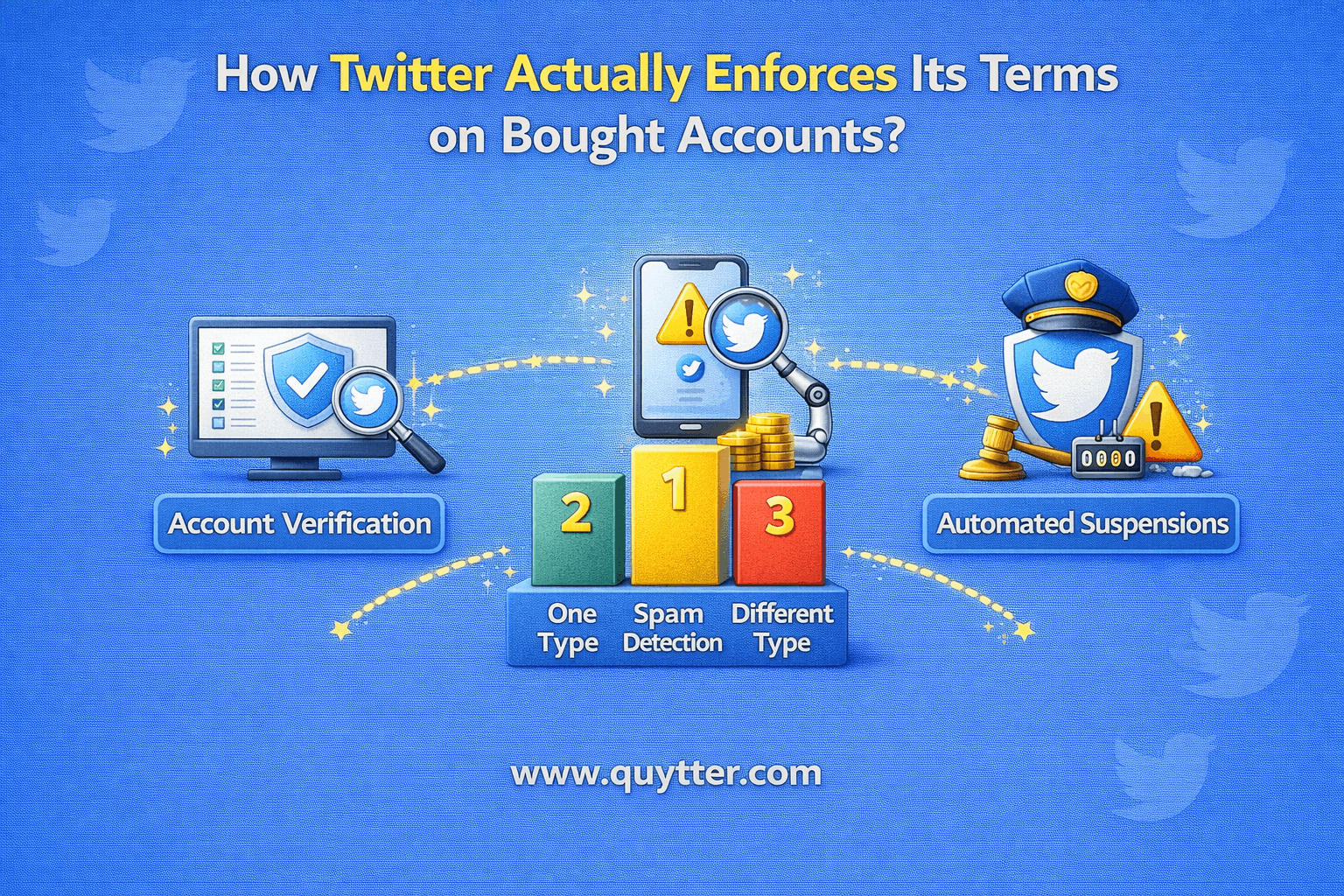
One of the biggest misconceptions around Twitter TOS buying accounts is the belief that enforcement is binary. Many assume accounts are either instantly banned or completely safe. In reality, enforcement exists on a spectrum and is heavily behavior driven rather than transaction focused.
Twitter primarily enforces its policies through automated detection systems that analyze usage patterns over time. These systems do not check whether money changed hands. Instead, they evaluate whether an account’s behavior aligns with historical signals. When a purchased account suddenly changes its activity rhythm, content categories, engagement style, or login environment, it may trigger internal review.
Enforcement is often delayed. Accounts can operate for weeks or months before action occurs. This delay creates a false sense of security among buyers. When suspension finally happens, users often assume it was random, when in fact it was the result of accumulated signals.
Another important factor is scale. Individual account purchases used for mild marketing often fly under the radar. However, bulk buying, networked automation, or coordinated posting increases visibility dramatically. Twitter prioritizes systemic abuse over isolated cases.
From an experience standpoint, the most common enforcement outcome is not permanent bans but temporary limitations. These include reduced reach, shadow visibility loss, or verification restrictions. Understanding this layered enforcement model is essential when evaluating buying Twitter accounts risk realistically.
Platform Risk vs Legal Risk: What Buyers Confuse Most
A critical part of understanding Twitter policy violations is separating platform risk from legal risk. Many articles exaggerate the legal consequences of buying accounts, creating unnecessary fear and misinformation.
Buying or selling a Twitter account is generally not illegal under civil or criminal law in most jurisdictions. There is no universal law prohibiting the transfer of social media accounts. What exists instead is a contractual violation. When you create an account, you agree to Twitter’s terms. Violating those terms exposes you to platform penalties, not legal prosecution.
This distinction matters because it reframes the risk profile entirely. Buyers are not facing lawsuits or criminal charges simply for acquiring accounts. They are facing loss of assets, time, and operational continuity if enforcement occurs.
Legal risk only becomes relevant when account sales intersect with fraud, identity misuse, or deception. For example, selling accounts that impersonate real individuals or misrepresent authority can escalate into legal territory. However, this is not inherent to account buying itself.
Understanding this boundary is part of operating with expertise. Inflating legal fear does not help decision making. Recognizing platform risk as the primary concern allows buyers to assess trade offs more rationally.
Ethical Considerations in Buying Twitter Accounts
Ethics play a subtle but important role in discussions about Twitter account ownership. While legality and enforcement are often debated, ethical implications are frequently ignored.
From Twitter’s perspective, account authenticity underpins trust. When accounts change hands, followers may unknowingly engage with a different operator than they originally chose to follow. This creates ethical tension, especially in political, financial, or informational contexts.
However, ethics are not binary. Many purchased accounts are generic, inactive, or clearly branded for business use. In these cases, ethical concerns are minimal. The ethical weight increases when accounts with established personal identities, opinions, or trust signals are repurposed without transparency.
Experienced marketers often mitigate ethical issues by rebranding accounts clearly after acquisition. Updating bios, usernames, and content direction signals change and reduces deception. While this does not remove policy risk, it aligns better with ethical best practices.
Understanding ethics helps buyers align long term strategies with trust based growth rather than short term exploitation. Ethical alignment also reduces user reports, which are a significant trigger for enforcement.
Why Some Bought Accounts Survive While Others Fail?
A recurring question in discussions about Twitter account marketplace activity is why some bought accounts last for years while others are suspended quickly. The answer lies in operational execution rather than luck.
Accounts that survive tend to follow gradual transitions. Content changes slowly, posting frequency ramps up over time, and engagement patterns evolve naturally. These accounts maintain continuity with their historical data.
Accounts that fail often exhibit sharp discontinuities. Sudden topic shifts, aggressive automation, or mass following behaviors create detectable anomalies. When combined with new IP addresses or devices, these anomalies compound.
Another factor is intent. Accounts used for spam, scams, or manipulation are actively hunted. Accounts used for legitimate marketing, community building, or brand presence face lower scrutiny.
This insight reinforces an important principle. Buying an account is not inherently what triggers enforcement. How the account is operated afterward determines outcomes.
The Role of Automation in Increasing Policy Risk
Automation significantly amplifies Twitter terms of service risk when layered onto purchased accounts. While automation itself is not prohibited, aggressive or poorly configured automation creates behavioral patterns that violate platform expectations.
Purchased accounts often lack established trust signals. Adding automation immediately after acquisition compounds risk because the account already appears unstable. Automated behaviors such as rapid posting, repetitive content, or synchronized actions across multiple accounts are easily detectable.
Experienced operators treat automation as a scaling tool, not a starting point. They allow accounts to stabilize under human like behavior before introducing automation gradually. This staged approach reduces risk and aligns more closely with platform tolerance thresholds.
Automation does not cause bans by default. Misuse of automation does. Understanding this distinction is critical for anyone combining buying Twitter accounts with growth systems.
Transparency, Rebranding, and Risk Reduction
One of the most under discussed mitigation strategies in Twitter account transfer scenarios is transparency. While Twitter does not require public disclosure of ownership changes, transparent rebranding reduces user confusion and complaints.
Changing usernames, updating bios, and adjusting profile visuals communicates a new chapter for the account. This reduces follower backlash and decreases the likelihood of user reports, which often trigger manual review.
Rebranding also helps align historical data with future use. An account previously focused on general topics transitioning into a niche brand benefits from a clear identity reset. While this does not eliminate policy risk, it improves operational stability.
Transparency should be viewed as a strategic choice rather than a compliance requirement. It supports trust, reduces friction, and aligns with ethical growth practices.
When Buying Twitter Accounts Makes Sense Despite Policy Risks?
After understanding how Twitter’s Terms of Service on buying accounts are enforced and where the real risks lie, the remaining question is practical rather than theoretical. When does buying accounts still make sense?
For many marketers, founders, and growth teams, the decision is not about whether buying accounts is fully compliant. It is about speed, leverage, and opportunity cost. Organic account aging takes time. For campaigns that require immediate reach, social proof, or testing at scale, starting from zero is often inefficient.
Buying accounts becomes rational when:
- The accounts are used as distribution assets, not authority figures
- The use case is marketing or testing, not impersonation
- The operator understands and accepts platform risk, not legal risk
- Post purchase behavior is conservative and human like
This is why agencies, SaaS teams, and automation builders continue to operate in this space. They treat purchased accounts as disposable growth assets rather than permanent brand identities.
The mistake is not buying accounts. The mistake is assuming zero risk or ignoring operational discipline after acquisition.
How to Minimize Suspension Risk When Using Bought Accounts?
While Twitter account buying policies prohibit transfers, enforcement remains behavior driven. That means risk can be reduced but never eliminated.
Experienced operators follow several core principles:
First, avoid sudden behavioral shifts. Purchased accounts should not immediately switch topics, frequency, or tone. Gradual evolution matters more than compliance rhetoric.
Second, control environment consistency. Logging in from stable locations and devices reduces anomaly signals that often trigger automated review.
Third, limit automation exposure. Automation increases efficiency but also magnifies detection risk. Manual warming before automation is a practical necessity.
Finally, rebrand clearly. Updating usernames, bios, and visuals reduces user confusion and minimizes reports. User reports are one of the fastest paths to manual enforcement.
None of these steps make buying accounts compliant. They simply align operations with how enforcement systems actually work inside platforms like Twitter.
Choosing the Right Use Cases for Purchased Accounts
Not all use cases carry the same level of risk under Twitter TOS buying accounts.
Lower risk use cases include:
- Content amplification
- Trend testing
- Engagement seeding
- Secondary brand distribution
- Network building for automation systems
Higher risk use cases include:
- Impersonation
- Financial advice under false authority
- Political messaging
- Direct monetization tied to personal identity
Understanding this distinction is part of operating with experience and judgment. Buying accounts is a tool. Like any tool, misuse increases consequences.
Where to Get Help Managing Twitter Account Risk Professionally?
For teams that rely on Twitter at scale, managing account risk manually becomes inefficient quickly. This is where professional services matter.
Specialized providers help with:
- Pre aged account sourcing
- Account warming and stabilization
- Safe handover procedures
- Behavior modeling
- Ongoing risk monitoring
Instead of guessing how enforcement works, these services rely on accumulated experience and real world data. For businesses where Twitter traffic translates directly into revenue, outsourcing risk management is often cheaper than repeated account losses.
If your strategy involves buying Twitter accounts as part of growth or automation, working with experienced providers is not optional. It is part of responsible execution.
Conclusion
Buying Twitter accounts will never be officially endorsed by the platform. That reality does not change. What changes outcomes is understanding how Twitter’s TOS on buying accounts is enforced in practice.
This article showed that the true risk is platform based, behavior driven, and scalable. There is no hidden legal trap for most buyers. There is only operational discipline or lack of it.
Teams that approach account buying with clear intent, ethical boundaries, and risk awareness consistently outperform those chasing shortcuts. The advantage is not avoiding risk entirely. The advantage is knowing how to manage it intelligently.
If your growth strategy depends on Twitter and speed matters, the next step is not asking whether buying accounts is allowed. The next step is deciding whether you are prepared to manage the risk properly or whether you need expert support to do it right.