
Growing on Twitter is no longer just about posting content consistently or chasing trending topics. As competition increases and the platform tightens its enforcement systems, the type of account you use has become a critical factor in long term success. This is where the debate around Aged vs. Fresh Twitter Accounts begins.
Many marketers, founders, and growth operators face the same question. Should they start from scratch with a brand new profile, or leverage an account that already has history, activity, and trust signals? Each option comes with unique advantages, limitations, and risks that are often misunderstood or oversimplified online.
This guide breaks down the real differences between aged Twitter accounts and fresh Twitter accounts, explains how account history affects growth, and helps you choose the right approach based on your goals, risk tolerance, and growth strategy. Rather than pushing a one size fits all answer, this article focuses on experience based insights, platform behavior analysis, and practical decision making.
Understanding the Key Differences Between Aged and Fresh Twitter Accounts
Before comparing performance or growth outcomes, it is essential to clearly understand what separates aged Twitter accounts from fresh Twitter accounts at a structural level. Many people confuse account age with follower count or assume that time alone determines credibility. In reality, Twitter evaluates accounts through a combination of age, behavior, and historical consistency.
An aged Twitter account is typically an account that was created months or years ago and has a visible activity history. This may include past tweets, likes, follows, profile updates, and login behavior that aligns with human usage patterns. The key value of an aged account is not just how old it is, but how naturally it has behaved over time.
A fresh Twitter account, on the other hand, is newly created and starts with no historical data. While it has a clean slate, it also lacks trust signals. Fresh accounts are subject to stricter posting limits, slower visibility, and closer monitoring by automated systems designed to prevent spam, manipulation, and coordinated abuse.
The distinction matters because Twitter does not treat all accounts equally. Older accounts with stable behavior often receive more flexibility in posting frequency, interaction volume, and algorithmic reach. Fresh accounts must earn that trust gradually through consistent and organic actions.
Understanding this foundational difference is critical before deciding which option aligns with your growth objectives.
What Is an Aged Twitter Account and Why It Holds Value?
An aged Twitter account is defined not just by its creation date, but by the depth and quality of its activity history. Accounts that have existed for a long period without violations tend to accumulate invisible trust signals that influence how the platform evaluates future actions.
From an experience standpoint, aged accounts often perform better in early stage growth because they bypass many of the restrictions imposed on new profiles. They can post more frequently, follow more users, and engage in conversations with a lower risk of triggering automated limitations. This makes them appealing for users who want immediate momentum rather than waiting weeks or months to warm up a fresh profile.
However, not all aged accounts are equal. Some have been dormant for long periods, while others may have been used for low quality automation or engagement farming. These factors significantly affect performance and safety. An aged account with a natural posting history and varied interactions will always outperform one that exists only on paper.
From an authority perspective, Twitter places weight on behavioral consistency. If an account has demonstrated normal usage patterns over time, sudden increases in activity are less likely to be flagged as suspicious. This gives aged accounts a clear advantage for campaigns that require speed, volume, or early credibility.
That said, aged accounts also carry hidden risks if their history is unknown or poorly managed. Past violations, shadowbans, or network associations can limit reach even if the account appears old and established. This is why experience and proper sourcing matter more than age alone.
What Is a Fresh Twitter Account and When It Makes Sense?
A fresh Twitter account starts with no baggage and no trust. This can be both a limitation and an opportunity depending on how it is used. Fresh accounts are ideal for users who want full control over branding, messaging, and behavioral patterns from day one.
From a technical standpoint, fresh accounts are placed under higher scrutiny. Twitter limits early activity to prevent spam networks and automated abuse. Posting too frequently, following aggressively, or engaging unnaturally during the early stages can quickly result in reach suppression or temporary locks.
Despite these limitations, fresh accounts offer a clean foundation. There is no risk of inherited penalties, questionable history, or mismatched audiences. For long term personal brands or businesses that prioritize authenticity, starting fresh can be the safest route.
Fresh accounts also align well with organic growth strategies. By gradually building interactions, content cadence, and engagement, users can establish a strong trust profile over time. This approach requires patience but often results in more stable performance and lower long term risk.
The key challenge with fresh accounts is expectations. Many users attempt to scale too quickly, applying tactics designed for aged accounts. This mismatch leads to early setbacks that could have been avoided with proper pacing and strategy.
How Twitter Evaluates Account Trust and Credibility?
Understanding how Twitter evaluates accounts is essential to choosing between aged vs. fresh Twitter accounts. While the platform does not publicly disclose its scoring systems, consistent patterns observed by growth professionals reveal how trust is built and maintained.
Twitter analyzes a combination of signals including account age, posting behavior, engagement quality, network interactions, and historical compliance. These signals form a trust profile that influences reach, visibility, and enforcement thresholds.
Account age acts as a baseline signal, but it is not decisive on its own. An older account with erratic behavior or spam like patterns may be treated more harshly than a newer account with clean and consistent activity. This is why behavioral data carries more weight than simple longevity.
Engagement quality is another critical factor. Accounts that receive meaningful replies, genuine likes, and organic interactions are favored over those that rely on repetitive or automated engagement. Twitter’s systems are designed to identify reciprocal spam loops and artificial amplification.
Posting rhythm also plays a role. Sudden spikes in activity can trigger reviews, especially on accounts without sufficient historical context. Aged accounts are more tolerant of variation, while fresh accounts require gradual scaling to avoid negative signals.
These trust mechanisms explain why aged accounts often perform better initially, but also why fresh accounts can eventually reach similar or even superior performance when managed correctly.
Aged vs. Fresh Twitter Accounts for Different Growth Goals
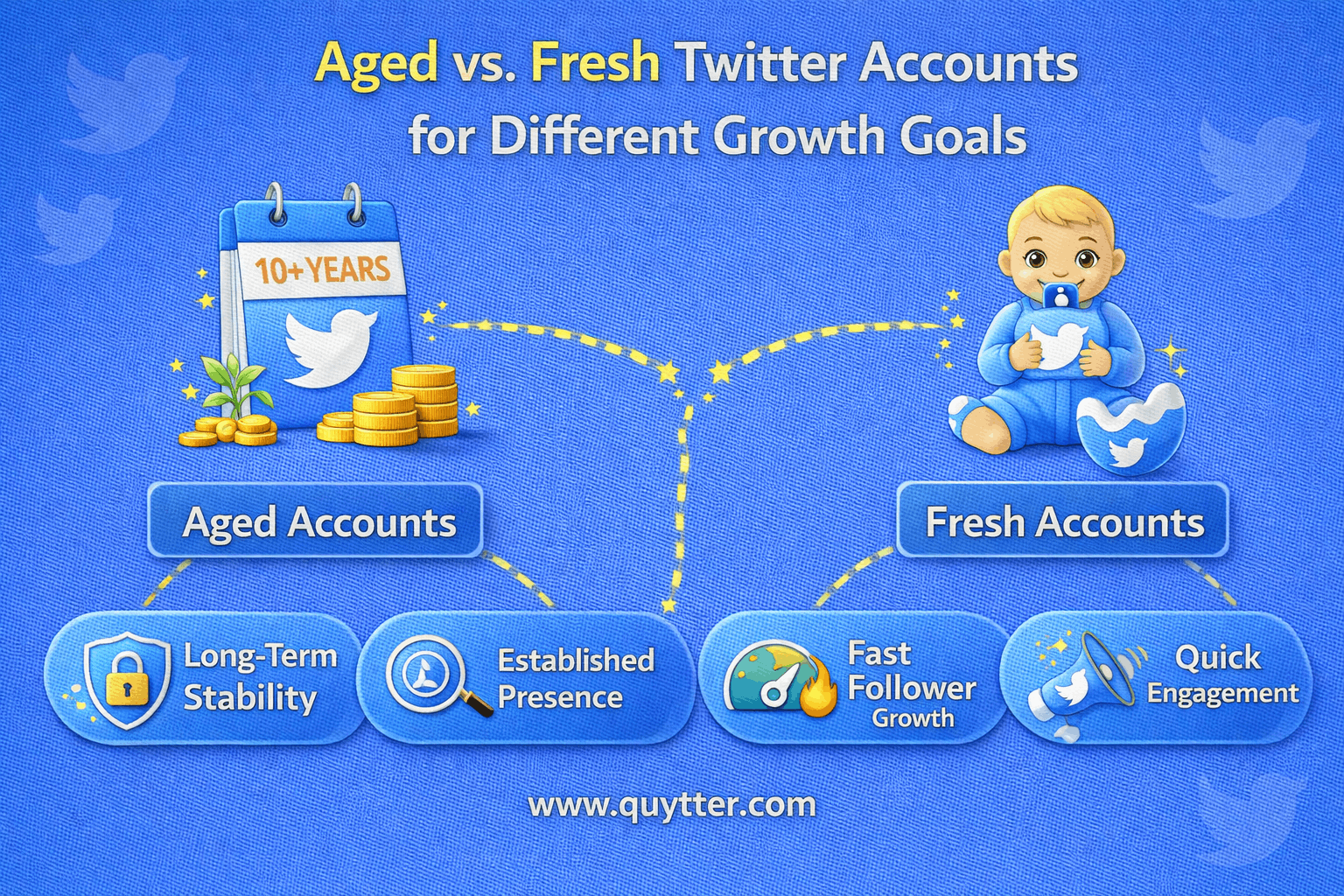
The choice between aged Twitter accounts and fresh Twitter accounts should always be driven by specific growth goals rather than assumptions. Different use cases benefit from different account profiles.
For rapid visibility, such as launching a product or promoting time sensitive content, aged accounts provide immediate leverage. Their existing trust allows faster engagement and broader reach without extended warm up periods.
For long term brand building, fresh accounts offer unmatched control. By shaping the account’s voice, audience, and engagement style from the beginning, users can build a more authentic presence that aligns closely with their values and objectives.
Automation heavy strategies tend to perform better on aged accounts due to higher tolerance levels. However, this comes with increased responsibility to manage activity carefully and avoid overuse that could negate the benefits of age.
Hybrid approaches also exist. Some users maintain aged accounts for outreach and amplification while developing fresh accounts for core branding. This diversified strategy balances speed with sustainability.
The most effective growth strategies recognize that there is no universal answer. Success depends on aligning account type with intent, resources, and acceptable risk levels.
Common Mistakes When Choosing Between Aged and Fresh Accounts
One of the most common mistakes is assuming that age guarantees safety. Many users purchase aged accounts without evaluating their history, leading to unexpected reach issues or enforcement actions. Age without quality is meaningless.
Another frequent error is treating fresh accounts like aged ones. Applying aggressive posting or engagement tactics too early often results in suppressed visibility that can be difficult to recover from.
Some users also underestimate the importance of consistency. Switching niches, posting styles, or interaction patterns abruptly can confuse trust systems regardless of account age.
Finally, focusing solely on cost rather than value leads to poor decisions. Cheap aged accounts with questionable histories often cause more harm than starting fresh.
How Quytter Helps You Choose and Use Twitter Accounts Safely for Growth?
Choosing between aged Twitter accounts and fresh Twitter accounts is only half of the equation. The other half, and often the most overlooked part, is how those accounts are sourced, prepared, and used after purchase. Many growth failures do not come from the wrong account type, but from poor handling, mismatched use cases, and lack of risk management.
This is where a structured approach matters. Quytter is built around the idea that Twitter account growth is a risk management problem before it becomes a scaling problem. Instead of selling accounts as interchangeable products, Quytter focuses on aligning account profiles with real usage scenarios.
One of the biggest mistakes buyers make is assuming that all aged Twitter accounts are ready for immediate heavy activity, or that fresh Twitter accounts must always start from zero. In practice, every account carries a different tolerance level based on its history, environment, and intended use. Quytter evaluates these factors before any account is delivered, reducing the gap between expectation and reality.
Another critical aspect is post delivery guidance. Many users lose accounts not because the account itself is bad, but because they apply the wrong behavior too quickly. Quytter emphasizes proper onboarding, realistic activity pacing, and environment consistency to help accounts survive beyond the initial growth phase. This includes aligning IP usage, device patterns, and interaction volume with the account’s trust profile.
For users managing multiple accounts or planning long term growth, Quytter also helps segment accounts by purpose. Some accounts are better suited for outreach and engagement, while others perform best as brand assets or amplification nodes. Treating all accounts the same increases risk and reduces efficiency. Strategic segmentation allows growth without unnecessary exposure.
Most importantly, Quytter does not position any account as risk free. Instead, it provides clarity around trade offs, realistic expectations, and practical safeguards. This transparency is essential for marketers, founders, and operators who value sustainability over short term gains.
Conclusion
The debate around Aged vs. Fresh Twitter Accounts often misses the core issue. There is no universally better option, only better alignment between account type, growth goals, and execution strategy. Both aged Twitter accounts and fresh Twitter accounts can drive growth when used correctly, and both can fail when misused.
Aged accounts offer speed, flexibility, and early trust, but require careful evaluation of history and behavior. Fresh accounts offer control, authenticity, and long term stability, but demand patience and disciplined growth. The real risk lies in choosing based on convenience or cost rather than intent.
Sustainable Twitter growth comes from understanding how the platform evaluates trust, how behavior shapes visibility, and how consistency reduces enforcement risk. Accounts are tools, not guarantees. The way they are sourced, handled, and scaled determines their true value.
If your goal is to grow efficiently while minimizing unnecessary risk, working with a structured approach matters. Whether you choose aged or fresh accounts, aligning them with the right strategy and safeguards will always outperform blind experimentation.
For teams and individuals who want clarity, control, and safer execution, leveraging a solution like Quytter helps turn account selection into a deliberate growth decision rather than a gamble.