
How many bots are on Twitter is one of the most frequently asked questions by brands, creators, journalists, and marketers trying to understand the true state of engagement on the platform. As Twitter has evolved into a major channel for public discourse, marketing, and community building, concerns about twitter bots, fake accounts, and spam activity have grown alongside it. Users want to know whether the likes, views, followers, and conversations they see are real or artificially inflated by automation.
The presence of bots affects everything from trust and credibility to reach and monetization. When engagement is distorted by fake followers on Twitter or automated interactions, it becomes harder to measure performance, harder to build authority, and riskier to grow an account the wrong way. Understanding the scale of bot activity is not just a technical curiosity. It is a practical concern for anyone who relies on Twitter for visibility or business outcomes.
This article breaks down what bots really are, how estimates about how many bots are on Twitter are formed, why those numbers change, and how bots impact real users and brands. More importantly, it explains how to grow on Twitter safely without falling into the trap of fake engagement or risky shortcuts.
What Counts as a Bot on Twitter?
Before discussing numbers, it is essential to define what people actually mean when they talk about twitter bots. Not every automated account is harmful, and not every fake looking profile is a bot. The term “bot” is often used too broadly, which leads to confusion and exaggerated claims.
At its core, a bot is an account that performs actions automatically rather than through consistent human control. However, there are several categories that matter in practice.
Some bots are utility based. These accounts automatically post news updates, weather alerts, price changes, or system notifications. They are often transparent, labeled, and provide clear value to users. Twitter has historically allowed this type of automation as long as it follows platform rules.
Then there are engagement bots. These accounts are designed to like, retweet, follow, or comment at scale. They often operate in networks and are used to artificially inflate metrics. This is the category most people refer to when discussing fake accounts on Twitter or fake followers on Twitter.
A third category includes spam and malicious bots. These accounts exist to push scams, phishing links, low quality promotions, or coordinated misinformation. They are typically short lived but numerous, constantly being created and removed.
There is also a growing grey area. Some accounts are semi automated, meaning a human controls the profile but relies heavily on automation tools for scheduling, engagement actions, or follower management. These accounts may look real but behave unnaturally.
Understanding these distinctions is critical because when reports estimate how many bots are on Twitter, they often lump very different behaviors into a single number. That is why absolute figures are always misleading without context.
Estimated Number of Bots on Twitter
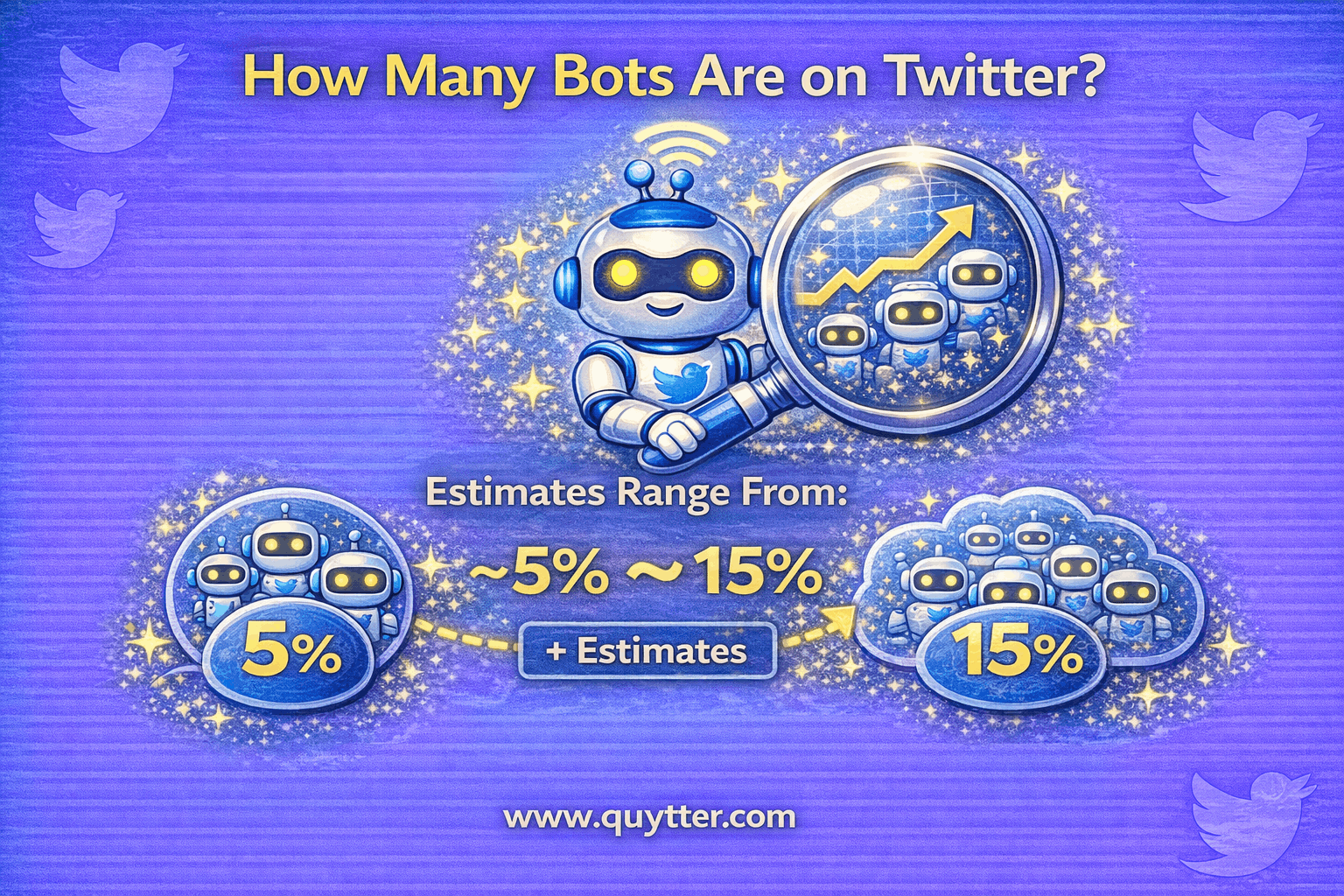
When people ask how many bots are on Twitter, they are usually looking for a clear percentage or total count. The reality is far more complex. There is no single authoritative number, and any estimate should be understood as a range rather than a precise figure.
Most public estimates suggest that a single digit percentage of active accounts exhibit strong bot like behavior at any given time. However, this number varies widely depending on how bots are defined, which behaviors are measured, and whether the focus is on daily active users or the total account base.
One reason estimates differ is that Twitter measures spam and bots using internal signals that are not fully disclosed. External researchers rely on observable behaviors such as posting frequency, network patterns, content similarity, and engagement ratios. These methods are useful but imperfect.
Another reason is account churn. Large numbers of twitter spam accounts are created, flagged, and removed continuously. This means that while the platform may be actively removing bots, new ones are constantly appearing. Looking only at removals without accounting for creation leads to skewed conclusions.
It is also important to distinguish between visible engagement bots and dormant fake accounts. Some fake profiles are created in bulk but remain inactive until needed. They may not appear in daily active user statistics but still exist within the ecosystem.
From a practical standpoint, what matters more than the exact number is the impact. Even a relatively small percentage of bots can distort engagement signals, especially in competitive niches like crypto, marketing, politics, or viral content.
For brands and creators, the takeaway is simple. Bots are present, but they are not the majority. Real users still dominate meaningful conversations. Growth strategies should be built around attracting and engaging real people rather than trying to exploit automation.
Why Bot Numbers Constantly Change?
One reason the debate around twitter bot statistics never settles is that bot activity is not static. It fluctuates continuously due to technical, economic, and policy driven factors.
Platform enforcement plays a major role. When Twitter updates its detection systems or enforcement policies, large waves of bots are removed. This can temporarily reduce visible bot activity and trigger headlines claiming major progress. Over time, bot operators adapt and re enter the system with new tactics.
Technology also drives change. As automation tools become more advanced, bots become harder to detect. At the same time, detection systems based on machine learning improve in parallel. This creates a constant arms race between abuse prevention teams and bad actors.
Economic incentives matter as well. When engagement manipulation becomes profitable in certain niches, such as token launches or viral marketing campaigns, bot creation spikes. When profits decline or enforcement becomes stricter, activity drops.
User behavior also influences bot prevalence. When users mass report suspicious accounts or avoid interacting with spam, bots become less effective. Conversely, when fake engagement still appears to work, demand for bots increases.
All of this means that asking how many bots are on Twitter without acknowledging volatility leads to false certainty. The more useful question is how bots affect your specific niche and whether your growth strategy is resilient to platform changes.
How Twitter Detects and Removes Bots?
Understanding how bots are detected helps explain why fake engagement is increasingly risky. Twitter does not rely on a single signal. Detection is based on patterns across behavior, networks, and content.
Behavioral signals include posting frequency, timing patterns, and action velocity. Accounts that like, retweet, or follow at unnatural speeds are flagged quickly. Even advanced bots struggle to perfectly mimic human rhythms over time.
Network analysis is another key factor. Bot accounts often follow or interact with the same clusters of profiles. When hundreds or thousands of accounts behave in coordinated ways, detection systems can identify them as part of a network rather than isolated users.
Content analysis also plays a role. Repeated messages, low originality, and link heavy posts are common traits of twitter spam accounts. Even when bots use AI generated text, subtle patterns still emerge at scale.
User reports and manual review provide an additional layer. While automated systems do most of the work, human reviewers handle edge cases and appeals, especially for high visibility accounts.
The important implication for marketers is that shortcuts do not age well. Engagement that looks acceptable today can become a liability tomorrow as detection systems evolve. This is why relying on fake followers on Twitter or low quality automation creates long term risk.
How Bots Impact Real Users and Brands?
The presence of bots is not just a platform level issue. It has direct consequences for individuals and businesses trying to grow on Twitter.
First, bots distort analytics. When views, likes, or followers are inflated by non human activity, performance metrics lose meaning. It becomes harder to understand what content resonates with real audiences and harder to optimize strategy.
Second, bots damage credibility. Savvy users can often spot fake engagement. A profile with thousands of followers but minimal real conversation signals low trust. This is especially damaging for brands, founders, and professionals.
Third, bots can trigger algorithmic penalties. Accounts associated with suspicious engagement patterns may experience reduced reach or visibility. In some cases, this leads to shadow restrictions that are difficult to diagnose.
Finally, bots waste resources. Time and money spent chasing fake numbers could be invested in real growth, partnerships, and content that builds lasting value.
From an experience perspective, marketers who have worked across multiple campaigns consistently see the same outcome. Short term gains from fake engagement are outweighed by long term stagnation or decline.
How to Identify Bots Versus Real Accounts?
While detection systems operate at scale, individual users can still learn to recognize suspicious activity. This skill is useful for auditing your own followers and evaluating growth services.
Profiles with incomplete information, generic usernames, or mismatched profile photos often raise red flags. However, appearance alone is not enough.
Engagement patterns matter more. Accounts that interact with dozens of unrelated posts in a short time window are rarely human. Real users show selective behavior and consistent interests.
Follower and following ratios also provide clues. Extreme imbalances, especially when combined with low quality engagement, suggest automation.
Content quality is another indicator. Real users express opinions, vary their language, and respond contextually. Bots tend to repeat phrases or post content that feels detached from ongoing conversations.
Learning to spot these patterns reinforces an important principle. Real engagement has texture and unpredictability. Anything that looks too uniform at scale deserves scrutiny.
Are Bots Still a Problem?
Bots have not disappeared. They have evolved. While crude spam accounts are easier to remove, more sophisticated engagement bots still exist. However, they are also easier to penalize over time because they leave behavioral footprints.
For most users, bots are no longer an unavoidable obstacle. They are a background risk that can be managed with informed strategy. The real danger lies in deliberately engaging with fake growth methods under the assumption that they are harmless.
The platform increasingly rewards authenticity, consistency, and meaningful interaction. Accounts that focus on real value are more resilient to policy changes and algorithm updates.
This is why modern Twitter growth is less about exploiting loopholes and more about aligning with how the system evaluates trust and relevance.
The Safe Way to Grow on Twitter Without Bots
For brands and creators who want sustainable results, the question is no longer how many bots are on Twitter, but how to avoid them entirely while still achieving growth.
Safe growth focuses on real engagement signals. Real views indicate genuine exposure. Real likes and comments reflect interest. Real followers contribute to long term reach and community building.
This approach prioritizes account safety. It avoids password sharing, automation abuse, and low quality networks. Delivery methods are designed to blend naturally with organic activity rather than overwhelm it.
From an expertise standpoint, effective growth balances speed and stability. Rapid spikes attract scrutiny. Gradual, consistent engagement aligns with how real audiences behave.
Services that emphasize real Twitter engagement, transparent processes, and retention guarantees are aligned with these principles. They act as accelerators, not replacements, for authentic content and interaction.
Grow with Real Engagement Using Quytter
If you are serious about growth and want to avoid the risks associated with twitter bots and fake accounts on Twitter, the solution is not to do nothing. It is to choose smarter methods.
Quytter focuses on helping accounts grow with real views, likes, followers, comments, and retweets delivered through safe, compliant processes. No passwords are required, and engagement is designed to look natural and stable over time.
Instead of inflating numbers with automation, Quytter supports visibility and social proof using real users. This helps improve reach, credibility, and performance without exposing your account to unnecessary risk.
Whether you are launching a new profile or scaling an established brand, real engagement creates a foundation that algorithms and audiences both trust.
Conclusion
So, how many bots are on Twitter is a valid question, but it is not the most important one. Bots exist, but they are not the future of growth. The accounts that succeed are those that understand the ecosystem, respect platform dynamics, and invest in real engagement.
By avoiding fake followers, understanding bot behavior, and choosing safe growth strategies, you protect your account while still achieving meaningful results.
If your goal is to grow on Twitter with real views, real likes, real followers, and real interaction without bots or shortcuts, Quytter provides a practical path forward. Sustainable growth is not about gaming the system. It is about working with it.