
Growing on Twitter (X) has become increasingly competitive. With millions of tweets published daily, creators, brands, crypto projects, and agencies are constantly looking for ways to gain visibility faster. That’s why Twitter boost panels have exploded in popularity.
But one question keeps coming up:
Are Twitter boost panels secure — or are they putting your account at risk?
At Quytter, we’ve worked with thousands of Twitter users across different industries. We’ve seen accounts grow safely — and we’ve also seen accounts get shadowbanned, throttled, or permanently damaged by using unsafe growth methods.
This guide will break everything down honestly and technically, so you can make an informed decision.
What Are Twitter Boost Panels?
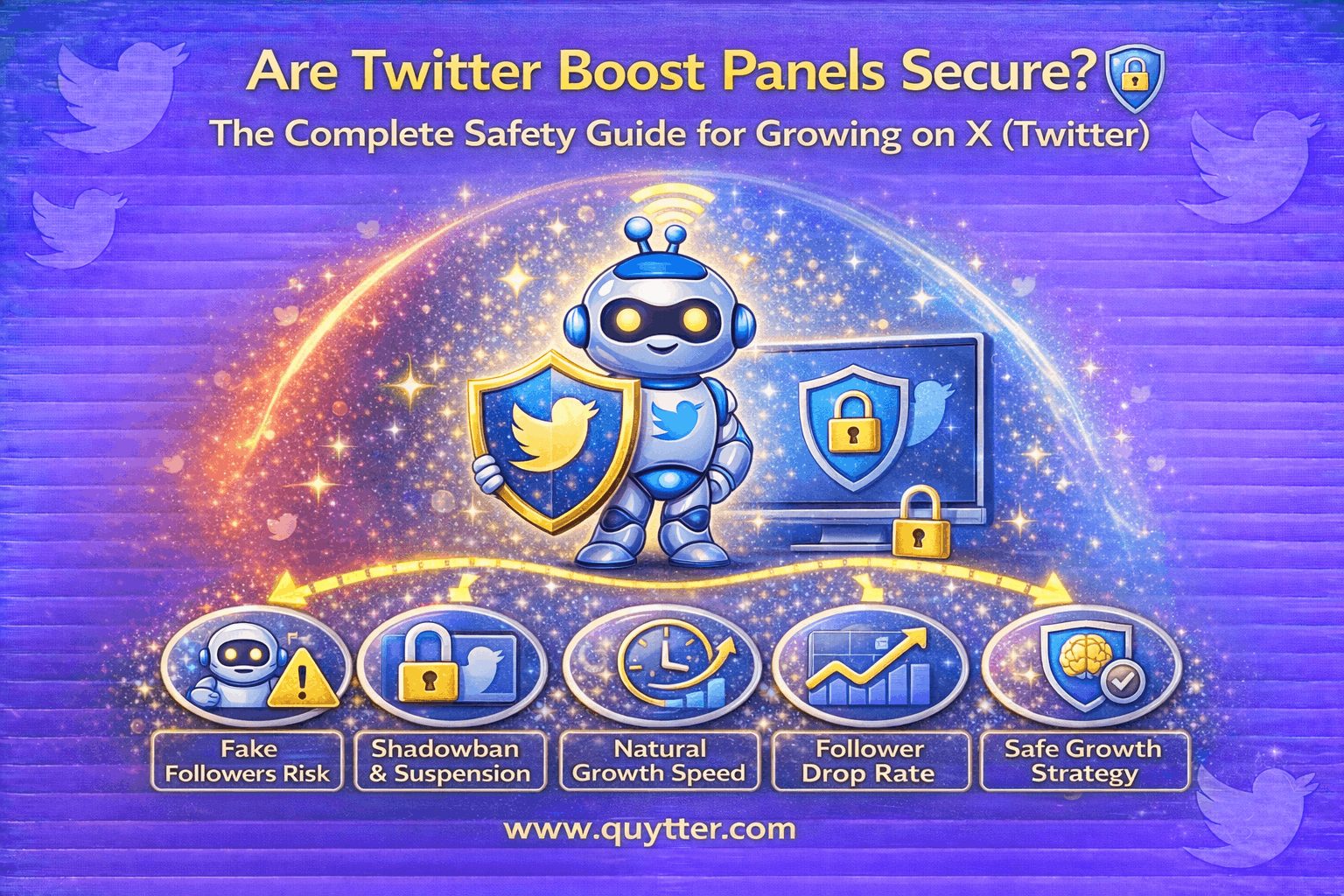
A Twitter boost panel (also called a social media panel or SMM panel) is a platform that sells engagement services such as:
- Twitter followers
- Twitter views
- Twitter likes
- Twitter comments
- Twitter retweets
These panels usually operate as self-service dashboards where users select a service, enter a username or tweet link, and receive engagement shortly after.
On the surface, boost panels seem convenient and cheap. But security and quality vary massively depending on how the panel works behind the scenes.
How Twitter Boost Panels Actually Work ?
To understand whether Twitter boost panels are secure, you first need to understand how engagement is created and delivered behind the scenes.
What most panels show on their homepage is marketing.
What actually matters happens at the infrastructure level.
Let’s break it down.
1. Account Sources: Where Engagement Really Comes From
Boost panels don’t magically create engagement.
They distribute actions (likes, views, followers, comments) using pre-existing account pools.
These pools usually fall into four categories.
Bot Networks (Scripts, Emulators, Fake Accounts)
This is the most common source used by cheap panels.
How it works:
- Thousands of auto-created accounts
- Controlled by scripts or emulators
- Actions executed in bulk
Problems:
- Predictable behavior patterns
- Reused IP ranges
- Low interaction depth (no real browsing, no session history)
Twitter is very good at detecting these patterns.
Even if the accounts look “real” on the surface, their behavior is not.
This is why:
- Engagement disappears later
- Reach declines silently
- Accounts get shadow-limited without warning
Aged but Inactive Accounts
These accounts:
- Are months or years old
- Have profile photos, bios, and history
- But are no longer actively used by real people
Panels reactivate them temporarily to perform actions.
Risks:
- Sudden reactivation after long dormancy
- Identical engagement behavior across many orders
- Limited session diversity
These accounts are less risky than pure bots, but still far from ideal.
They often trigger delayed filtering rather than instant flags.
Low-Quality Click Farms
Click farms involve:
- Real humans
- Performing repetitive actions
- From limited geographic regions
- On low-end devices or shared networks
Why this is risky:
- Identical action timing across many users
- Limited behavioral variation
- Poor engagement depth (no scrolling, no reading)
While technically “real users,” the behavior still looks unnatural at scale.
Twitter doesn’t only care who clicks — it cares how they behave.
Real User Networks (Rare, Expensive, Controlled)
This is the least common and most secure source.
Characteristics:
- Smaller, curated user pools
- Limited reuse per campaign
- Gradual, human-like activity patterns
- Higher cost and lower volume capacity
Because these networks are expensive to maintain, most panels do not use them, despite claiming “100% real users.”
Security improves dramatically here, but scalability is limited.
2. Delivery Patterns: The Biggest Detection Trigger
Account source is important, but delivery behavior is often the deciding factor.
Twitter’s system closely monitors:
- Engagement velocity (how fast actions occur)
- Time distribution
- Repeated network fingerprints
- Correlation with account history
Sudden Engagement Spikes
If a tweet normally gets:
- 20–50 interactions
and suddenly receives: - 1,000 actions in minutes
This creates an obvious anomaly.
Even if no rule is “broken,” the algorithm flags the activity for review.
Unnatural Timing Patterns
Common red flags include:
- Actions arriving at exact intervals
- Large batches delivered at the same timestamp
- Identical behavior across multiple tweets or accounts
Human engagement is messy.
Automation is clean — and that’s the problem.
Reused Networks Across Orders
Many panels reuse the same accounts for thousands of customers.
This creates:
- Network overlap
- Detectable relationship graphs
- Pattern clustering
Once a network is flagged, every account connected to it inherits risk.
3. Access Requirements: The Hard Red Line
This is where security risk becomes non-negotiable.
Some panels ask for:
- Twitter passwords
- API keys
- OAuth permissions
- “Verification” access
This is never necessary to deliver engagement.
Why this is dangerous:
- Account takeover risk
- Data harvesting
- Policy violations
- Permanent account loss
If a panel requires anything beyond:
- Your public username
- Or a tweet URL
That’s an immediate red flag.
No legitimate engagement delivery system needs account access.
Twitter boost panels are not inherently secure or insecure by default.
Security depends on:
- Account source quality
- Delivery pacing
- Network reuse limits
- Zero access to user credentials
Most cheap panels fail on at least two of these points. That’s why security issues often appear weeks later, not instantly.
Are Twitter Boost Panels Secure?
- Short Answer
Most Twitter boost panels are NOT secure.
While many panels advertise “safe,” “real,” or “no risk,” the reality is that a large percentage of Twitter boost panels operate using methods that can put your account, data, or long-term growth at risk.
- Long Answer
Twitter boost panel security does not depend on marketing claims, pricing, or how professional the website looks.
It depends entirely on how the panel operates behind the scenes.
Two panels can look identical on the surface — same packages, same promises, same keywords — yet one can be relatively safe while the other quietly damages accounts over time.
To understand whether Twitter boost panels are secure, you need to look at how engagement is generated, how accounts interact, and what risks are involved.
Let’s break down the main risks.
Major Security Risks of Twitter Boost Panels
1. Violation of Twitter (X) Policies
Many boost panels:
- Use automation
- Simulate fake engagement
- Abuse coordinated behavior
This directly violates Twitter’s platform integrity rules.
Even if you’re not banned immediately, your account can suffer:
- Reduced reach
- Engagement suppression
- Long-term trust score damage
2. Shadowbans & Algorithm Suppression
One of the most common outcomes we see at Quytter is silent damage.
Your account may:
- Still exist
- Still post tweets
- But stop appearing in feeds, search, or recommendations
This is often caused by:
- Low-quality engagement
- Repeated bot interactions
- Unnatural growth velocity
3. Drops After Twitter Purges
Twitter regularly removes:
- Fake accounts
- Inactive accounts
- Coordinated networks
If your boost panel uses these sources, you’ll see:
- Followers drop
- Likes disappear
- Views reset
Many panels do not replace losses, leaving you worse off than before.
4. Credential & Privacy Risks
Any panel that asks for:
- Passwords
- Login access
- Account verification steps
Is putting your entire account at risk.
This can lead to:
- Account hijacking
- Unauthorized tweets
- Permanent suspension
At Quytter, we consider this non-negotiable:
A safe service never requires your password.
Why Some Boost Panels Appear Secure?
You might wonder:
“I used a boost panel before and nothing bad happened — so are they actually safe?”
Here’s why they sometimes seem secure:
- Twitter doesn’t punish instantly
- Damage can be gradual
- Algorithm penalties are often delayed
- Not every account is reviewed manually
This creates a false sense of safety — until reach suddenly collapses weeks later.
How to Evaluate If a Twitter Growth Service Is Secure?
Based on years of experience, Quytter uses a strict safety checklist.
A Secure Twitter Growth Service Must:
- Never require a password
- Deliver engagement gradually (5–10 days, not minutes)
- Use real, active accounts
- Avoid sudden spikes
- Offer a non-drop guarantee
- Replace losses automatically
- Be transparent about risk and delivery
If a panel fails even one of these points, it’s not secure.
Boost Panels vs Safe Twitter Growth Services
Here’s the key distinction most users miss:
Boost panels focus on volume.
Safe growth services focus on stability.
Boost Panels:
- Cheap
- Fast
- High risk
- Short-term results
- Often bot-driven
Secure Growth (Quytter Model):
- Gradual
- Stable
- Real users
- Long-term trust
- Algorithm-safe
How Quytter Approaches Twitter Growth Differently
At Quytter, we intentionally do not operate like a traditional boost panel.
Our philosophy is simple:
If growth looks fake, Twitter will treat it as fake.
Our Core Principles:
- Real users only — no bot networks
- Natural delivery speed — no instant spam
- Non-drop guarantee — lifetime protection
- No login access ever
- Tweet-specific targeting (for views, likes, comments)
- Manual quality checks
This is why Quytter users don’t experience:
- Sudden drops
- Shadowbans
- Algorithm suppression
Is Buying Twitter Engagement Safe at All?
Yes — if done correctly.
Buying Twitter engagement becomes unsafe when:
- You prioritize speed over safety
- You chase the cheapest provider
- You ignore delivery patterns
- You use panels designed for mass spam
Safe growth is strategic, not aggressive.
How Buying Twitter Engagement Can Help (When Done Safely)
When growth is stable and real, it can actually support organic performance.
Benefits:
- Stronger social proof
- Higher initial visibility
- Better engagement velocity
- Increased follower conversion
- Improved trust for new visitors
Twitter’s algorithm rewards accounts that already look credible.
Common Myths About Twitter Boost Panels
There are many misconceptions around Twitter boost panels, especially among first-time users. These myths often come from marketing slogans rather than how Twitter’s system actually works.
Let’s break down the most common ones.
Myth #1: “All Twitter Boost Panels Are the Same”
False. The backend matters far more than the front-end.
At a glance, most boost panels look identical:
- Similar service lists
- Similar pricing
- Similar promises (“safe,” “real,” “instant”)
But what truly defines a panel’s safety and effectiveness is how engagement is generated behind the scenes.
Key backend differences include:
- Where the accounts come from
- Whether engagement networks are reused or isolated
- How delivery is paced
- How drops are handled (or ignored)
Two panels can sell the same service, but one may use:
- Recycled, flagged accounts shared across thousands of users
while another uses: - Smaller, controlled pools with limited reuse
From Twitter’s perspective, these behave very differently.
Assuming all panels are the same is risky because the risk profile varies dramatically depending on backend operations.
Myth #2: “Fast Delivery Is Better”
False. Fast delivery is the #1 reason accounts get flagged.
Speed feels attractive because:
- Numbers go up instantly
- Results look impressive short-term
- Users get quick validation
However, Twitter’s algorithm is extremely sensitive to:
- Sudden spikes
- Engagement velocity
- Activity that doesn’t match account history
When hundreds or thousands of actions happen in minutes, it creates:
- Behavioral anomalies
- Pattern inconsistencies
- Algorithmic suspicion
Fast delivery often leads to:
- Engagement removal days or weeks later
- Reduced organic reach
- Long-term visibility suppression
In many cases, the damage is subtle — your account isn’t banned, but your tweets stop performing.
From a security standpoint, slow and gradual delivery is safer than instant results.
Myth #3: “Bots Don’t Matter If the Numbers Go Up”
False. Bots hurt long-term reach more than they help.
Many users believe that follower count alone is what matters.
In reality, Twitter evaluates how accounts interact, not just how many exist.
Low-quality or automated accounts:
- Don’t engage naturally
- Don’t click, reply, or stay active
- Create poor engagement ratios
This leads to:
- Lower engagement per follower
- Reduced algorithm confidence
- Weaker distribution of future tweets
Even worse, bot-heavy engagement trains the algorithm to treat your account as low-value.
So while numbers may increase temporarily, overall performance often declines over time.
Bots don’t just “do nothing” — they actively damage credibility and reach.
Why These Myths Persist
These myths continue because:
- Panels market what users want to hear
- Short-term results feel successful
- Long-term impact is harder to notice immediately
Most users only realize the problem when:
- Engagement starts dropping
- Reach declines despite higher numbers
- Growth stalls unexpectedly
By then, the damage has already been done.
The Reality
Twitter boost panels are not judged by:
- How good they look
- How cheap they are
- How fast they deliver
They are judged by:
- How naturally engagement behaves
- How sustainable growth is over time
- How little algorithmic suspicion they create
Understanding these myths helps users avoid false confidence and make smarter decisions when evaluating any Twitter growth service.
FAQ — Twitter Boost Panels & Security
Are Twitter boost panels legal?
They operate in a gray area. Many violate Twitter’s rules through automation.
Can boost panels get your account banned?
Yes — especially panels using bots or aggressive delivery.
Do Twitter panels still work in 2025?
Some do short-term, but many cause long-term damage.
Is there a safe way to buy Twitter followers?
Yes — gradual, real-user delivery with non-drop guarantees.
Does Twitter detect bought engagement?
Twitter detects patterns, not purchases. Unsafe patterns get flagged.
Final Verdict: Are Twitter Boost Panels Secure?
Most are not.
If a platform:
- Promises instant results
- Sells ultra-cheap packages
- Uses automation
- Lacks a non-drop guarantee
- Requires login access
It is not secure, no matter what it claims.
At Quytter, we believe Twitter growth should:
- Look real
- Feel natural
- Last long-term
- Protect your account
If you’re serious about growing on X without risking your reputation, security must come before speed.
Ready to Grow Safely?
Explore secure Twitter growth solutions designed for:
- Creators
- Businesses
- Crypto & NFT projects
- Agencies
Choose stability. Choose safety. Choose Quytter.