
The Twitter growth market is crowded with services promising fast and safe results, but many rely on bots, recycled accounts, or hidden automation that quietly damages account health. Knowing how to identify a legitimate Twitter growth service is essential before risking your reach, engagement, or long-term visibility.
This article explains how to check whether a Twitter growth service is legitimate, what red flags to avoid, and which signals indicate a service aligns with how Twitter’s algorithm evaluates real user behavior.
Transparency Is the First Signal
Transparency is the fastest way to separate legitimate Twitter growth services from risky ones. A real service does not hide how growth is generated, because it has nothing to hide.
You should be able to clearly understand where engagement comes from, whether actions are manual, assisted, or system-supported, and how delivery is paced over time. Legitimate services explain these things in plain language, even if the explanation isn’t perfectly technical.
Vague marketing terms like “AI-powered growth,” “smart automation,” or “secret methods” are usually intentional. They are designed to distract from the fact that engagement is coming from bot networks, recycled accounts, or mass automation that violates Twitter’s behavioral expectations.
Real growth methods are explainable because they follow predictable human behavior. Fake growth depends on confusion, buzzwords, and the assumption that users won’t ask deeper questions.
Real Users, Not Artificial Behavior
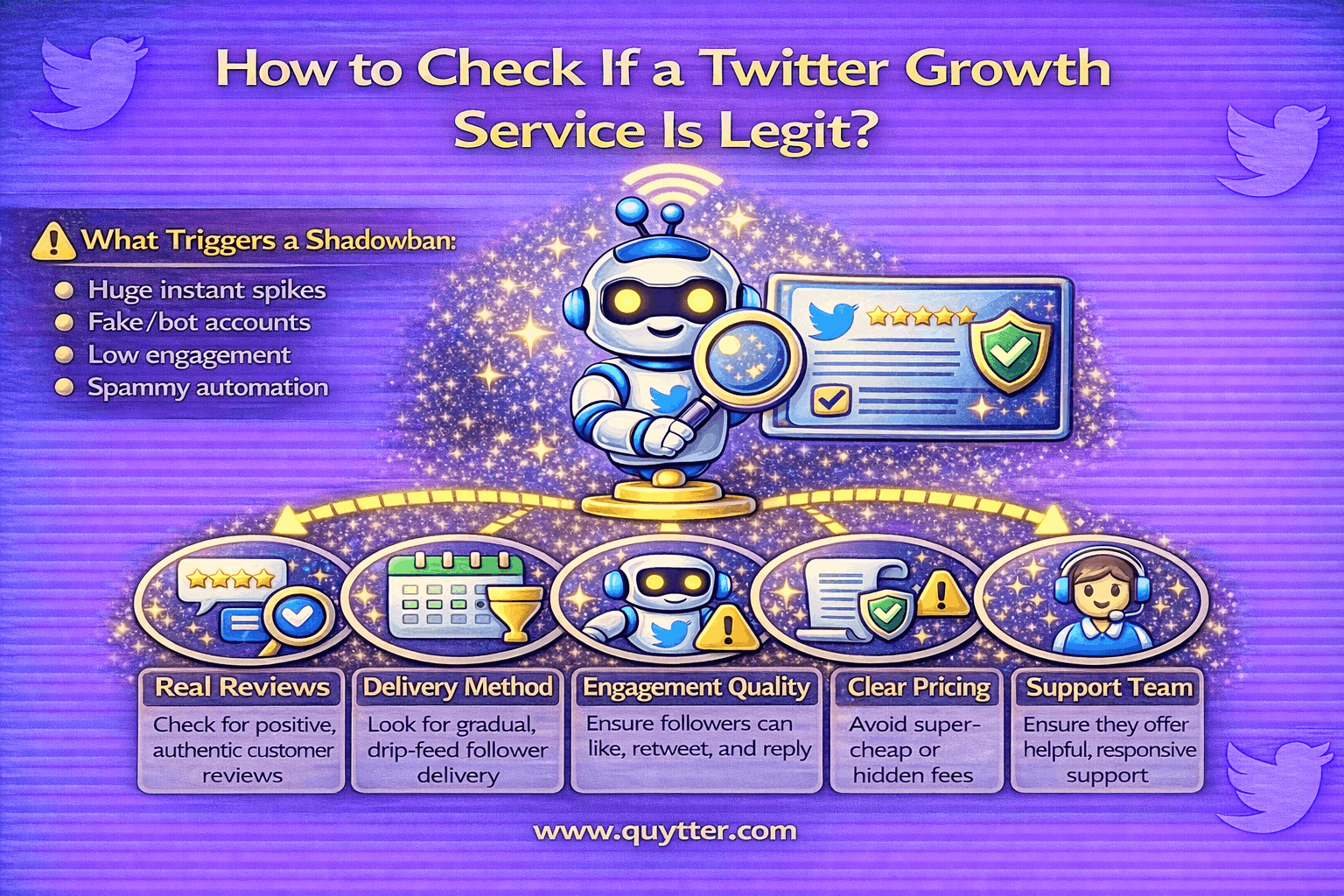
The most important legitimacy check is not what a service promises, but who is actually behind the engagement. Legitimate Twitter growth services rely on real users acting independently, not scripts executing commands or bot farms operating in coordination.
Artificial systems leave patterns behind. Engagement arrives at perfectly even intervals, looks identical across different tweets, or appears regardless of content relevance. These systems optimize for efficiency, not authenticity, and the result is behavior that looks clean but unnatural.
Real user engagement is inconsistent by nature. Some tweets perform better than others. Timing varies. Context matters. Legitimate growth reflects this unevenness because it mirrors how people actually use Twitter.
If engagement looks too smooth, too predictable, or disconnected from what the content is about, it is rarely organic—even if the numbers look impressive.
Natural Pacing Over Explosive Results
Twitter’s algorithm is designed to observe behavior over time, not reward sudden spikes. Legitimate growth services respect this by delivering views, engagement, or followers gradually, allowing the platform to evaluate signals without disruption.
Explosive results are a warning sign. Services that promise thousands of followers or massive view counts instantly are optimizing for volume, not account health. Even when these spikes don’t trigger immediate penalties, they create abnormal distribution patterns that reduce trust in future testing.
Natural growth often feels slow, uneven, and even boring. That is because it aligns with how Twitter expects accounts to evolve. Sustainable growth builds confidence gradually, rather than forcing attention all at once.
On Twitter, stability is not a weakness. It is usually a signal that growth is real.
No Forced Actions or Simulated Intent
A legitimate Twitter growth service never forces behavior or attempts to manufacture intent. It does not bundle views with artificial likes, automated replies, or scripted follows that are designed to make engagement appear intentional when it is not. These actions may look harmless on the surface, but they interfere directly with how Twitter evaluates authenticity.
Likes, replies, and follows are high-sensitivity signals because they represent user intent. When a service forces these actions without genuine interest, Twitter detects a mismatch between exposure and behavior. Content may receive interaction, but the surrounding signals—timing, repetition, account similarity, and lack of downstream activity—do not align with how real users behave. Over time, this inconsistency teaches the algorithm that engagement around the account is unreliable, which quietly weakens distribution even if no penalty is applied.
A trustworthy service allows intent to emerge naturally. It focuses on exposure and lets Twitter observe what real users choose to do after seeing the content. When engagement happens by choice rather than enforcement, behavioral signals remain consistent, and account health is preserved instead of compromised.
Alignment With Account Health, Not Vanity Metrics
A legitimate Twitter growth service evaluates success through account health and distribution performance, not surface-level numbers. It understands that followers, likes, or impressions are only meaningful if they improve how Twitter tests and expands content reach over time. This is why serious services discuss engagement quality, pacing, audience relevance, and how growth signals interact with the algorithm.
Services that focus only on selling metrics—without explaining how those metrics affect reach, engagement consistency, or long-term visibility—are optimizing for appearance rather than performance. Inflated numbers may look impressive, but they often weaken behavioral signals and reduce future distribution. Legitimate services protect performance first, because sustainable numbers only emerge when the account remains algorithmically healthy.
How to Verify a Twitter Growth Service Before Using It?
Even when a service looks legitimate on the surface, verification matters. The safest services allow you to evaluate them before making long-term commitments.
Start by checking whether the service offers gradual delivery options instead of fixed, instant packages. Legitimate services let you control pacing because they understand how sensitive distribution patterns are.
Next, observe engagement behavior on a small scale. Early signals should look uneven and context-dependent, not perfectly consistent. Real engagement varies by tweet, timing, and topic. Predictable behavior is usually artificial.
Finally, look at how the service communicates risk. Legitimate providers acknowledge limits, explain what they can and cannot influence, and avoid guarantees. If everything sounds risk-free and effortless, that’s usually a warning sign.
Signs a Twitter Growth Service Is Not Legitimate
Illegitimate services tend to reveal themselves through what they avoid saying.
If a service refuses to explain how engagement is generated, promises guaranteed results, or claims to bypass Twitter’s system, it is not aligned with account health. These services optimize for short-term numbers, not sustainable distribution.
Another red flag is rigidity. Fixed packages, instant delivery, and identical outcomes across accounts suggest automation and reuse. Real growth adapts to account size, posting behavior, and audience context.
When a service prioritizes speed, secrecy, and certainty, it is almost always trading off long-term performance.
How Quytter Fits These Criteria ?
Quytter is built around real Twitter user activity, not bots, recycled accounts, or hidden automation. All views, engagement, and followers come from active accounts that behave independently, which allows Twitter to observe natural exposure and response patterns instead of artificial signals.
Quytter does not force behavior or simulate intent. Views are not bundled with fake likes or scripted replies, and engagement is never designed to push users into actions they did not choose. This ensures that downstream signals—such as profile visits, replies, or follows—reflect genuine interest rather than manufactured activity.
Delivery is paced gradually to align with how Twitter evaluates distribution and account health. Instead of inflating numbers for appearance, Quytter focuses on helping content reach real users, so engagement and follower growth develop naturally without weakening long-term performance.
Final Thought
A legitimate Twitter growth service doesn’t promise shortcuts. It respects how Twitter learns from behavior and avoids anything that distorts those signals.
If a service is transparent, uses real users, scales gradually, and prioritizes account health, it’s likely legitimate. If it hides methods, promises instant results, or focuses only on numbers, it’s not worth the risk.
On Twitter, how growth happens matters more than how fast it looks.
See more: The Complete Safety Guide for Growing on X (Twitter)