
Using growth services on Twitter is not automatically dangerous. What damages accounts is using them without understanding how Twitter evaluates behavior.
Twitter does not judge intent. It judges patterns.
Every account develops a behavioral fingerprint over time — how fast it grows, how engagement fluctuates, how audiences react, and how consistent those signals are. When growth services introduce patterns that don’t align with that fingerprint, the algorithm recalibrates trust.
Protecting your account is not about hiding activity. It’s about maintaining behavioral coherence.
How Twitter Evaluates Growth Behavior ?
A common misconception is that Twitter tries to identify whether engagement is paid or organic. In reality, the system doesn’t care about payment — it cares about predictability.
Twitter models expectations based on historical data. It learns what “normal” looks like for your account: typical engagement velocity, usual reach, how often users reply or click through, and how distribution behaves over time.
When new activity fits inside that learned range, it’s accepted.
When activity breaks the pattern, the system adjusts.
This adjustment is rarely a punishment. It’s a recalibration of confidence.
If the algorithm can no longer predict engagement reliably, it reduces amplification to protect the overall user experience.
Why Most Accounts Get Flagged When Using Growth Services ?
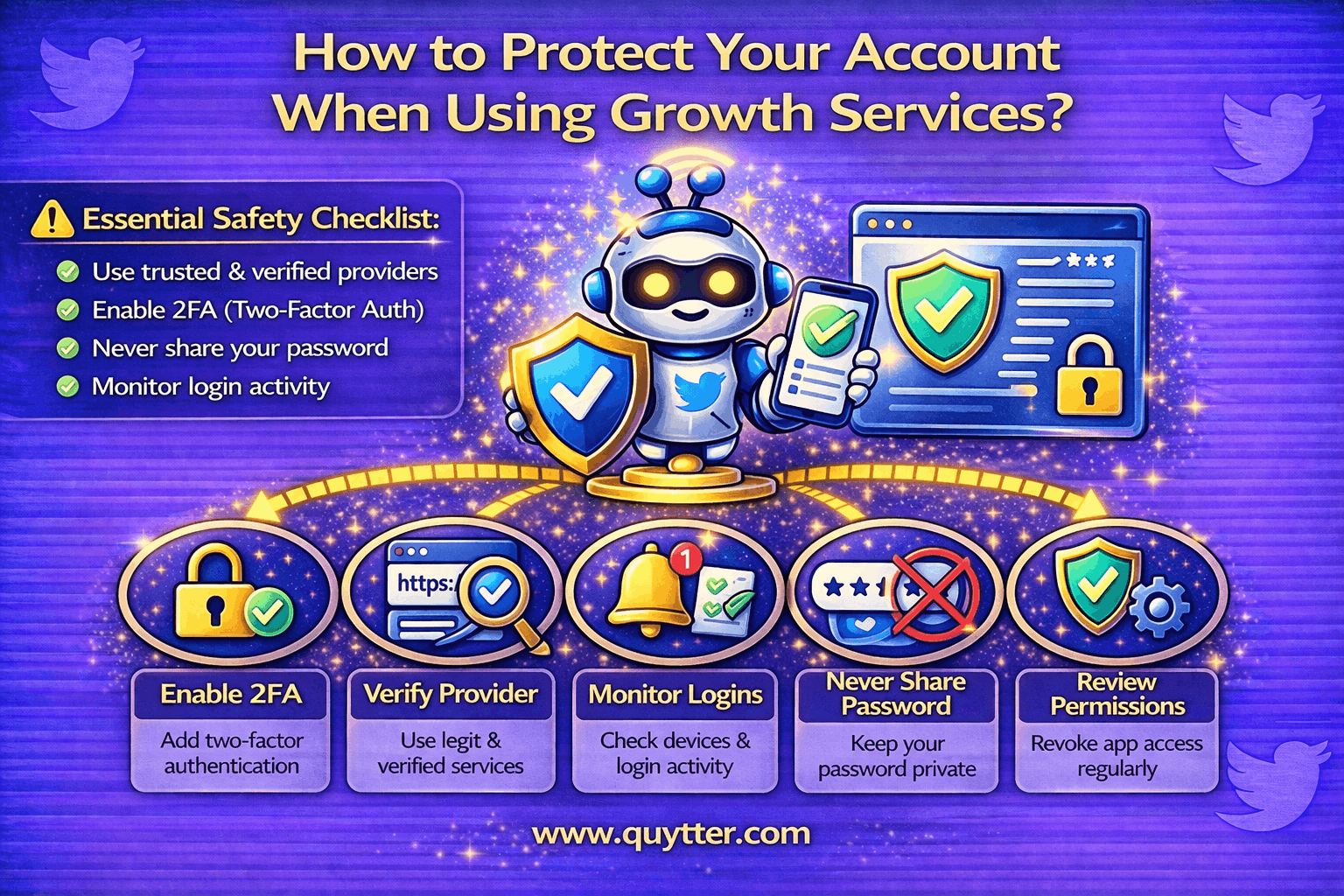
Most accounts don’t get suppressed because growth services are used. They get suppressed because growth services override natural limits the algorithm has already learned.
Twitter builds expectations over time. It learns how your account normally behaves — how quickly engagement accumulates, how interactions are distributed across time, and how audiences respond relative to your size. These patterns become your account’s baseline.
When growth services push activity beyond that baseline, the system doesn’t interpret it as success. It interprets it as uncertainty.
One of the most common triggers is unrealistic engagement velocity. If a tweet receives more interaction in a few minutes than similar tweets have received in days, the algorithm flags the pattern as statistically abnormal. This doesn’t require bots or fake accounts. Even real users, when delivered too quickly, break the expected growth curve.
Another red flag is synchronization. Human engagement is messy — it arrives unevenly, at different times, and in different forms. When dozens or hundreds of interactions occur simultaneously or follow identical timing patterns, the activity stops looking organic. Uniformity, not authenticity, becomes the issue.
A third trigger is contextual mismatch. When performance suddenly exceeds historical behavior without any organic explanation — no viral discussion, no external traffic spike, no visible conversation — the algorithm cannot reconcile the change. Without context, it assumes the signal is unreliable.
Importantly, Twitter does not need proof of manipulation to respond. The system operates on probability, not certainty. When behavior becomes statistically inconsistent, confidence drops. And when confidence drops, distribution is reduced.
From the system’s perspective, something fundamental changed about the account. To protect the timeline experience, Twitter adjusts reach until it can relearn predictable behavior.
This is why suppression often feels sudden and unexplained. Nothing was “detected” in the traditional sense. The algorithm simply stopped trusting the signals it was receiving.
Respect Your Account’s Historical Baseline
Every account operates inside a behavioral range.
There is a normal growth speed.
A normal engagement ceiling.
A normal level of fluctuation.
Safe growth services work within that range, not beyond it.
The moment paid activity pushes your account outside its historical baseline, you create a recalibration event. Twitter doesn’t interpret that as success — it interprets it as uncertainty.
This is why aggressive packages are dangerous even when they advertise “real users.”
Real users behaving unrealistically still break patterns.
At Quytter, growth is constrained by historical performance first — not by how many numbers a customer wants to see.
Why Consistency Matters More Than Speed ?
Fast growth feels good because it produces immediate feedback. Numbers move, dashboards look alive, and progress feels visible. But from Twitter’s perspective, speed is not a positive signal — it’s a source of uncertainty.
Twitter does not optimize for how quickly an account grows. It optimizes for how predictably users respond.
Every account teaches the algorithm what to expect. Over time, the system learns the rhythm of engagement: how long it usually takes for likes to appear, how replies spread, how interaction tapers off. These patterns form a probabilistic model. When new activity follows that model, confidence increases. When it breaks the model, confidence drops.
Fast growth breaks models.
Engagement that arrives too quickly compresses what should be a multi-hour or multi-day interaction cycle into minutes. Even if the accounts involved are real, the timing alone violates learned behavior. The algorithm doesn’t interpret this as success — it interprets it as noise.
Uniformity makes the problem worse. Human engagement is irregular by nature. People check Twitter at different times, react at different speeds, and interact in different ways. When growth appears smooth, evenly spaced, or perfectly distributed, it stops looking human. Clean curves are not organic curves.
This is why protected growth is slow by design.
Gradual growth gives the algorithm time to update expectations. Natural variation — some posts performing better, others worse — reinforces authenticity. Respecting past behavior allows the system to adapt without triggering defensive recalibration.
Services that promise instant results optimize for emotional satisfaction, not platform trust. They deliver attention quickly, but at the cost of long-term distribution.
Speed creates attention.
Consistency builds trust.
And on Twitter, trust is what determines reach.
Account Quality Matters More Than Engagement Volume
One of the biggest risks when using growth services is network overlap.
Cheap providers often reuse the same low-quality account pools across thousands of clients. Even if those accounts are technically real, their repeated behavior creates detectable patterns at scale.
Protecting your account means understanding where engagement comes from:
- Are the accounts active and diverse?
- Do they have real posting history?
- Is behavior varied, not automated?
- Is delivery controlled or mass-scheduled?
If a provider can’t explain how engagement is delivered safely, they don’t understand Twitter’s detection systems.
Volume without quality erodes trust faster than no growth at all.
Paid Growth Must Support Organic Signals Not Replace Them
Paid engagement is safest when it reinforces behavior that already exists.
Twitter does not evaluate metrics in isolation. It evaluates relationships between signals. Likes, retweets, replies, profile clicks, and dwell time are compared against each other to determine whether engagement looks complete or artificial.
When paid likes or retweets appear on an account that isn’t replying, participating in conversations, or interacting within its niche, those relationships break. Surface-level metrics increase, but deeper engagement remains flat. From the algorithm’s perspective, this imbalance suggests low-quality or coerced interaction.
This is why paid engagement cannot function as a substitute for real activity.
Twitter tracks how users move through content. Do they stop scrolling? Do they read replies? Do they click profiles? Do conversations form? When paid engagement arrives without these follow-through actions, the system learns that interaction stops at the surface.
But when paid engagement blends into an already active account, the effect is different. Replies already exist. Conversations are already happening. Paid signals don’t stand out — they disappear into the pattern. Instead of distortion, they provide reinforcement.
Growth services should amplify what’s already working, not compensate for inactivity. If there’s nothing organic to support, paid growth doesn’t fix the problem — it exposes it.
The Danger of Stacking Growth Tactics
One of the fastest ways to destroy trust is trying to grow everything at once.
Buying followers, likes, retweets, and traffic simultaneously overwhelms the system with conflicting inputs. Each tactic changes a different variable, and Twitter cannot isolate which change caused which outcome. When causality becomes unclear, the algorithm defaults to caution.
This is not a punishment. It’s risk control.
From Twitter’s perspective, stacked growth looks like manipulation because nothing evolves naturally. Audience size jumps, engagement jumps, and traffic jumps — all without time for adaptation. Even if each tactic is individually “safe,” their combination creates chaos.
Protected growth is sequential, not stacked.
One controlled variable at a time allows the algorithm to update expectations gradually. It can learn what changed, why performance shifted, and whether the new pattern is sustainable.
Stacking removes that learning process — and when the system can’t learn, it reduces exposure.
Watch Distribution, Not Vanity Metrics
Follower count and likes are lagging indicators. Distribution is the early warning system.
If impressions drop, non-follower reach declines, or tweets stop appearing in recommendations, the correct response is to pause — not escalate.
Most long-term damage happens when users push harder at the first sign of suppression.
Account protection means knowing when to stop.
How Quytter Approaches Account Protection ?
At Quytter, we don’t sell shortcuts.
We’ve seen what shortcuts do to Twitter accounts — suppressed reach, unstable growth, and long-term trust damage. That’s why we don’t treat growth as number inflation. We treat it as signal engineering.
Twitter doesn’t reward volume. It rewards behavioral consistency. Every service we offer is designed around how the algorithm actually evaluates accounts, not around what looks impressive on a dashboard.
Account protection starts with respecting limits.
Before any campaign runs, we anchor delivery to historical performance. Growth that exceeds an account’s past behavior isn’t “strong growth” — it’s a recalibration trigger. Our role isn’t to push accounts as fast as possible, but to move them without breaking trust.
Delivery is always gradual and human-like by design.
Real users don’t engage all at once. They don’t follow perfect curves. They arrive unevenly, at different times, and with natural variation. Our pacing reflects that reality, because timing is often more important than volume when it comes to safety.
Account quality is non-negotiable.
We only work with real, active accounts. Not recycled networks. Not empty profiles. Not automation pools reused across thousands of clients. Network overlap is one of the fastest ways accounts get flagged, and we build specifically to avoid it.
Paid engagement must blend into organic activity, not replace it.
We never treat paid growth as a substitute for real interaction. Likes, retweets, or views only make sense when an account is already active — replying, participating, and engaging within its niche. Our services are designed to reinforce existing signals, not mask inactivity.
We also avoid stacking tactics.
Growth is introduced sequentially, not all at once. One controlled variable at a time allows Twitter’s algorithm to adapt without triggering suppression. Most account damage happens when too many signals change simultaneously — we structure campaigns to prevent that.
The goal is never to trick Twitter.
Our goal is alignment.
Most growth services sell outcomes: instant followers, fast likes, viral numbers. We manage risk. We design growth that holds up over time growth that supports long-term reach instead of sacrificing it for short-term attention.
That’s what account protection means at Quytter.
The Rule That Never Changes
If a growth tactic cannot be explained in terms of how Twitter evaluates behavior, it is not a safe tactic.
Account protection comes from understanding the algorithm, respecting limits, and introducing signals deliberately — not from hacks or shortcuts.
If you’re going to use growth services, use them like an operator, not a gambler.
Quytter helps you grow on Twitter with controlled, algorithm-safe engagement, without sacrificing long-term reach.