
How to use paid Twitter bots safely has become one of the most debated topics in modern social media marketing. As organic reach continues to fluctuate and competition for attention intensifies, many marketers, founders, and creators feel pressured to accelerate growth through automation. Paid Twitter bots promise fast engagement, increased visibility, and scalable results, but they also carry serious risks. Accounts can be shadowbanned, engagement quality can collapse, and brand credibility can be damaged if automation is misused. The real challenge is not whether bots work, but whether they can be used without harming long term marketing performance.
This guide takes a practical and experience driven approach to paid Twitter bots, separating hype from reality. Rather than promoting reckless automation, this article explains how twitter automation bots, twitter marketing bots, and twitter engagement bots actually function within the platform ecosystem. By understanding detection mechanisms, behavioral patterns, and compliance boundaries, marketers can make informed decisions about when automation helps and when it becomes a liability.
What Are Paid Twitter Bots in Marketing?
Paid Twitter bots are automated software tools or managed services designed to perform actions on Twitter accounts in exchange for a fee. These actions often include liking tweets, retweeting content, following users, sending direct messages, or replying to posts at scale. Unlike free scripts or amateur tools, paid solutions typically advertise advanced features such as human like timing, proxy rotation, and targeting filters.
In marketing contexts, twitter automation bots are positioned as growth accelerators. Agencies and SaaS providers market them as shortcuts to visibility, especially for new brands or accounts struggling to gain traction organically. However, the term “bot” covers a wide spectrum. Some tools are closer to scheduling and workflow automation, while others operate as aggressive engagement generators that interact with thousands of accounts daily.
To understand their role in marketing, it is critical to distinguish between automation assistance and synthetic engagement. Automation assistance includes scheduled posting, content queuing, or rule based actions triggered by specific keywords. Synthetic engagement, on the other hand, aims to manipulate visibility metrics through mass likes, retweets, or follows, often without contextual relevance. This second category carries significantly higher risk.
From an expertise standpoint, most platform enforcement actions target behavioral anomalies rather than the presence of automation itself. That means use twitter bots safely does not mean avoiding tools entirely, but understanding which behaviors are interpreted as manipulation. Marketers who fail to recognize this distinction often assume that paying for a tool equals safety, which is a dangerous misconception.
Why Marketers Use Paid Twitter Bots Despite the Risks?
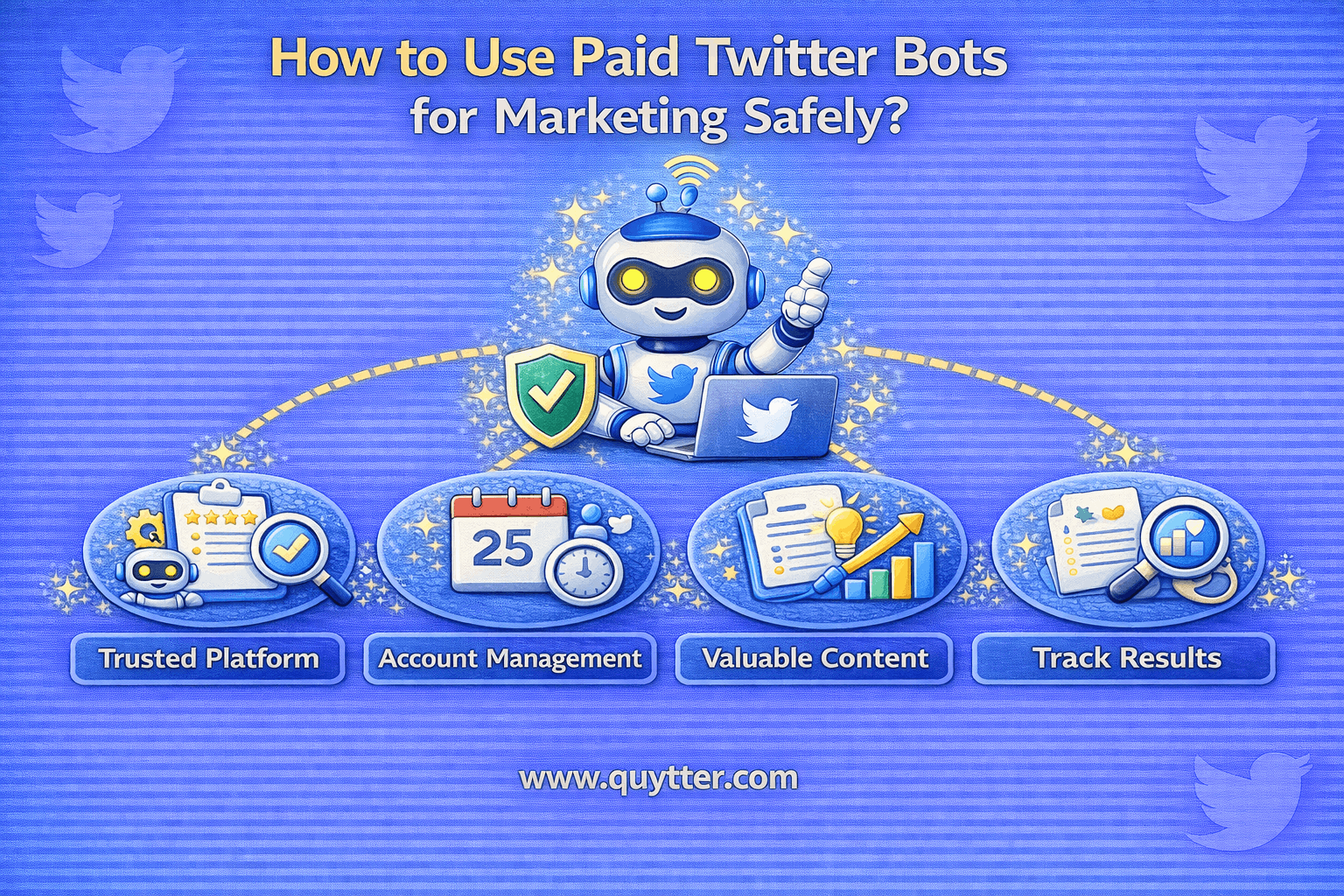
Despite repeated warnings, paid Twitter bots remain widely used across industries. The primary reason is speed. Organic engagement requires time, content consistency, and audience trust, while automation promises immediate feedback loops. For early stage startups or solo creators, waiting months for organic traction can feel unsustainable.
Another factor is social proof psychology. High like counts and retweets influence perceived authority. When users encounter posts with visible engagement, they are more likely to engage themselves. This creates a feedback loop that marketers attempt to trigger artificially using twitter engagement bots. While this tactic can temporarily inflate metrics, it often masks deeper issues related to content relevance and audience fit.
There is also a misunderstanding of risk. Many marketers assume that enforcement only targets spam networks or malicious actors. In reality, twitter bot safety issues affect legitimate businesses every day. Automated campaigns that exceed safe thresholds, operate on low trust accounts, or repeat predictable patterns are flagged regardless of intent.
Experience shows that marketers who rely solely on bots often do so under pressure. Deadlines, KPIs, and growth expectations push teams toward shortcuts. Without proper expertise, these shortcuts backfire. True twitter marketing automation should support strategy, not replace it.
How Twitter Detects Unsafe Bot Activity?
To understand safe twitter automation, one must understand how the platform evaluates behavior. Twitter does not simply scan for tools or software signatures. Instead, it evaluates patterns at scale. Actions are assessed in relation to timing, frequency, diversity, and network context.
One key detection signal is timing regularity. Bots that perform actions at perfectly consistent intervals stand out immediately. Human behavior is inherently irregular. Advanced twitter automation bots attempt to randomize timing, but poor configuration often results in detectable patterns.
Another major factor is action density. Accounts that like, retweet, or follow hundreds of users in a short period trigger risk scoring systems. This is especially true for new or low trust accounts. Even when actions are spread out, cumulative volume over time matters. Marketers who ignore twitter automation limits often experience delayed penalties, making the cause difficult to identify.
Network quality is also critical. Engaging primarily with low quality accounts, bot clusters, or unrelated niches signals inauthentic behavior. Twitter evaluates who you interact with, not just how often. This is where many twitter growth bots fail. They optimize for quantity, not relevance.
Finally, content interaction context matters. Auto replies that repeat similar phrases across unrelated conversations are easy to detect. Even twitter auto DM bot campaigns that appear personalized can be flagged if message structures repeat excessively.
From an authoritativeness perspective, these detection mechanisms are well documented through years of enforcement trends. Marketers who treat automation as a black box inevitably misstep.
The Real Risks of Using Paid Twitter Bots for Marketing
The most common fear associated with bots is account suspension, but this is not the most frequent outcome. More often, accounts experience reduced reach without explicit notification. This phenomenon, commonly referred to as shadowbanning, limits visibility in timelines and search results while leaving the account technically active.
Avoid twitter suspension is a misleading goal if shadowbanning is ignored. Many marketers continue posting, unaware that their content is suppressed. Engagement drops, conversion rates decline, and campaign performance deteriorates silently. By the time the issue is identified, recovery is difficult.
Another risk is long term trust degradation. Twitter assigns trust signals based on account age, behavior consistency, and interaction quality. Aggressive automation erodes these signals. Even after stopping bot usage, recovery can take months.
Brand perception damage is another underestimated risk. Users increasingly recognize inorganic engagement. When replies feel generic or DMs feel automated, audiences disengage. This undermines twitter engagement strategy rather than enhancing it.
From a trustworthiness standpoint, no paid service can guarantee safety. Any provider promising “ban proof” bots is misrepresenting reality. Safe usage depends on configuration, moderation, and strategic integration, not the tool alone.
Which Types of Paid Twitter Bots Are Safer to Use?
Not all bots carry equal risk. Understanding differences between bot types allows marketers to prioritize lower risk automation. Generally, bots that assist with content distribution rather than interaction manipulation are safer.
Twitter auto like bot tools can be relatively low risk when configured conservatively and paired with manual activity. Liking content within a specific niche at low volumes mimics natural discovery behavior. However, mass liking across unrelated topics increases detection risk.
Twitter auto retweet bot tools are riskier due to the amplification effect. Retweets spread content to followers, making patterns more visible. Safe usage requires strict targeting and limited frequency.
Twitter auto follow bot tools are among the highest risk. Follow and unfollow behavior is heavily monitored. Rapid changes in follower ratios and repetitive cycles trigger enforcement quickly. These bots should be avoided for brand accounts.
Twitter auto DM bot solutions sit in a middle ground. While they can support customer service or onboarding flows, promotional DM campaigns often violate twitter terms of service when misused. Contextual relevance and opt in mechanisms are essential.
From experience, safer automation aligns with intent. Actions that support existing relationships are less risky than those designed purely for growth hacking.
How to Use Paid Twitter Bots Safely (Foundational Principles)?
At the core of how to use paid Twitter bots safely is moderation. Automation should amplify human strategy, not replace it. The safest accounts are those where bot activity represents a small percentage of total behavior.
Volume control is the first principle. Low daily action caps reduce anomaly detection. This includes cumulative actions across all automation tools. Many marketers mistakenly configure each tool independently, exceeding safe totals.
Behavior diversity is equally important. Human accounts do not perform the same action repeatedly. Mixing posting, replying, liking, and manual engagement creates natural variability. Bots should never operate in isolation.
Timing randomness must reflect real usage patterns. Avoid 24 hour automation cycles. Human users sleep, work, and disengage. Align automation windows with realistic activity periods.
Content quality is the final safeguard. Automation cannot compensate for irrelevant or low value content. High quality posts naturally attract engagement, reducing reliance on bots. When bots amplify strong content, risk decreases.
From an E E A T perspective, safe automation reflects experience and restraint. Professionals treat bots as tools within a broader twitter marketing automation framework, not as shortcuts.
Common Mistakes That Get Accounts Penalized When Using Paid Twitter Bots
One of the biggest reasons marketers fail to use paid Twitter bots safely is not the tool itself, but how it is configured and integrated into daily activity. Most penalties come from predictable mistakes repeated across thousands of accounts.
The first mistake is over automation. Many users assume that because a service is paid, it automatically operates within safe boundaries. In reality, paid tools often ship with aggressive default settings designed to show “fast results.” High daily action limits, continuous activity windows, and broad targeting immediately push accounts into high risk territory. Even when individual actions look harmless, cumulative behavior becomes abnormal.
Another common issue is single action dependency. Accounts that rely almost exclusively on one automated behavior, such as likes or follows, create highly skewed activity profiles. Real users do not like hundreds of tweets per day without posting, replying, or browsing. This imbalance is one of the strongest signals used in bot detection systems.
A third mistake involves account readiness. New or low trust accounts are far more sensitive to automation. Many marketers activate twitter growth bots on fresh profiles before establishing baseline credibility. Without organic interactions, profile completeness, and content history, automation appears immediately artificial.
There is also a widespread misunderstanding of targeting. Bots that interact with unrelated niches, trending hashtags, or random accounts sacrifice contextual relevance. Twitter evaluates interaction networks, not just raw volume. Engaging outside your niche repeatedly signals manipulation rather than discovery.
Finally, many marketers fail to monitor feedback signals. Declining impressions, disappearing search visibility, or sudden engagement drops are early warning signs. Ignoring these indicators and continuing automation often escalates penalties. Safe automation requires continuous observation, not set and forget execution.
Paid Twitter Bots vs Manual Growth: What Actually Works Long Term
Comparing paid Twitter bots to manual growth reveals a fundamental trade off between speed and sustainability. Automation delivers immediate metrics, while manual strategies build durable assets.
Bots excel at surface level engagement. Likes, retweets, and follower counts can increase quickly, creating short term visibility. However, this engagement is often shallow. It rarely translates into meaningful conversations, clicks, or conversions unless paired with strong content and targeting.
Manual growth focuses on relationship building. Replying thoughtfully, participating in niche discussions, and collaborating with relevant accounts takes time but produces higher trust signals. Twitter’s ranking systems reward these behaviors with broader distribution over time.
The key insight from experienced marketers is that bots should not replace manual effort. The safest and most effective approach blends limited automation with active human participation. Automation handles repetitive tasks, while humans drive strategy and authenticity.
Accounts that rely exclusively on bots often hit a ceiling. Growth stagnates once trust signals decline. In contrast, accounts that use automation sparingly while maintaining human engagement tend to compound reach and credibility.
From an E E A T standpoint, authority is earned through consistency and relevance. Bots can amplify visibility, but they cannot establish expertise or trust on their own.
How to Structure a Safe Twitter Automation Strategy?
A safe Twitter automation strategy starts with defining purpose. Automation should solve a specific operational problem, not act as a growth crutch. Whether the goal is content distribution, engagement support, or workflow efficiency, clarity determines configuration.
The first layer is baseline human activity. Before automation begins, accounts should demonstrate organic behavior. This includes regular posting, authentic replies, and interactions within a defined niche. Automation layered on top of existing behavior blends more naturally.
The second layer involves conservative thresholds. Daily action limits should be set well below platform maximums. It is safer to underuse automation than to push boundaries. Gradual scaling allows behavior models to adapt without triggering alerts.
Timing strategy matters as well. Automation windows should align with realistic usage hours and include inactivity periods. Continuous 24 hour automation is a common red flag.
Targeting refinement is another critical factor. Automation should focus on accounts and content closely aligned with your niche. Broad engagement patterns dilute relevance and increase risk.
Finally, automation should be periodically paused. Natural user behavior includes breaks. Scheduled downtime helps reset behavioral signals and reduces detection probability.
Why Many Marketers Are Moving Away From Bots Entirely?
Despite optimization techniques, many experienced marketers are reducing reliance on paid Twitter bots. The reason is simple: platform enforcement evolves faster than automation tools.
As detection systems improve, the margin for error narrows. What was considered safe automation yesterday may become risky tomorrow. This uncertainty makes bots an unstable foundation for long term growth.
Additionally, brands increasingly prioritize real engagement over inflated metrics. Advertisers, partners, and audiences care more about conversation quality than follower counts. Synthetic engagement often fails to deliver meaningful ROI.
There is also a reputational aspect. Being associated with bot driven growth can undermine brand trust. As users become more educated, obvious automation damages credibility.
These factors have driven demand for alternatives that deliver engagement without automation risk.
A Safer Alternative to Paid Twitter Bots for Sustainable Growth
This is where services like Quytter become relevant. Instead of automating actions through bots, Quytter focuses on real Twitter engagement delivered by real users. This distinction is critical.
Unlike bots that simulate behavior, Quytter provides services such as Twitter likes, views, retweets, comments, and followers through controlled, human driven systems. Because interactions come from real accounts, engagement patterns align more closely with natural platform behavior.
From a safety perspective, this approach reduces the core risks associated with automation. There are no repetitive scripts, no abnormal timing loops, and no synthetic behavior clusters. Engagement appears organic because it is organic.
Quytter is particularly effective for marketers who want visibility without compromising account trust. By boosting early engagement on quality content, posts gain momentum that attracts additional organic interaction. This supports discovery without triggering detection systems.
Another advantage is control. Marketers choose when and where engagement is applied, rather than allowing bots to operate continuously. This aligns with best practices for twitter marketing automation without the automation risk.
For brands, creators, and agencies, Quytter functions as a bridge between organic growth and scale. It complements manual strategy instead of replacing it. This hybrid approach reflects how experienced professionals operate in competitive environments.
How to Combine Manual Strategy With Quytter for Best Results?
The most effective use of Quytter occurs when combined with intentional content strategy. High quality posts act as the foundation. Quytter amplifies visibility, while human interaction sustains engagement.
A common workflow involves publishing valuable content, allowing initial organic responses, and then using Quytter to reinforce momentum. This avoids sudden engagement spikes and maintains natural growth curves.
Replies and conversations should always remain human driven. Automation or purchased engagement should never replace genuine dialogue. Trust is built through interaction, not metrics.
By focusing on consistency rather than volume, accounts maintain long term health. Quytter supports this model by providing scalable engagement without automation penalties.
Conclusion
How to use paid Twitter bots safely is ultimately about understanding limits, risks, and alternatives. While bots can deliver short term engagement, they introduce structural vulnerabilities that threaten account stability and brand trust.
Sustainable Twitter marketing favors strategies that prioritize relevance, authenticity, and controlled growth. Automation should assist, not dominate. For marketers seeking safer options, human driven services like Quytter offer a practical path forward.
By combining strong content, manual engagement, and responsible amplification, brands can grow on Twitter without sacrificing credibility or long term performance.