
Growing on Twitter is not about chasing followers directly. It is about moving users through a funnel: from views, to engagement, to followers, and finally to conversions. Accounts that skip steps may inflate numbers, but they rarely build sustainable reach or business results.
This article explains how the Twitter growth funnel actually works, how Twitter’s algorithm supports each stage, and how to structure your strategy so growth compounds instead of collapsing.
What the Twitter Growth Funnel Really Is?
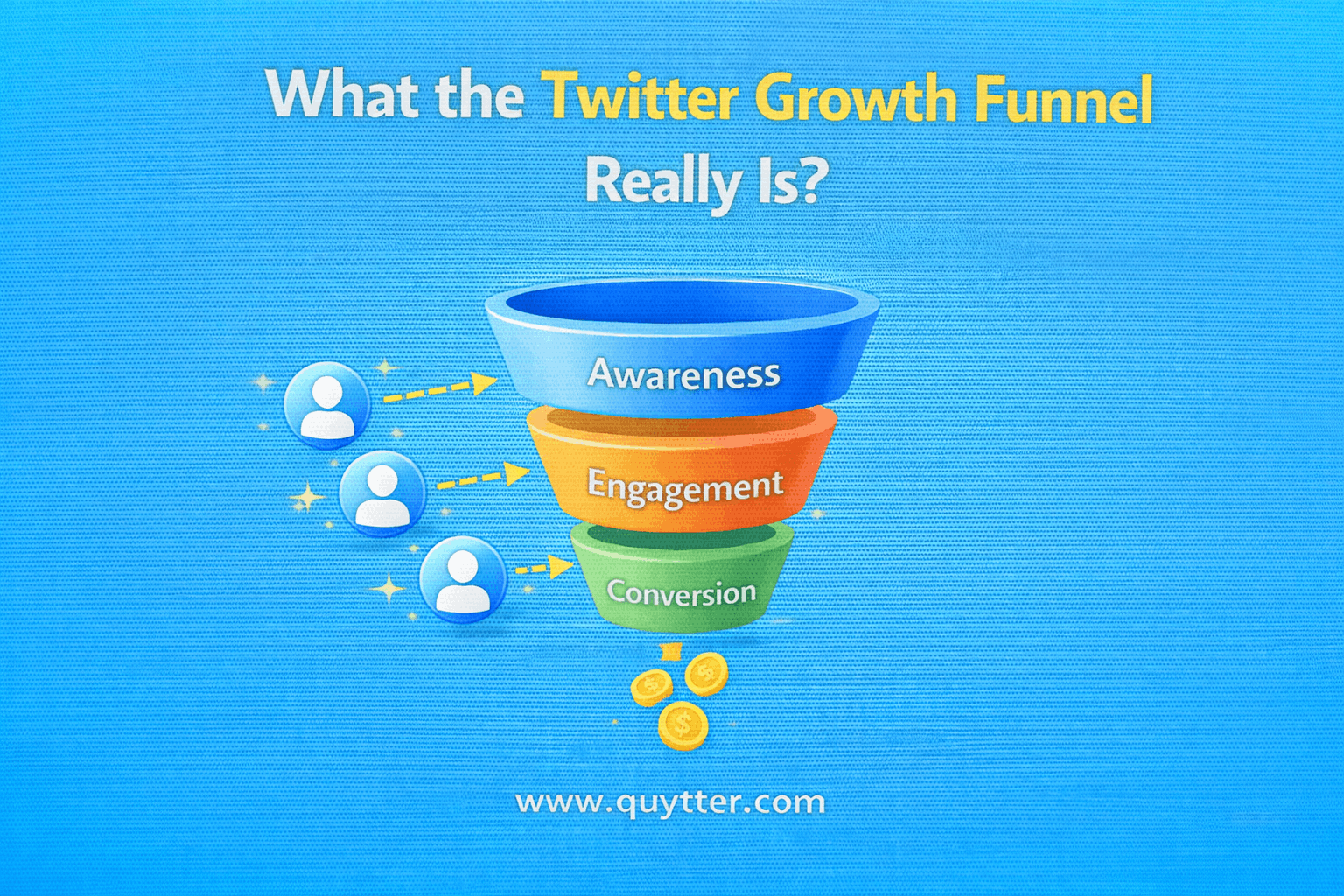
The Twitter growth funnel explains how users move from first exposure to meaningful action on the platform. Growth on Twitter does not happen in a single step. It happens through a sequence of behavioral stages that Twitter’s algorithm continuously observes and evaluates.
At its core, the funnel describes how attention turns into trust, and trust turns into outcomes.
The funnel has four core stages:
Views (Exposure)
Views are the entry point of the funnel. This is where Twitter decides whether your content is worth testing at all. Tweets must first be seen before they can generate any signal. Without sufficient exposure, even high-quality content produces no data for the algorithm to evaluate.
Views determine whether your tweet enters timelines beyond your immediate followers. Weak exposure means the funnel never truly begins.
Engagement (Signals)
Engagement is how Twitter measures attention quality. Replies, retweets, profile clicks, and time spent reading tell the algorithm that users did more than scroll past.
This stage trains Twitter on who your content resonates with. Strong engagement signals increase confidence and expand distribution. Weak or absent engagement tells Twitter to stop testing.
Followers (Retention)
Followers represent retained interest. When users follow after engaging, Twitter learns that your content consistently meets expectations.
Followers are not the goal — they are a byproduct of successful exposure and engagement. Accounts that gain followers without strong prior signals often see future reach decline because retention was not earned behaviorally.
Conversions (Outcome)
Conversions are the final outcome of the funnel: clicks, sign-ups, sales, leads, or off-platform actions.
Twitter does not optimize directly for conversions. It optimizes for behavior that leads to conversions. If earlier stages are weak, conversions rarely happen at scale, regardless of follower count.
Each stage feeds the next.
If views are weak, engagement never forms.
If engagement is weak, followers lack trust.
If followers are weak, future reach is suppressed.
If reach is suppressed, conversions stall.
Twitter does not reward accounts that skip stages or jump straight to follower acquisition. It rewards accounts that generate consistent, aligned behavioral signals across the entire funnel.
This is why sustainable Twitter growth feels gradual at first — and exponential later — when the funnel is built correctly.
Stage 1: Views — The Foundation of All Growth
Views are the entry point to everything else.
If people do not see your tweets, nothing downstream matters. Twitter measures views through impressions, timeline exposure, and discovery surfaces such as search, replies, and recommendations.
At this stage, Twitter evaluates:
- Whether users pause on your tweet
- Whether they scroll past quickly
- Whether your tweet fits the context of the timeline
Views are not vanity metrics. They are distribution tests.
A tweet with strong view performance teaches Twitter that your content is relevant to a certain audience. A tweet that fails to earn attention reduces future testing.
This is why accounts with good content but poor visibility often stagnate. The issue is not quality — it is lack of exposure.
Why Views Must Come Before Followers?
Many users attempt to grow by buying followers or optimizing profiles before solving visibility.
This reverses the funnel.
Followers are a result of repeated exposure, not the cause. Without views, followers have no behavioral context. Twitter cannot learn who your content is for.
Safe growth strategies focus on increasing real views first, because views allow the algorithm to observe behavior and refine distribution.
Stage 2: Engagement — Teaching the Algorithm What Matters
Engagement is how Twitter learns.
Likes, replies, retweets, profile clicks, and dwell time all act as feedback signals. They tell Twitter whether a tweet deserves wider testing.
Not all engagement is equal.
Twitter prioritizes:
- Replies (conversation)
- Retweets (recommendation)
- Time spent reading (attention)
Likes are lightweight. Replies and retweets are commitment signals.
A tweet with low engagement relative to its views teaches Twitter that exposure was wasted. A tweet with strong engagement tells Twitter to expand reach.
This is why early engagement matters more than total engagement.
Engagement as a Funnel Filter
Engagement filters your audience.
At this stage, users decide whether you are worth following. They ask subconsciously:
- Is this content relevant?
- Does this account add value?
- Do I want more of this in my feed?
If engagement is forced, artificial, or inconsistent, Twitter detects the mismatch. Distribution weakens even if numbers look good.
Real engagement aligns naturally with content quality and audience interest.
Stage 3: Followers — Retention, Not Growth Hacks
Followers are not growth fuel. They are retention assets.
Twitter uses followers as the first testing group for every new tweet. This means follower quality directly affects future reach.
High-quality followers:
- Pause to read
- Engage selectively
- Click through profiles
- Reply when content resonates
Low-quality or inactive followers create silence. Silence teaches Twitter that your content underperforms, even if it is good.
This is why unsafe follower buying damages reach long-term.
Why Followers Should Emerge, Not Be Injected?
Healthy follower growth happens when users:
- See your content repeatedly
- Engage with it
- Decide to opt in
When followers emerge from exposure, their behavior aligns with expectations. Twitter’s feedback loop remains intact.
Injected followers break this loop.
Safe growth strategies treat followers as an outcome, not a tactic.
Stage 4: Conversions — The Only Metric That Pays
Conversions are the final stage of the funnel.
Depending on your goal, conversions may include:
- Website clicks
- Email signups
- Product trials
- Sales
- Community joins
- DM inquiries
Twitter does not optimize directly for conversions. It optimizes for behavior that leads to conversions.
If earlier funnel stages are weak, conversions will always underperform — regardless of follower count.
Why Most Twitter Accounts Fail to Convert?
Most accounts fail because they:
- Chase followers instead of attention
- Optimize likes instead of replies
- Ignore distribution mechanics
- Treat Twitter as a broadcast channel
Conversions happen when users trust you. Trust is built through repeated exposure and interaction, not inflated metrics.
How the Twitter Algorithm Connects the Funnel?
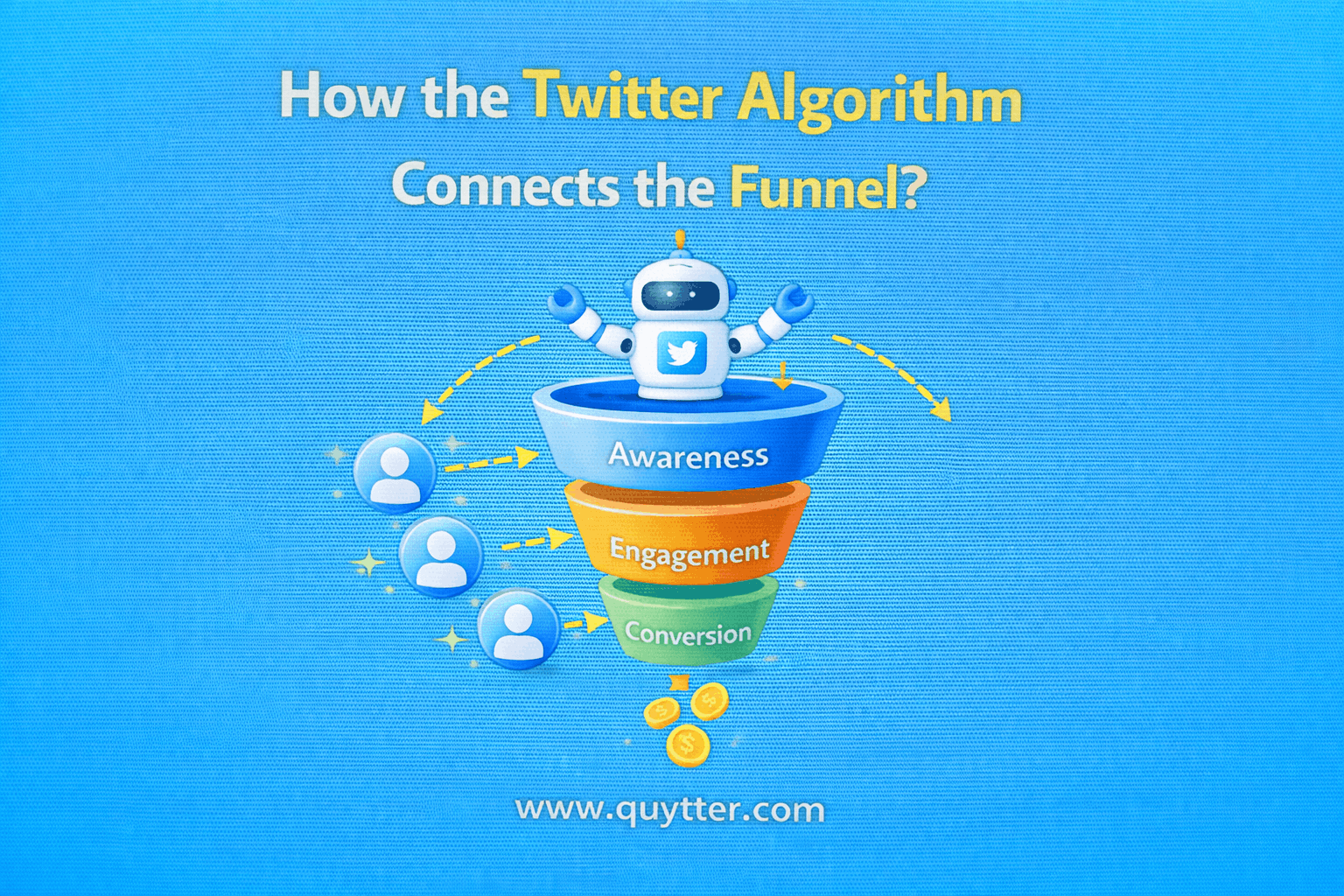
Twitter’s algorithm does not evaluate views, engagement, followers, or conversions as separate metrics. It treats them as a continuous behavioral chain. Each stage feeds data into the next, and weakness at any point affects everything downstream.
The process always starts with exposure. Twitter decides who sees your tweet first and in what context. These early views are not random — they are selected to test relevance. If users scroll past without pausing, the system learns that the content failed to earn attention. Weak view behavior limits how aggressively the tweet is tested again.
When views are strong, Twitter moves to engagement evaluation. This is where replies, profile clicks, dwell time, and secondary actions matter. Engagement is not counted in isolation; it is compared against how many people saw the tweet. Strong engagement relative to impressions increases confidence. Weak engagement teaches the algorithm that exposure was wasted.
Next comes follower trust formation. Twitter observes whether people who repeatedly engage eventually follow, and whether existing followers continue interacting over time. Followers are not just a number — they are treated as a predictive audience. If followers consistently ignore tweets, Twitter reduces future testing because the account’s audience appears uninterested.
Finally, Twitter evaluates conversion behavior, even if you never track it directly. Link clicks, profile visits, bookmarks, and off-platform actions tell the system whether attention led somewhere meaningful. Accounts that repeatedly generate downstream actions are treated as higher-value sources of content.
This is why the funnel is inseparable:
- Weak views mean fewer chances to earn engagement
- Weak engagement reduces follower confidence
- Low-quality followers suppress future reach
- Suppressed reach limits conversions
- Poor conversion behavior feeds back into weaker future distribution
When all stages reinforce each other positively, growth feels exponential. Each tweet benefits from the data created by the last one. When stages are distorted — by fake followers, forced engagement, or artificial signals — the system loses confidence, and growth feels impossible no matter how often you post.
Twitter does not reward appearance. It rewards consistent, believable behavior across the entire funnel.
Using Paid Growth Inside the Funnel (Safely)
Paid growth can support the funnel if used correctly.
Safe use cases include:
- Boosting real views to increase discovery
- Supporting strong tweets with gradual retweets
- Improving early exposure to relevant users
Unsafe use cases include:
- Buying followers directly
- Forcing engagement
- Creating unnatural spikes
Paid growth should amplify signals, not manufacture them.
Where Quytter Fits in the Twitter Growth Funnel?
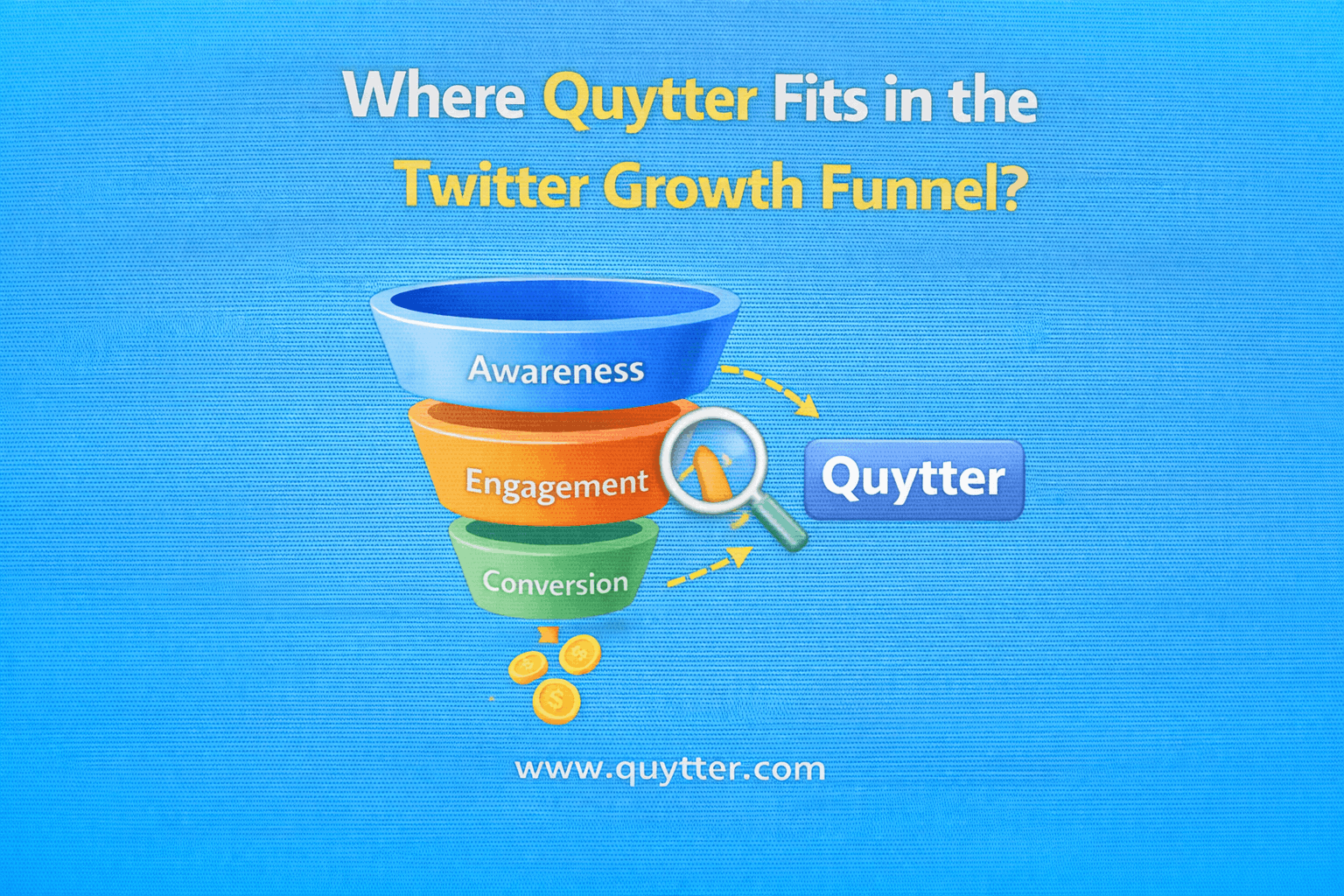
Quytter is designed to operate inside Twitter’s natural growth funnel, not around it. Its role is to strengthen the stages where most accounts fail: discovery and early engagement. These are the points where good content often dies simply because it is not seen by enough relevant users.
At the top of the funnel, Quytter focuses on real Twitter views. Views are the cleanest discovery signal because they expose content without forcing behavior. When a tweet receives real views from active users, Twitter can accurately measure how people react: whether they pause, scroll, click, or reply. This gives the algorithm high-quality input to decide whether the tweet deserves wider testing. Quytter’s view delivery is paced and contextual, allowing tweets to enter real timelines instead of artificial traffic pools.
In the middle of the funnel, Quytter supports gradual engagement without manufacturing intent. Engagement is not bundled or forced. Instead, exposure increases the probability that real users choose to interact naturally. This preserves behavioral consistency, which is critical for Twitter’s learning system. When replies, profile visits, or follows happen as a result of genuine exposure, Twitter interprets them as trustworthy signals and expands reach further.
What Quytter intentionally avoids is the bottom-funnel shortcut that many growth services push: fake followers or inflated metrics. Injecting followers skips the learning phase and corrupts the audience layer that Twitter uses to test future content. Quytter leaves follower growth and conversions to emerge as outcomes, not inputs. When users follow because they discovered value, those followers behave correctly, engage over time, and support future distribution instead of weakening it.
In practical terms, Quytter acts as a distribution stabilizer. It ensures that high-quality tweets do not fail due to lack of initial exposure, while still allowing Twitter’s algorithm to do its job. Content quality remains the deciding factor. Quytter simply removes the visibility bottleneck that prevents good content from entering the funnel in the first place.
This is why Quytter fits naturally into a sustainable Twitter growth strategy. It supports discovery and engagement where leverage is highest, respects algorithmic expectations, and allows followers and conversions to develop organically—without distorting the signals that long-term performance depends on.
Measuring Funnel Health Correctly
To evaluate growth, stop looking at follower count alone.
Track:
- Impressions per tweet
- Engagement rate relative to views
- Profile visits
- Follower growth consistency
- Click-through behavior
A healthy funnel shows steady improvement across layers, not spikes in one metric.
Final Thought: Growth Is a System, Not a Shortcut
Twitter growth is not about hacking a single metric. It is about aligning with how the platform learns from user behavior.
Views create opportunity.
Engagement creates validation.
Followers create stability.
Conversions create real value.
When this funnel is built in the right order, growth compounds naturally. When steps are skipped, the system quietly limits reach and visibility.
Understanding concepts like Twitter Growth Funnel: From Views to Followers to Conversions, How Twitter’s Algorithm Works, and Mistakes to Avoid When Growing a Twitter Account helps explain why some profiles scale while others stagnate.
All of these elements come together in a complete Twitter Marketing Strategy, where content, engagement, and audience trust work together to produce sustainable growth.