
Why most Twitter accounts fail to grow is a question asked by almost every creator, founder, or brand that spends time posting but sees little to no results. Many accounts publish consistently, share useful ideas, and even follow best practices, yet their follower count stays flat and their engagement remains low. This failure is rarely caused by a single mistake. It is usually the result of multiple small issues that compound over time and quietly kill momentum.
Growth on Twitter is not random, but it is also not automatic. The platform rewards visibility, interaction, and consistency far more than effort alone. When an account fails to grow, it is often because the system behind the content is broken, not because the person running the account lacks ideas or motivation.
This guide explains why most Twitter accounts fail to grow and how to fix it using a clear, practical framework. You will learn what actually blocks growth, how the Twitter algorithm evaluates accounts, why organic posting alone often falls short, and how to combine content strategy with engagement support to accelerate results. If your account feels stuck, this article will show you exactly where the problem is and how to solve it.
The Illusion of “Just Keep Posting”
One of the most damaging beliefs on Twitter is the idea that growth will eventually happen if you simply keep posting. Many creators are told to be patient, stay consistent, and trust the process. While consistency matters, posting without strategy often leads to burnout rather than growth.
The problem with “just keep posting” is that it ignores how Twitter actually works. Twitter does not reward effort. It rewards interaction. If your tweets are not generating engagement, posting more of them does not fix the underlying issue. It simply increases the amount of content being ignored.
Many accounts fall into a cycle that looks like this:
• They post daily or multiple times a day
• Engagement stays low
• Reach declines over time
• Motivation drops
• Content quality suffers
This happens because Twitter gradually learns that the account does not generate interaction. Once this perception forms, even good tweets struggle to get visibility.
Another issue is noise. Twitter is saturated with content. Posting generic advice or surface-level observations blends into the background. Without a clear reason for people to stop, read, and respond, your tweets disappear within minutes.
Posting more only works when the content already triggers engagement. If it does not, more frequency accelerates failure instead of growth.
To fix this, you must shift from output-focused thinking to signal-focused thinking. Every tweet should be evaluated by one question: does this invite interaction?
Growth starts when you stop posting for the sake of consistency and start posting with intention. Until that happens, effort alone will not move the needle.
You Are Not Getting Enough Engagement Signals
The most common reason Twitter accounts fail to grow is the lack of strong engagement signals. Twitter does not evaluate accounts based on how often they post or how long they have existed. It evaluates them based on how users respond to their content.
Engagement signals are actions that indicate interest, relevance, and value. Among these signals, retweets and comments are the most powerful. Likes matter, but they are passive. Retweets and comments show active participation.
If your tweets consistently receive likes but few replies or retweets, your account is sending weak signals to the algorithm. Twitter sees your content as consumable but not shareable or discussable. As a result, reach remains limited.
Several factors contribute to weak engagement signals:
• Tweets feel complete and leave no room for response
• Content informs but does not provoke thought or emotion
• Calls to action are missing or ineffective
• Early engagement is absent
Early engagement is especially important. When a tweet receives interaction shortly after posting, Twitter is more likely to show it to additional users. Without early signals, even high-quality tweets can stall.
Another issue is imbalance. Many accounts rely heavily on likes while ignoring the importance of comments and retweets. This creates a false sense of success. The tweet appears popular, but it does not travel far.
Accounts that grow consistently usually design their tweets to encourage specific actions. They know whether a tweet is meant to spark discussion, drive shares, or build credibility.
To improve engagement signals, focus on:
• Writing tweets that invite opinions or disagreement
• Ending tweets with prompts that encourage replies
• Sharing content that people feel comfortable retweeting
• Ensuring early interaction whenever possible
Without strong engagement signals, growth becomes unpredictable and slow.
Your Content Lacks a Clear Positioning
Another major reason most Twitter accounts fail to grow is unclear positioning. Many accounts talk about too many topics, shift tone frequently, or lack a recognizable theme. This makes it difficult for users to understand why they should follow.
On Twitter, people follow accounts for clarity. They want to know what they will get. When an account posts random thoughts, mixed advice, and inconsistent messages, it becomes forgettable.
Clear positioning answers three questions:
• Who is this account for?
• What problem does it help solve?
• Why should I care?
Accounts that grow quickly usually focus on one primary theme and build authority around it. This does not mean repeating the same message endlessly. It means staying within a defined lane.
Unclear positioning often shows up as:
• Generic motivational content
• Broad business advice with no niche
• Switching topics without context
• Posting trends unrelated to core focus
When positioning is weak, even high-quality tweets struggle to convert viewers into followers. People may like or reply, but they do not feel compelled to follow.
Fixing this requires intentional focus. Decide what your account stands for and reinforce it consistently. Over time, Twitter associates your account with a specific value, making growth easier.
Strong positioning also improves engagement. When followers know what to expect, they are more likely to interact and share your content.
You Are Invisible to the Algorithm
Many creators believe their account is being ignored unfairly. In reality, most accounts are invisible to the algorithm because they fail to generate signals that justify distribution.
Twitter does not hide content arbitrarily. It prioritizes content that keeps users engaged on the platform. If your tweets do not generate interaction, Twitter has no incentive to show them to more people.
Low visibility often stems from:
• Low impressions on tweets
• Minimal interaction per post
• No momentum across multiple tweets
• Inconsistent engagement patterns
Once an account becomes invisible, growth slows dramatically. Tweets may only reach existing followers, limiting discovery.
Visibility is not permanent. It can be rebuilt by improving engagement patterns. When tweets consistently receive interaction, Twitter gradually expands reach again.
Creators who understand this focus on visibility as a system, not a hope. They actively work to ensure their content gets seen and interacted with.
This includes:
• Posting when their audience is active
• Encouraging replies early
• Promoting tweets externally when needed
• Supporting visibility through engagement strategies
Without visibility, even the best content fails to perform.
You Are Relying on Organic Growth Alone
One of the biggest reasons Twitter accounts fail to grow is the belief that organic growth alone is enough. While organic strategies are important, they are often too slow for competitive environments.
Many large accounts use some form of engagement support to kickstart visibility. This is not about faking popularity. It is about ensuring content has the opportunity to perform.
Relying solely on organic reach means:
• Waiting longer for momentum
• Risking good content being ignored
• Slower feedback and iteration
Strategic engagement support helps overcome early barriers. When used correctly, it amplifies content rather than replacing quality.
The key is intention. Engagement should support content that is already designed to perform. When combined properly, organic and supported strategies create faster and more predictable growth.
The Smart Way to Fix Twitter Growth Problems
Fixing Twitter growth problems requires a system, not a single tactic. Successful accounts align content, engagement, and visibility into a repeatable process.
A strong growth system includes:
• Clear positioning and audience focus
• Content designed for replies and shares
• Consistent posting with purpose
• Early engagement to build momentum
• Ongoing analysis and adjustment
This approach removes guesswork. Instead of hoping for virality, you create conditions where growth is more likely.
Accounts that follow systems grow steadily because each part reinforces the others. Content attracts engagement. Engagement boosts visibility. Visibility attracts followers.
Growth stops being mysterious and becomes manageable.
How Quytter Helps Twitter Accounts Grow Faster?
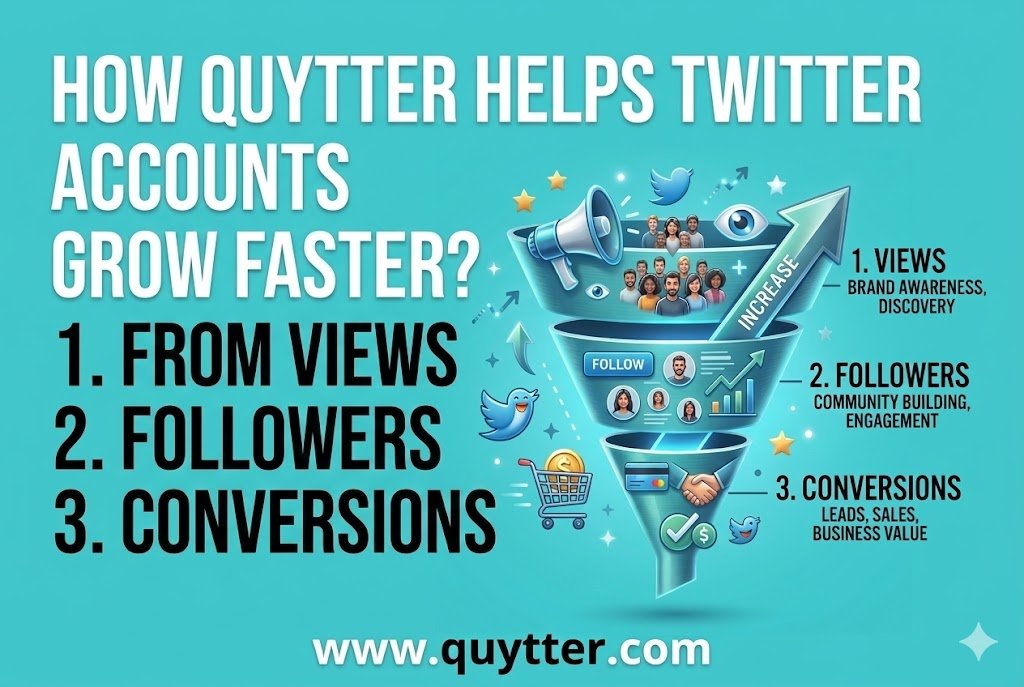
For accounts that want to accelerate growth, Quytter provides engagement services designed to support visibility and interaction at critical moments.
Quytter helps solve common growth problems by offering:
• Twitter retweets to expand reach beyond existing followers
• Twitter comments to create discussion and activity
• Twitter likes to reinforce social proof
• Twitter views to increase impressions and algorithm signals
• Real Twitter followers to improve profile credibility
These services are especially effective when launching new content, promoting important tweets, or building momentum on growing accounts.
Instead of waiting for organic discovery, Quytter helps your content get the initial push it needs to perform. This allows strong tweets to reach more people and encourages real interaction.
Quytter’s services work best when combined with a clear content strategy. They amplify what is already working and help you identify what resonates faster.
For creators, brands, and businesses serious about growth, Quytter provides practical tools to support consistent visibility and engagement.
Conclusion
Most Twitter accounts fail to grow not because their creators lack talent, but because they lack a system. Growth on Twitter is driven by engagement signals, visibility, and positioning rather than effort alone.
Understanding concepts such as Why Most Twitter Accounts Fail to Grow, How to Create Content That Encourages Retweets and Comments, and How Twitter’s Algorithm Works helps explain why some profiles gain traction while others remain invisible.
When you recognize these patterns, fixing the problem becomes much easier. By improving content design, strengthening engagement signals, and supporting visibility, growth becomes far more predictable within a well structured Twitter marketing strategy.
If you want to stop guessing and start growing faster, combining strong content with targeted engagement support makes a measurable difference. Quytter helps bridge the gap between good ideas and real reach by providing services that boost retweets, comments, likes, views, and followers.
Growth is not luck. It is structure, consistency, and momentum. Quytter helps you build all three.