
Buying Twitter followers often feels like a shortcut to credibility. A larger follower count looks impressive on the surface — but when engagement suddenly drops afterward, it becomes clear something went wrong.
If your Twitter engagement declined after buying followers, you’re not imagining it. This is a common outcome, and it happens for structural reasons inside Twitter’s algorithm — not because your content suddenly became worse.
At Quytter, we regularly help creators and brands recover from follower-related engagement drops. This article explains why buying followers hurts engagement, what actually happens to your account, and how to fix it without making the situation worse.
Why Buying Followers Often Leads to Engagement Drops ?
Twitter does not evaluate accounts based on how many followers they have. It evaluates them based on how audiences respond relative to their size.
When you buy followers, especially low-quality or fake ones, you immediately distort that relationship. Your follower count increases, but your ability to generate real interaction does not. In mathematical terms, you inflate the denominator without improving the numerator. The engagement-to-follower ratio drops instantly.
From the algorithm’s perspective, this isn’t neutral — it’s informative.
A sudden decline in relative engagement signals that your content has become less relevant to your audience. Twitter doesn’t assume manipulation at this stage; it simply updates its expectations. If users with a large audience fail to generate interaction, the system predicts low value and reduces distribution accordingly.
The problem compounds because most bought followers are inactive. They don’t scroll attentively, don’t click profiles, don’t reply, and don’t participate in conversations. Over time, the algorithm learns a new pattern: when your tweets are shown, nothing happens.
So Twitter shows them to fewer people.
This outcome isn’t punishment. It’s optimization. The platform is protecting user experience by amplifying content it expects people to engage with — and deprioritizing content it expects them to ignore.
How Twitter Detects Low-Quality or Fake Followers ?
Twitter evaluates followers the same way it evaluates engagement: through patterns, not labels.
Low-quality or fake followers tend to cluster around predictable behaviors. They are often newly created, post rarely or not at all, follow large numbers of accounts, and interact minimally. Individually, one such account means nothing. In aggregate, hundreds or thousands of them form a statistically obvious footprint.
Twitter analyzes follower graphs at scale. When a significant portion of an account’s audience shares low-trust characteristics, the system doesn’t need to take dramatic action. It doesn’t need to remove followers or issue warnings.
It simply adjusts how much confidence it places in that audience.
The more untrusted followers an account has, the less predictive its engagement becomes. As a result, the algorithm reduces how heavily it weighs the account’s signals when deciding distribution. Reach declines not because of a rule violation, but because the system has learned that the audience is unlikely to respond.
This is why engagement often drops after buying followers, not during the purchase itself. Detection happens through delayed pattern recognition, not instant judgment.
What Actually Happens to Your Account ?
After buying followers, most accounts experience algorithmic suppression, not a formal penalty.
Your account continues to function normally. Tweets publish without errors. You can reply, retweet, and interact as usual. But behind the scenes, distribution is quietly reduced.
Tweets are shown to fewer non-followers. They appear less often in recommendation surfaces. Even existing followers may see your content less consistently, because the algorithm predicts low engagement based on past performance.
This experience is often described as a shadowban, but in most cases that’s a misunderstanding. What’s happening is trust recalibration.
Twitter has learned that your follower base is less responsive than expected, so it limits exposure to prevent low-value content from dominating timelines. The system isn’t blocking you — it’s simply choosing not to amplify you.
Should You Remove Fake Followers?
Removing fake followers can help, but it’s not a universal solution — and done incorrectly, it can make things worse.
If a large portion of your audience is clearly fake or completely inactive, gradually reducing that number can improve engagement ratios over time. A smaller, more responsive audience often produces stronger signals than a large, silent one.
However, aggressive cleanup tools and mass removals introduce their own risks. Sudden drops in follower count create sharp graph changes that can trigger new anomalies. From the algorithm’s perspective, rapid audience contraction is just as suspicious as rapid growth.
In many cases, it’s safer to outgrow low-quality followers rather than force a hard reset. By rebuilding engagement, attracting real users, and restoring interaction patterns, low-quality followers become statistically irrelevant over time.
The right choice depends on:
- How many fake followers you have
- How quickly they were added
- How the removal is executed
There is no single correct answer — only risk-managed decisions.
Across all of this, one principle stays consistent: Twitter does not punish accounts for buying followers. It reduces amplification when audience metrics stop making sense.
Recovery is about restoring coherence between follower count, engagement behavior, and distribution outcomes. When those elements align again, reach follows naturally.
Tips: The Complete Safety Guide for Growing on X (Twitter)
Step-by-Step: What to Do After Engagement Drops
When engagement drops after buying followers, the instinctive reaction is panic. Most people try to “fix” the numbers immediately — and that reaction is exactly what traps the account in long-term suppression.
Recovery is not about adding new signals. It’s about removing bad ones and re-establishing a believable baseline.
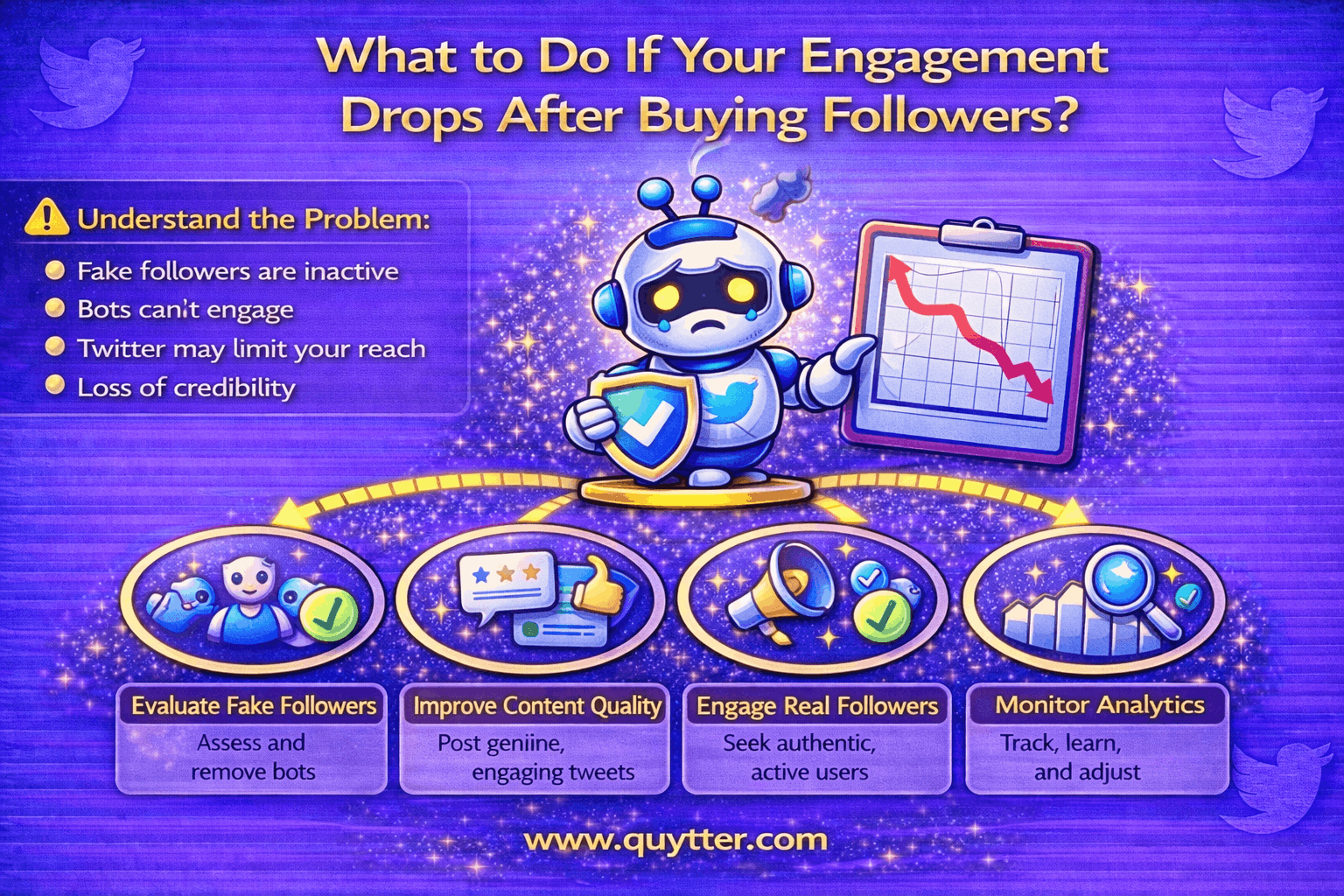
Stop Buying Followers Immediately
The single worst response to an engagement drop is doubling down.
Buying more followers — even from providers advertising “real” or “high-quality” accounts — does not solve the underlying problem. From Twitter’s perspective, the behavior hasn’t changed. The pattern remains the same: artificial audience inflation without corresponding organic interaction.
Twitter evaluates accounts relatively, not absolutely. It compares your current behavior to your past behavior. When follower growth continues without organic engagement improving, the algorithm doesn’t see improvement — it sees persistence.
This is why switching providers rarely helps. Changing the source doesn’t change the signal.
At this stage, stopping all follower purchases creates something crucial: a clean break in the data. Without that break, the algorithm has no reason to update its trust model. Silence, in this context, is corrective.
Stabilize Your Account Metrics
Once follower buying stops, the next priority is stability — not performance.
Many accounts make things worse by reacting emotionally. They post more often, change content style overnight, chase trends, or experiment aggressively. While this feels productive, it introduces volatility at the exact moment the algorithm needs consistency.
Twitter’s distribution system relies on predictable baselines:
- How often you post?
- How your audience typically responds?
- How engagement decays over time?
Sudden spikes in activity or radical shifts in tone confuse recalibration. Instead of learning that your account is stabilizing, the algorithm sees noise.
Stability means maintaining a predictable cadence, even if engagement is temporarily low. Normalizing impressions week over week matters more than maximizing short-term interaction. A stable pattern gives the algorithm something reliable to measure against.
Rebuild Engagement with Real Signals
Once metrics stop deteriorating, recovery becomes active — but still controlled.
Not all engagement signals carry equal weight. Passive actions like likes are easy to generate artificially and therefore less trusted. Conversational signals — replies, quote tweets, back-and-forth discussions — are harder to fake and more valuable to the platform.
This is why rebuilding engagement starts with interaction, not reach.
Engaging with real users in your niche, participating in ongoing conversations, and prompting thoughtful replies teaches the algorithm something critical: your account can still generate genuine interaction without artificial amplification.
This process retrains Twitter’s internal expectations. Instead of assuming low responsiveness from your audience, the system begins to re-evaluate distribution potential.
Progress here is gradual, but it compounds.
Fix the Engagement-to-Follower Ratio
One of the quiet consequences of buying followers is expectation mismatch.
When follower count rises but engagement doesn’t, Twitter recalibrates its expectations downward. Your tweets are shown to fewer people because the system predicts low interaction based on past performance.
Fixing this doesn’t require viral numbers — it requires believable ratios.
As engagement stabilizes and improves relative to follower count, the algorithm updates its assumptions. Over time, reach can recover even if your effective audience is smaller than your visible follower number.
This is why quality engagement always outweighs audience size. A smaller, responsive audience produces stronger signals than a large, inactive one.
Recovery happens when the numbers start making sense again.
The Key Principle Behind This Process
Twitter doesn’t punish accounts for buying followers. It reduces exposure to accounts whose metrics stop making sense.
Every step above serves one purpose: restoring internal coherence between audience size, engagement behavior, and distribution outcomes. When those elements align again, reach follows naturally.
When (and If) Paid Engagement Can Help ?
Paid engagement is not always the enemy — but it is rarely the solution people think it is.
In some cases, controlled paid engagement can support recovery, but only after the account has clearly stabilized. Stability here doesn’t mean “feels better than yesterday.” It means impressions have stopped declining, engagement no longer drops suddenly, and posting performance has become predictable again.
At this stage, paid engagement serves a very narrow purpose: signal reinforcement.
When delivered gradually and in a human-like manner, engagement from real, active accounts can help restore confidence in the account’s interaction patterns. It reminds the algorithm what normal engagement looks like — not by overwhelming it, but by aligning with existing behavior.
The critical constraint is proportionality. Paid engagement must stay within historical performance ranges. If it exceeds what the account has demonstrated organically, it becomes suspicious. Growth acceleration reintroduces the same anomalies that triggered suppression in the first place.
This is why timing matters more than volume. Used too early or too aggressively, paid engagement doesn’t help recovery — it resets the damage.
Why Most Accounts Fail to Recover After Buying Followers ?
Most recoveries fail not because recovery is impossible, but because people panic.
When engagement drops, users look for immediate fixes. They switch providers, buy different types of followers or engagement, and layer new tactics on top of unresolved problems. From the algorithm’s perspective, nothing has changed. The same trust issues persist, just expressed in new forms.
Another common mistake is forcing growth before the system is ready. Recovery requires a period where the account proves it can behave normally without artificial support. Skipping that step undermines the entire process.
The final failure point is misunderstanding how Twitter evaluates behavior. The platform doesn’t respond to intentions or explanations — it responds to data consistency over time. Without that understanding, users chase hacks instead of correcting signals.
Recovery requires patience, restraint, and alignment with how the algorithm actually works. Shortcuts don’t just fail — they usually make recovery harder.
How Quytter Helps You Recover and Grow Safely ?
At Quytter, we don’t treat follower count as a growth metric. We focus on trust-based Twitter growth.
Our approach emphasizes:
- Real, active followers
- Gradual engagement support
- Behavior aligned with organic interaction
- Long-term account health
If your engagement dropped after buying followers, Quytter can help you rebuild reach the right way — without repeating the mistakes that caused suppression.
Explore Quytter’s Twitter Marketing Services and grow with confidence.