
When people talk about “safe” Twitter engagement, they often mean one thing, avoiding detection. That framing is wrong. Twitter does not punish engagement because it is paid. It suppresses engagement when behavior stops making sense.
Understanding that distinction is the foundation of delivering engagement that actually lasts.
What “Safe Engagement” Really Means on Twitter ?
Safe engagement is not invisible engagement, it is believable engagement.
Twitter is not trying to hide paid activity or hunt for transactions. The system is designed to predict how users behave and to amplify content that fits those predictions. Engagement becomes unsafe only when it breaks those expectations.
Over time, Twitter builds a behavioral model for every account. It learns how quickly engagement usually accumulates, how interactions spread across time, and how different types of engagement relate to each other. These patterns become the account’s reference point.
When new engagement behaves within that reference point, distribution remains stable. When it suddenly arrives faster, cleaner, or larger than anything the account has shown before, the algorithm loses confidence.
Who engages matters as much as how many engage. Engagement coming from accounts with real activity, diverse behavior, and normal usage patterns reinforces trust. Engagement coming from low quality or overly similar accounts weakens it, even if those accounts are technically real.
Timing is often where things go wrong. Human interaction is uneven. People scroll at different moments, react at different speeds, and engage for different reasons. When engagement arrives in tight clusters or perfectly smooth curves, it stops looking human and starts looking engineered.
Context matters just as much. A tweet that suddenly outperforms everything before it needs a visible reason. Conversations, replies, external sharing, or topical relevance all provide context. When engagement spikes without any of that, the algorithm treats it as unreliable.
Most unsafe engagement fails not because it is fake, but because it violates timing, scale, or context at the same time. Once that happens, Twitter does not need to take action against the account. It simply reduces distribution until predictable behavior returns.
Safe engagement is engagement that fits the story the account has already told the algorithm.
When engagement makes sense, Twitter has no reason to intervene.
Why Real Accounts Matter More Than Big Numbers ?
On Twitter, engagement does not exist in isolation. Every like, retweet, or reply carries the context of the account behind it.
Twitter evaluates not just the action, but the actor. It looks at how an account behaves across the platform, how often it posts, what types of content it interacts with, and how its activity compares to other accounts. These behavioral signals determine how much weight that engagement carries.
Real accounts tend to have depth. They post periodically, engage with different types of content, and show variation in behavior. Their timelines are not empty, their interactions are not repetitive, and their activity does not follow rigid schedules. This diversity makes their engagement credible.
Low quality networks fail at this level. Even when accounts are technically real, they often share similar traits. They follow the same patterns, interact in the same ways, and appear across multiple campaigns in similar timeframes. That overlap makes them statistically obvious.
Twitter does not need to identify individual accounts as fake. It simply learns that engagement coming from those clusters predicts low downstream interaction. Over time, the system discounts those signals automatically.
This is why chasing big numbers is risky. A large volume of low weight engagement does not strengthen trust. It dilutes it.
Safe engagement depends on diversity. Different accounts, different behaviors, different timing. Who engages matters just as much as how many engage, because Twitter weighs credibility before it counts volume.
Timing Is Where Most Services Fail
Even high quality engagement becomes risky when timing breaks expectation.
Human interaction is messy. People scroll at different hours, react at different speeds, and engage for different reasons. Real engagement spreads unevenly across time. Some minutes are quiet, others spike briefly, then drop again.
Most services fail because they optimize for speed, not realism. Engagement is delivered too quickly, too smoothly, or too consistently. From a statistical perspective, that behavior is rare in organic systems.
Twitter does not look for proof of manipulation. It looks for deviation. When engagement arrives in patterns the account has never shown before, the algorithm reduces confidence automatically.
Gradual delivery is not a feature. It is a requirement for engagement to be trusted.
When timing feels natural, engagement blends into the account’s existing behavior. When it feels engineered, even real accounts lose weight.
Safe Engagement Must Match Account History
Every Twitter account has a behavioral baseline.
That baseline includes how many impressions tweets usually receive, how quickly engagement accumulates, and how performance fluctuates over time. The algorithm uses this history as a reference point.
Safe engagement stays within that reference. It nudges performance forward without rewriting the account’s story.
When services push engagement beyond what the account has ever demonstrated, Twitter does not interpret it as growth. It interprets it as noise. The system responds by limiting distribution until behavior becomes predictable again.
This is why instant delivery packages are dangerous, regardless of how they are marketed. Speed alone is not the problem. Discontinuity is.
Engagement that respects history reinforces trust. Engagement that ignores it forces recalibration, and recalibration almost always means reduced reach.
Paid Engagement Must Support Organic Activity
Paid engagement is safest when it blends into real activity, not when it tries to stand in for it.
Twitter evaluates behavior holistically. Likes and retweets are only one layer. The system also tracks replies, conversation depth, dwell time, profile visits, and interaction diversity. These signals tell Twitter whether engagement is part of a living account or just surface noise.
When an account posts consistently, replies to others, and participates in its niche, engagement has context. Likes and retweets appear as a natural extension of ongoing interaction. The signal balance stays intact.
Problems start when paid engagement arrives in isolation. If an account is quiet, does not reply, and does not interact, sudden engagement creates an imbalance. The algorithm sees activity without cause, and confidence drops.
Paid engagement should reinforce momentum, not manufacture it. It works best when it amplifies tweets that are already receiving some attention, not when it tries to create attention from zero.
Accounts that rely on paid engagement to replace organic behavior rarely recover. Accounts that use it to support existing activity tend to remain stable, because the engagement fits the broader behavioral picture.
Engagement should amplify what already exists, not replace it.
How Quytter Approaches Safe Twitter Engagement ?
At Quytter, the focus has always been on long term account health, not short term spikes.
After analyzing thousands of Twitter accounts affected by low quality growth services, one pattern becomes clear. Accounts don’t lose reach because they grow. They lose reach because growth is delivered in ways the algorithm cannot trust.
That is why Quytter structures engagement differently.
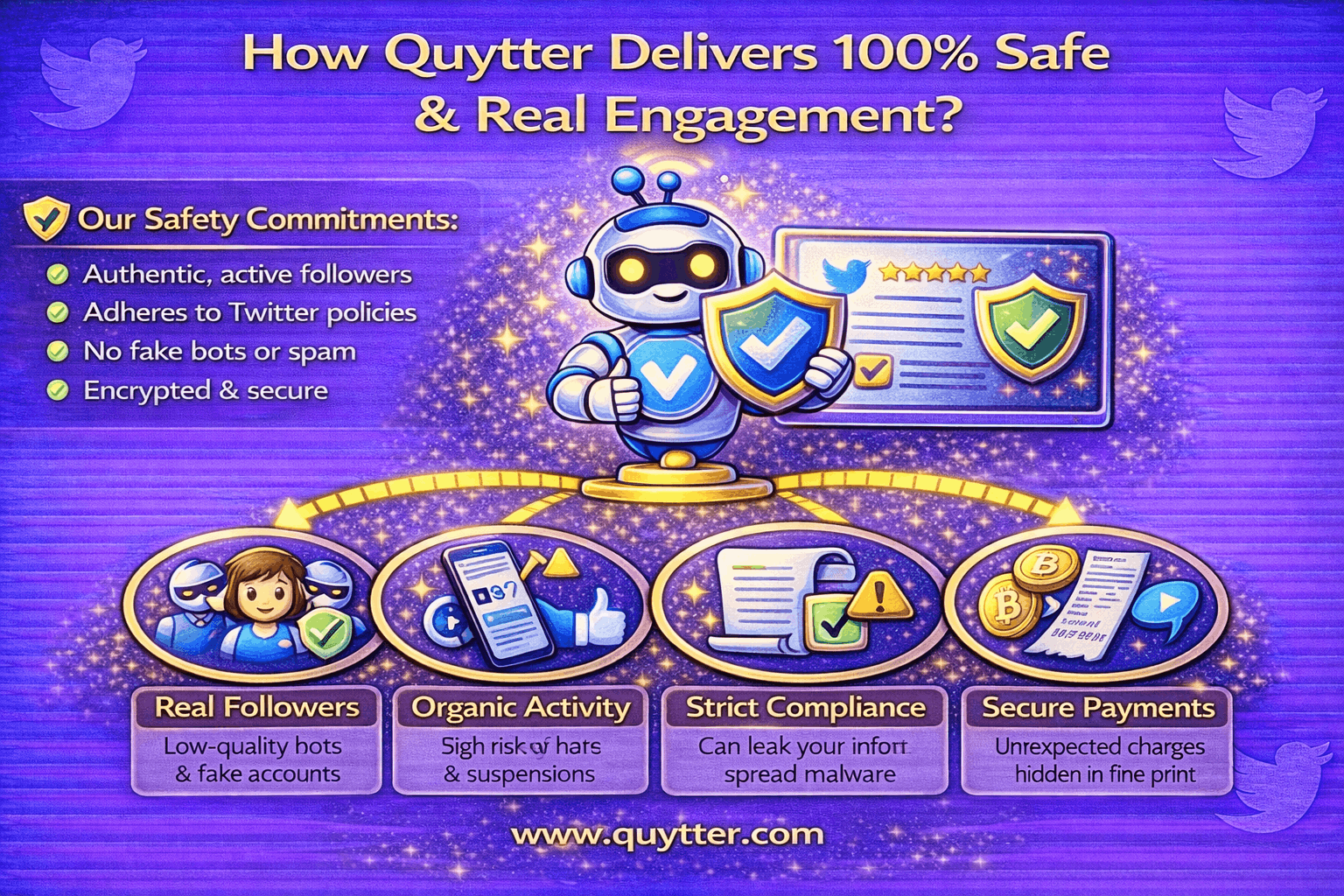
Engagement is sourced from real, active accounts, delivered gradually, and always anchored to historical performance. Growth is introduced sequentially, not stacked, so Twitter can adapt without triggering suppression.
Paid engagement is never treated as a replacement for real activity. It is designed to blend into existing organic signals and reinforce interaction patterns that already exist.
The goal is not speed. The goal is alignment.
This approach avoids the common traps that cause reach drops and allows accounts to grow while maintaining distribution stability.
Final Thoughts
Safe Twitter engagement is not about tricks or secrecy. It is about alignment with how the platform evaluates behavior.
If engagement looks real, arrives naturally, and fits the account’s history, Twitter has no reason to suppress it. That principle applies whether engagement is organic or paid.
The problem is that most services ignore this reality. They sell speed, volume, and instant results, without accounting for timing, context, or behavioral baselines. That is why so many accounts lose reach after using growth services, even when nothing looks obviously fake.
At Quytter, engagement is approached as signal management, not number inflation. Delivery is controlled, paced, and designed to fit the account’s existing behavior, not overwrite it.
If you are going to use paid engagement, the question is not whether it works. The question is whether it respects how Twitter measures trust.
That is exactly the problem Quytter was built to solve.