
When people talk about safety in Twitter growth, they usually focus on algorithms, detection, and engagement behavior. In this article, we break down a risk most users overlook, how payment methods affect privacy, exposure, and long term account safety when buying Twitter services.
Buying growth does not only interact with Twitter’s systems. It also creates off platform data trails through payment processors, billing records, and third party intermediaries. Understanding how those trails are created, and how crypto payments reduce them, is a critical part of protecting your account and your operation.
The Hidden Risks of Traditional Payment Methods
Most Twitter growth services rely on credit cards or centralized payment platforms because they are easy to integrate and familiar to users. Convenience, however, comes with exposure.
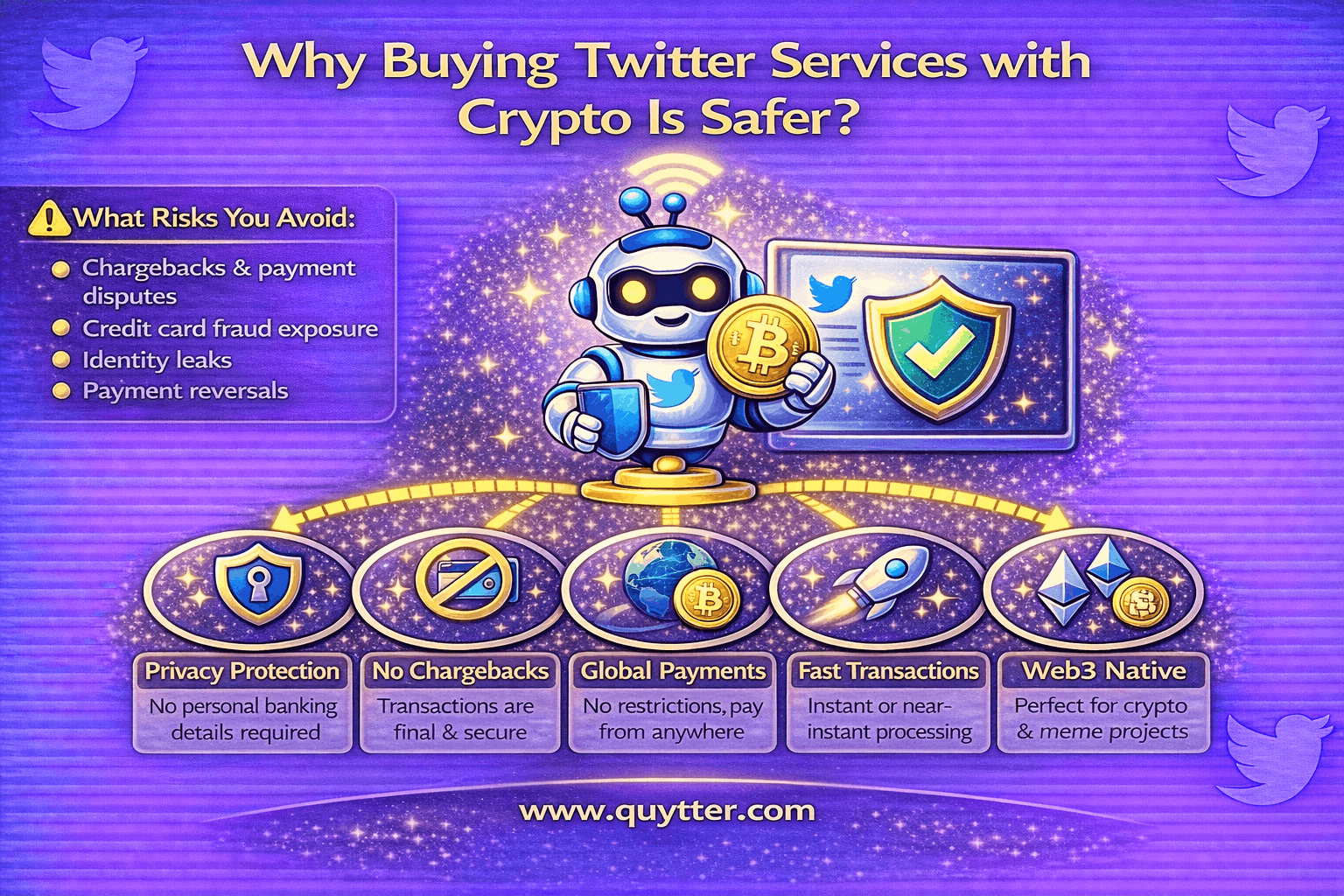
Traditional payment methods tie purchases directly to personal or corporate identities. Billing names, addresses, and transaction histories are stored by processors for long periods of time, often far beyond the lifespan of the service itself. Users rarely have control over how long this data is retained or how it may be shared.
Disputes, chargebacks, or sudden policy changes can introduce additional risk. Funds can be frozen without warning, and access to services can be interrupted even when no wrongdoing has occurred. These issues happen at the payment layer, outside the control of both the user and the service provider.
Even when a growth service operates legitimately, third party processors add another layer of visibility that cannot be removed later. For users who care about privacy and operational security, this creates unnecessary risk that has nothing to do with engagement quality or algorithm safety.
Why Privacy Matters When Buying Twitter Services?
Using Twitter growth services is not always something users want permanently attached to their identity. Brands may be testing positioning. Founders may be validating early traction. Creators may be experimenting with visibility before committing to a public narrative. Agencies often act on behalf of multiple clients.
In all of these cases, privacy is about control, not concealment.
Every additional system that stores transaction data becomes a potential point of friction later. Payment processors retain records for compliance and risk management, not for user benefit. That data can be reviewed, restricted, or acted upon independently of how responsibly a service is used.
Reducing unnecessary exposure limits how many external systems can associate a Twitter account with a specific transaction. This lowers the risk of payment related issues spilling into growth operations, such as frozen funds, delayed access, or sudden service interruptions.
Privacy is not about hiding engagement from Twitter. Twitter evaluates behavior on platform, not payment methods. Privacy is about minimizing off platform risk and maintaining operational flexibility.
How Crypto Payments Reduce Exposure?
Crypto payments remove several layers of linkage that exist in traditional payment flows.
There is no billing identity tied to the transaction. No card number stored by a processor. No centralized platform holding recurring payment data linked to personal information. Payments are direct and verifiable on chain, but not automatically connected to real world identity.
This significantly reduces the long term data footprint associated with purchasing Twitter services. Once a transaction is complete, there is no chargeback risk, no account review by a processor, and no dependency on shifting third party policies.
For users who value operational security, this creates a cleaner boundary between growth activity and personal or corporate identity. It does not change how engagement is evaluated by Twitter, but it reduces exposure everywhere else.
That separation is why crypto payments are considered safer, not because they bypass rules, but because they eliminate unnecessary external risk.
What Crypto Does and Does Not Protect?
Crypto does not make engagement algorithm safe.
Twitter does not evaluate how a service is paid for. It evaluates how engagement behaves on the platform. Timing, context, account history, and interaction quality determine whether growth is trusted. Using crypto does not bypass detection, suppress warnings, or protect unsafe growth tactics.
Payment methods and engagement behavior exist on separate layers.
What crypto protects is the user.
By removing billing identities and centralized processors, crypto reduces exposure outside the platform. It limits how much personal or corporate data is stored, how long it is retained, and who controls it. It also eliminates chargeback risk and dependency on third party payment policies.
This creates a cleaner operational boundary. Growth activity remains evaluated by Twitter as usual, but external risks are reduced.
Payment safety and engagement safety are not interchangeable. Crypto strengthens one layer, not the other. When combined with responsible growth practices, it contributes to a more controlled and resilient setup.
Who Benefits Most from Crypto Payments?
Crypto payments are especially valuable for users who operate at scale or under higher scrutiny, where small risks compound quickly.
Agencies managing multiple Twitter accounts benefit because payment privacy simplifies operations. There is no need to attach dozens of campaigns to a single billing profile or payment processor that can become a single point of failure. Each transaction stays isolated, reducing dependency on centralized systems.
Brands testing campaigns also benefit. Early growth experiments often change direction. Privacy allows teams to iterate without permanently tying exploratory activity to a corporate billing trail that may be reviewed later by finance, compliance, or third parties.
Creators rebuilding reach after past issues value crypto for a different reason. When trust is being reestablished, minimizing external friction matters. Fewer payment related interruptions means fewer variables interfering with recovery.
More broadly, anyone who prefers fewer data dependencies benefits from payment privacy. The larger and more visible the operation becomes, the more important it is to control risk at every layer, not just on platform behavior.
Where Quytter Fits In?
At Quytter, growth is treated as a system, not a single tactic. Payment methods are considered part of that system, which is why Quytter supports crypto payments alongside traditional options.
All Quytter services are built around algorithm safe engagement. Delivery is paced, human like, and aligned with each account’s historical behavior. Engagement comes from real, active accounts and is designed to reinforce organic activity, not distort it. Payment privacy simply completes that picture.
Allowing crypto payments gives users more control over how their growth activity is handled off platform. There is no unnecessary billing data, no reliance on centralized processors, and no added exposure that has nothing to do with performance.
Crypto is not a shortcut and not a workaround. It does not change how Twitter evaluates engagement. It changes how much external risk the user accepts while using growth services.
By combining controlled engagement delivery with optional crypto payments, Quytter gives users a cleaner, safer way to grow. Less friction, fewer dependencies, and fewer things that can go wrong outside the platform itself.
Final Thoughts
Safe Twitter growth is not defined by a single decision. It is the result of multiple layers working together.
Engagement behavior matters. Timing matters. Account history matters. Payment methods matter too.
Buying Twitter services with crypto does not change how Twitter evaluates engagement. It changes how much of your identity is exposed outside the platform.
For users who take growth seriously, that distinction matters.