
Paid engagement on X is one of the most misunderstood topics in social media growth. Many users assume that buying likes or retweets is automatically against the platform’s Terms of Service. Others believe it is a harmless shortcut with no real consequences.
The truth sits in between.
In this article, we break down what X actually prohibits, how enforcement works in practice, why many accounts get suppressed after using paid engagement, and where the real risk comes from. Most importantly, we explain the difference between paid engagement and engagement manipulation, because that distinction is where most users get it wrong.
What X’s Terms of Service Actually Prohibit ?
X does not prohibit payment by itself. There is no rule stating that paying for engagement is automatically a violation of the Terms of Service.
What the platform explicitly targets is behavior that manipulates or misrepresents platform signals. This includes spam, coordinated inauthentic activity, and artificial amplification that creates a false impression of interest or popularity.
The distinction matters. X does not evaluate intent or financial transactions. It evaluates outcomes. If engagement alters how content appears to perform in ways that do not reflect genuine user behavior, it becomes problematic regardless of how it was sourced.
A like is not judged by whether it was paid for. It is judged by how it behaves in context. Who delivered it, when it arrived, how it aligns with past behavior, and whether it leads to meaningful follow up actions. When those factors align with normal platform expectations, engagement remains acceptable. When they do not, enforcement is triggered through reduced trust and distribution.
Understanding this difference is critical. The rules are written to protect signal integrity, not to police payment methods.
Paid Engagement vs Engagement Manipulation
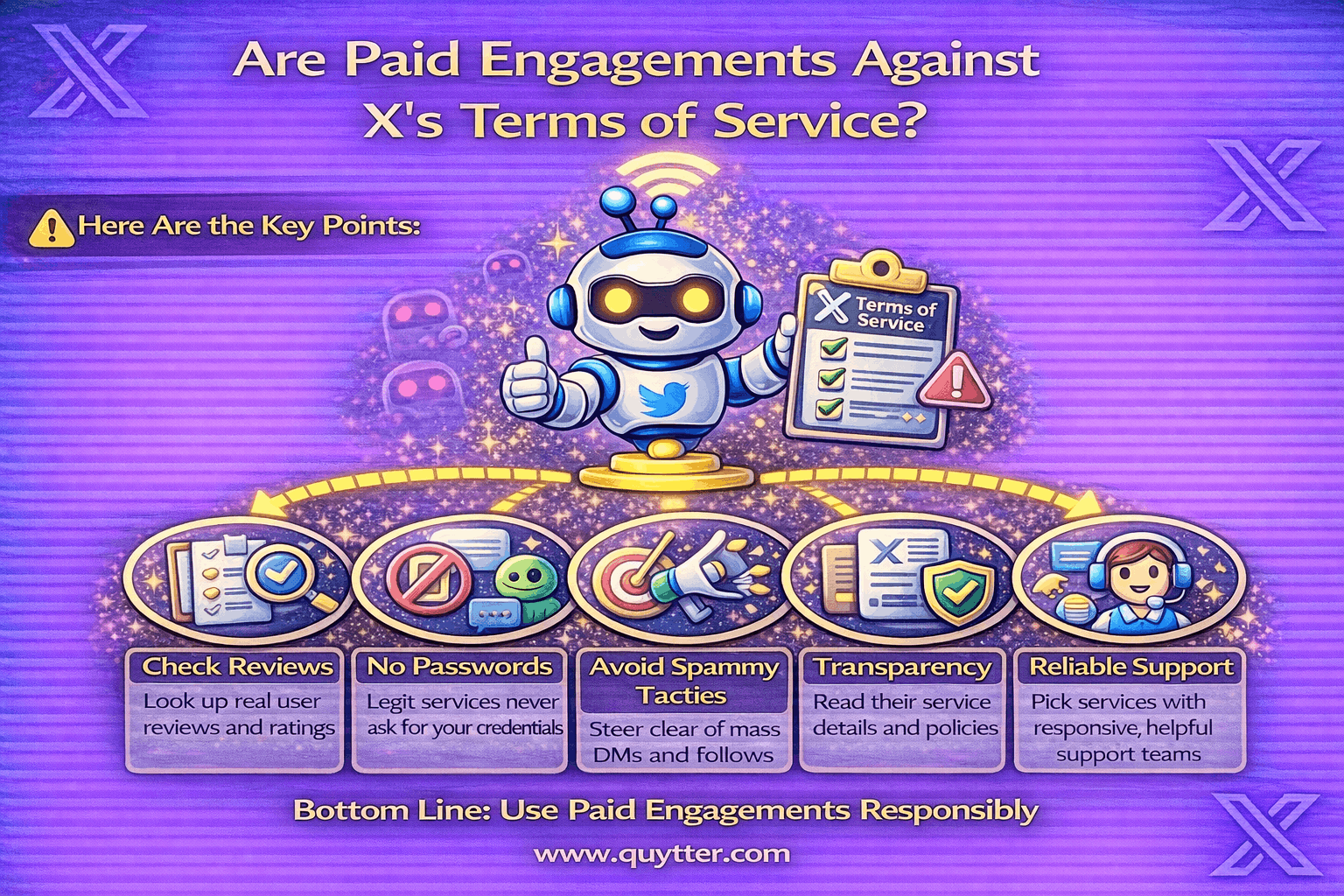
Paid engagement and engagement manipulation are often treated as the same thing, but they are fundamentally different.
Manipulation is not defined by payment. It is defined by behavior. It occurs when engagement arrives in ways that break the platform’s expectations around timing, scale, and context. Common signals include synchronized bursts of activity, repeated engagement from the same account clusters, shallow interaction with no follow up, or sudden performance that exceeds historical behavior without any organic explanation.
Paid engagement only becomes risky when it starts to resemble these patterns.
If engagement behaves the way real users behave, arrives gradually, varies naturally, and stays within an account’s historical range, it does not inherently violate platform rules. The system evaluates what it sees, not how it was purchased.
When engagement violates those expectations, payment becomes irrelevant. The behavior alone is enough to trigger trust reduction and enforcement. On X, it is not the act of paying that creates risk. It is the way engagement behaves after it arrives.
How X Enforces These Rules in Practice ?
Enforcement on X is driven primarily by algorithms, not manual review. The platform does not need to issue warnings or take visible action in most cases because distribution itself is the enforcement mechanism.
When engagement patterns raise concerns, the account is not usually flagged with a notification. Tweets continue to publish normally. From the outside, nothing appears broken. What changes is how far content is allowed to travel.
The system gradually adjusts exposure based on confidence. Tweets reach fewer non followers. Appearances in recommendations decline. Even followers may see content less consistently as the algorithm becomes more conservative with distribution.
This is not punishment in a traditional sense. It is recalibration.
X is constantly evaluating whether engagement represents genuine interest. When confidence drops, exposure is reduced to protect the overall user experience. When confidence stabilizes, distribution can recover without any formal action.
Because this process is quiet and incremental, many users mistake it for a shadowban or assume a rule was explicitly broken. In reality, the system is responding to patterns, not issuing penalties.
Why Many Users Believe Paid Engagement Is “Banned”?
This belief is shaped more by experience than by policy.
Many users experiment with low cost growth services that promise instant likes or followers. At first, engagement increases and reach may improve briefly. Shortly after, distribution collapses. From the user’s perspective, it feels as if the platform detected paid engagement and applied a penalty.
What actually happened is behavioral. The service delivered engagement in ways that violated platform expectations. Timing was unnatural. The same accounts appeared repeatedly. Interaction lacked depth and follow up. These patterns reduced confidence, triggering a recalibration of reach.
Because these unsafe services are widespread, users experience the same outcome repeatedly. Over time, they generalize the result and conclude that all paid engagement must be against the Terms of Service.
The misunderstanding comes from conflating poor execution with prohibited behavior. The platform is not reacting to payment. It is reacting to patterns that do not resemble real user interaction.
The Gray Area Most Accounts Operate In
Most accounts operate within a tolerance zone rather than a strict pass or fail boundary.
X allows for natural variation in how accounts grow and perform. Engagement is not expected to be perfectly organic or perfectly consistent at all times. What matters is whether patterns remain believable when viewed over time.
When engagement reinforces existing activity, stays within historical limits, and reflects independent user behavior, it generally remains within acceptable bounds. The system sees continuity rather than disruption.
Problems arise when engagement begins to replace organic behavior or forces growth beyond what the account has demonstrated before. At that point, patterns shift abruptly, pushing the account outside its tolerance range.
This is why enforcement feels ambiguous. The rules are applied through pattern recognition, not fixed thresholds.
What Makes Paid Engagement Risky Under X’s Rules?
Risk does not come from the act of paying. It comes from how engagement behaves after it arrives.
Engagement becomes risky when it exceeds the account’s historical pace, relies on repeated or overlapping account networks, lacks meaningful follow up interaction, or is combined with multiple growth tactics at the same time.
These behaviors resemble coordination rather than interest. Once the system recognizes that pattern, engagement weight is reduced and distribution contracts naturally.
The platform does not need to label the activity as manipulation. Reduced confidence alone is enough to limit reach.
How to Evaluate Whether a Service Is ToS Risky?
Before using any growth service, the most important question is not how many likes it promises to deliver. It is whether the provider understands how X evaluates behavior.
A safe service can explain how engagement delivery fits your account’s past performance. Speed should make sense relative to what the account has already demonstrated. Engagement should not stop at surface metrics. Replies, profile visits, and secondary interactions matter because they reflect real interest rather than mechanical activity.
Account behavior is equally important. Engaged users should not behave identically. Variation in timing, interaction style, and activity patterns is a sign of independence. When engagement looks uniform or arrives instantly, it creates signals that are easy to discount.
Providers that focus only on numbers, speed, or guarantees are optimizing for marketing appeal, not platform safety. If a service cannot articulate how its engagement aligns with platform behavior models, it is not built for long term use.
How Quytter Approaches Paid Engagement Within Platform Constraints?
Quytter was built around behavioral alignment, not loopholes or technical tricks.
Paid engagement is treated as signal engineering rather than amplification. Every interaction is designed to fit within what an account has already proven capable of earning. Delivery speed is constrained by historical performance. Pacing is intentionally uneven. There are pauses, delays, and variations that mirror how real users discover and respond to content over time.
Engagement sources are not optimized for volume. They are optimized for independence. Accounts behave differently, interact selectively, and do not engage with every post in the same way. Replies vary in tone and length. Some interactions lead to follow up actions, others do not. This diversity is critical because X evaluates engagement in context, not in isolation.
The objective is not to bypass X’s rules or exploit blind spots. It is to operate entirely within how the platform already measures trust. Engagement is meant to reinforce existing signals, not overwrite them. When organic activity exists, paid engagement supports it. When it does not, growth is intentionally limited rather than forced.
Quytter does not sell outcomes, rankings, or guarantees. It manages exposure risk by ensuring engagement behaves in a way the platform already recognizes as believable.
The result is not dramatic spikes or viral screenshots. It is stability. Over time, distribution remains intact, confidence does not erode, and growth compounds instead of collapsing.
Quytter focuses on keeping accounts inside the tolerance zone where growth is allowed to continue.
Final Thoughts
Paid engagement is not automatically against X’s Terms of Service. Unsafe behavior is. The platform does not judge intent or payment methods. It evaluates patterns. When engagement behaves like real human interaction, distribution continues. When it does not, reach contracts quietly.
Understanding this difference is the key to using growth services without damaging long term visibility. Growth on X is not about finding shortcuts. It is about aligning with how trust is measured.