
On Twitter, engagement is often treated as a scoreboard. More likes, more retweets, more visibility. But this mindset misses how the platform actually works. Twitter does not reward raw numbers. It rewards behavior that looks believable over time.
In this article, we break down the real difference between authentic and fake Twitter engagement, not from a moral angle, but from a structural one. The goal is to understand how Twitter evaluates interaction, why some engagement gets amplified while other engagement quietly loses impact, and how to avoid growth tactics that damage reach instead of improving it.
What Twitter Actually Considers “Real” Engagement?
Twitter does not classify engagement as real or fake in a binary way. There is no simple label attached to a like or a retweet. What Twitter evaluates are signals, and more importantly, how those signals behave in context.
Every interaction is measured relative to expectations. Who engaged matters, but so does when they engaged, how often they engage with similar content, and what usually happens after they interact. Twitter looks at patterns over time, not isolated events.
An engagement event gains weight when it fits naturally into an existing behavioral model. If a tweet receives likes or replies from accounts that have prior activity, normal posting behavior, and realistic interaction habits, and those interactions arrive at a pace that matches the account’s history, the system treats it as credible interest. Distribution continues because nothing looks out of place.
Follow up behavior reinforces this trust. Profile visits, replies, dwell time, and secondary interactions tell the algorithm that the engagement represents attention, not just surface activity. These signals are difficult to fake consistently, which is why they carry more weight than raw counts.
Problems arise when engagement breaks expectations. Interactions that arrive too fast, from accounts that rarely engage, or from networks that behave identically create statistical inconsistencies. The system does not need to decide that the engagement is fake. It simply learns that it is unreliable.
When that happens, engagement weight drops. Distribution contracts. Reach declines. Not as punishment, but as adjustment.
From Twitter’s perspective, real engagement is not about authenticity in a moral sense. It is about behavioral credibility. If engagement behaves like real human interaction within the account’s normal range, it is treated as real. If it does not, its influence fades regardless of how it was generated.
Behavioral Differences Between Real and Fake Engagement
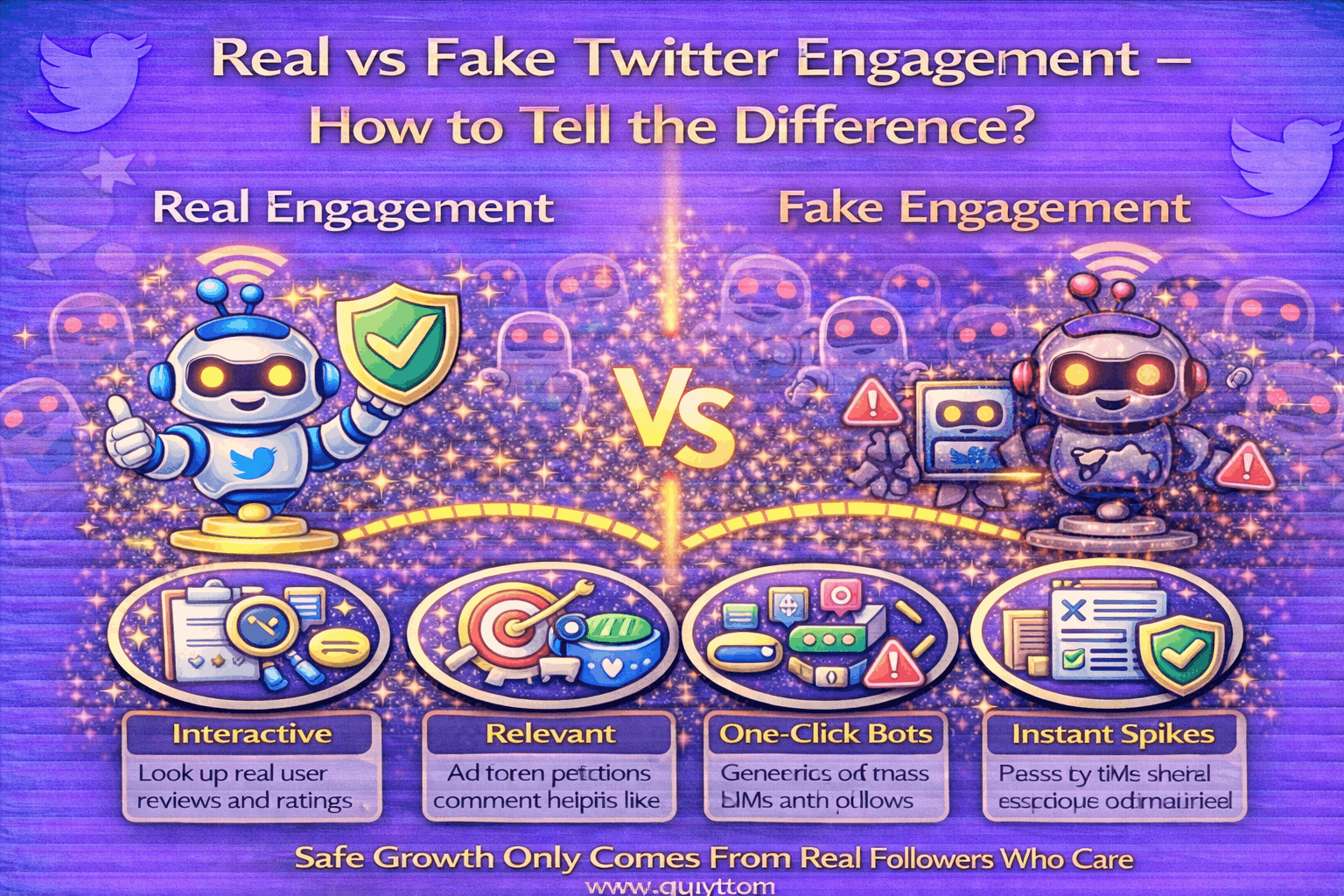
The clearest distinction between real and fake engagement is not account labels or profile appearances. It is behavior over time.
Real engagement is uneven by nature. Some tweets gain attention slowly. Some peak late. Some underperform entirely. This irregularity is not a flaw, it is a signature of human behavior. People discover content at different times, respond for different reasons, and engage inconsistently.
Fake engagement, by contrast, often arrives in clusters. Interactions appear too fast, too smooth, or too synchronized. Engagement curves look clean instead of messy. From an algorithmic perspective, this is not how attention behaves in the real world.
Depth is another key difference. Real engagement rarely stops at a single action. Likes may lead to profile clicks. Replies trigger follow up replies. Quote tweets bring new viewers into the thread. These secondary actions are varied and unpredictable.
Fake engagement tends to concentrate on surface metrics. Likes and retweets appear, but replies are thin, profile visits are minimal, and conversation rarely develops. This creates an imbalance the algorithm quickly notices.
Independence matters most. Real users act independently of each other. They have different posting schedules, different interests, and different ways of interacting. Fake networks, even when composed of real accounts, behave similarly across many tweets. They engage at similar times, in similar ways, and with similar intensity.
Over time, the algorithm does not need to decide that engagement is fake. It learns that it is repetitive and therefore unreliable. Once that pattern is recognized, the weight of those interactions drops, and with it, the reach of the account relying on them.
Real engagement is messy, inconsistent, and varied. Fake engagement is orderly, predictable, and uniform. Twitter trusts the former because it reflects how humans actually behave.
Engagement Ratios That Reveal Problems
Twitter pays far more attention to ratios than raw numbers. Engagement is always evaluated in relation to audience size, past performance, and interaction depth.
When follower count grows but replies stay flat, confidence drops. When likes increase without profile visits or follow up actions, engagement weight drops. When retweets appear without conversation, credibility weakens. These imbalances signal that attention is shallow or misaligned.
A tweet with modest likes but active replies and discussion often travels further than a tweet with inflated numbers and no depth. This is because interaction density matters more than visibility metrics. Twitter is trying to predict interest, not count reactions.
Fake engagement usually fails at this layer. It increases the denominator without strengthening the underlying interaction quality. Over time, that weakens every future tweet before it is even evaluated.
Why Fake Engagement Often Looks Effective at First ?
Many users report that cheap engagement seems to work once. This is not a coincidence, and it is not purely psychological.
At the beginning, the algorithm has limited information about new engagement sources. When a tweet receives an unexpected burst of interaction, Twitter does not immediately assume manipulation. It treats the activity as a test case and observes how the system responds.
Early engagement can temporarily improve distribution because the platform is still evaluating signal reliability. The algorithm measures timing, account overlap, follow up actions, and how the engagement compares to normal behavior. During this phase, visibility may increase before any adjustment happens.
Problems emerge when the pattern repeats. Engagement begins to arrive from the same sources. Timing becomes familiar. Depth remains shallow. The system no longer sees novelty, it sees repetition.
At that point, learning accelerates. Engagement weight is reduced, not because the activity is labeled fake, but because it is statistically predictable and therefore unreliable. As weighting drops, reach declines naturally.
Many users react by purchasing more engagement to compensate for falling performance. This reinforces the same pattern and shortens the learning cycle. Each repetition strengthens the algorithm’s confidence that the signals should be discounted.
What feels like a sudden drop in reach is rarely sudden at all. It is the delayed result of accumulated data and gradual trust recalibration.
How Real Engagement Behaves Over Time ?
Real engagement rarely looks impressive when viewed in isolation. There are no clean spikes or perfectly shaped curves. Instead, performance unfolds unevenly and often unpredictably.
Some tweets gain attention slowly and peak hours later. Others perform well early, then stall. Interaction arrives in waves rather than bursts. Replies vary in tone, length, and intent because they come from people engaging for different reasons at different moments. New users discover the account gradually, not all at once.
This inconsistency is not noise. It is structure.
From the algorithm’s perspective, variation signals independence. Real users do not act in coordination. They scroll at different times, respond with different levels of interest, and engage inconsistently across content. That messiness is difficult to fake and therefore highly trusted.
Over time, this behavior trains the algorithm to expect genuine attention. Distribution becomes more stable. Reach stops collapsing after each post. Content begins to travel further without requiring artificial input.
Sustainable growth often looks boring in screenshots. There are no dramatic before and after comparisons. But over weeks and months, the compounding effect becomes clear. Engagement carries more weight, visibility increases naturally, and performance becomes resilient instead of fragile.
Real engagement builds trust slowly, but once established, it supports growth without constant intervention.
Why Most Growth Services Fail This Test ?
Most growth services are designed around delivery, not behavior. Their primary objective is to move numbers quickly and visibly, because speed and volume are easy to market.
Account history is treated as irrelevant. Engagement is delivered using standardized pacing that ignores how the account has performed in the past. Interaction diversity is limited, and multiple tactics are often stacked at the same time, likes, retweets, followers, traffic, creating overlapping and contradictory signals.
Even when real accounts are used, behavior begins to resemble infrastructure rather than independent users. Engagement arrives in familiar patterns, from similar sources, with similar timing. Over time, this predictability reduces signal credibility.
The outcome is rarely dramatic. There is usually no ban, no warning, and no clear line crossed. Instead, confidence erodes quietly. The algorithm lowers exposure because it no longer trusts that engagement reflects genuine interest.
Real engagement earns trust by behaving inconsistently, developing depth, and compounding over time. Fake engagement loses trust by trying to appear impressive too quickly, before credibility has been established.
How Quytter Approaches Safe Twitter Engagement ?
Quytter was built around behavioral alignment, not number inflation. From the beginning, the problem was never how to generate engagement, but how to deliver it without breaking the behavioral expectations Twitter already has for an account.
Engagement is treated as signal engineering, not a volume product. Every account has a historical rhythm, how fast interactions usually arrive, how much engagement it can absorb without triggering recalibration, and what kind of users typically interact with it. Quytter’s delivery is designed to stay inside those boundaries, not push past them.
Pacing is intentionally gradual and irregular. Engagement does not arrive in clean waves or fixed intervals because real users do not behave that way. Activity unfolds over time, with natural variation, pauses, and uneven response. This makes engagement blend into existing behavior instead of standing out as an external input.
Account quality matters just as much as timing. Interaction comes from real, active accounts with diverse posting histories and behavioral patterns. This diversity is critical. When engagement comes from overlapping or repetitive networks, its weight drops quickly. When it comes from varied users who behave differently across the platform, it carries far more trust.
The objective is simple. Make engagement behave in a way Twitter already understands and is willing to distribute. Not by hiding it, but by aligning it with how real interaction looks at scale.
Instead of forcing spikes, Quytter supports what is already happening on the account. Engagement amplifies existing activity, replies, conversations, and content momentum. It does not attempt to replace organic behavior or compensate for inactivity. This balance reduces risk, preserves long term reach, and allows growth to compound naturally instead of collapsing under algorithmic pressure.
How to Evaluate Engagement Before Using Any Service?
Before using any growth service, the most important step is not comparing prices or package sizes. It is evaluating whether the engagement behavior makes sense for your account.
Start with delivery speed. Engagement that arrives faster than anything your account has ever experienced should raise immediate questions. Growth does not jump orders of magnitude without context. If delivery ignores your past performance, it is designed for volume, not alignment.
Next, look at interaction depth. Likes alone are weak signals. Real engagement usually produces follow ups, replies, profile visits, and some level of conversation. Services that only deliver surface metrics often fail because they create imbalance between visible engagement and actual interest.
Account behavior matters as much as metrics. Engaged accounts should not behave identically. They should have different posting styles, different activity rhythms, and different interaction patterns across the platform. When engagement comes from accounts that look and act the same, the system learns quickly.
Finally, consider whether the service can explain its logic. A safe service understands how Twitter evaluates behavior and can articulate how its delivery fits within that model. If a provider can only promise numbers, speed, or guarantees, it is not built for long term use.
If engagement cannot be explained in terms of timing, context, and behavioral credibility, it is not designed to last.
Conclusion
Real versus fake Twitter engagement is not about authenticity labels. It is about behavioral fit.
Engagement that looks human, arrives naturally, and aligns with account history continues to carry weight. Engagement that breaks timing, scale, or context expectations gets discounted.
Twitter does not need to punish what it does not trust. It simply stops amplifying it.
Understanding this difference is the foundation of safe growth. And it is the principle behind how Quytter approaches Twitter engagement, quietly, carefully, and with long term visibility in mind.