
Growing on Twitter (X) has become more competitive—and more dangerous—than ever.
Every day, new tools promise instant followers, automated engagement, and viral growth. But behind many of these promises are suspicious growth tools and bots that can quietly damage your account, destroy trust, and even get you suspended.
In this article, we’ll break down how to identify risky Twitter growth tools, how Twitter detects fake activity, and how to grow safely using real, compliant methods.
Why Suspicious Growth Tools Are a Serious Risk on Twitter/X?
Twitter’s enforcement systems are no longer basic. The platform actively analyzes behavior patterns, engagement quality, and account networks to detect artificial growth.
Using unsafe tools can lead to:
- Shadowbans that reduce reach without notification
- Sudden drops in impressions and engagement
- Removal of fake followers
- Permanent account suspension
The biggest misconception is believing that fast growth equals success. On Twitter, unnatural growth is often the fastest way to lose credibility.
What Are Suspicious Growth Tools and Bots?
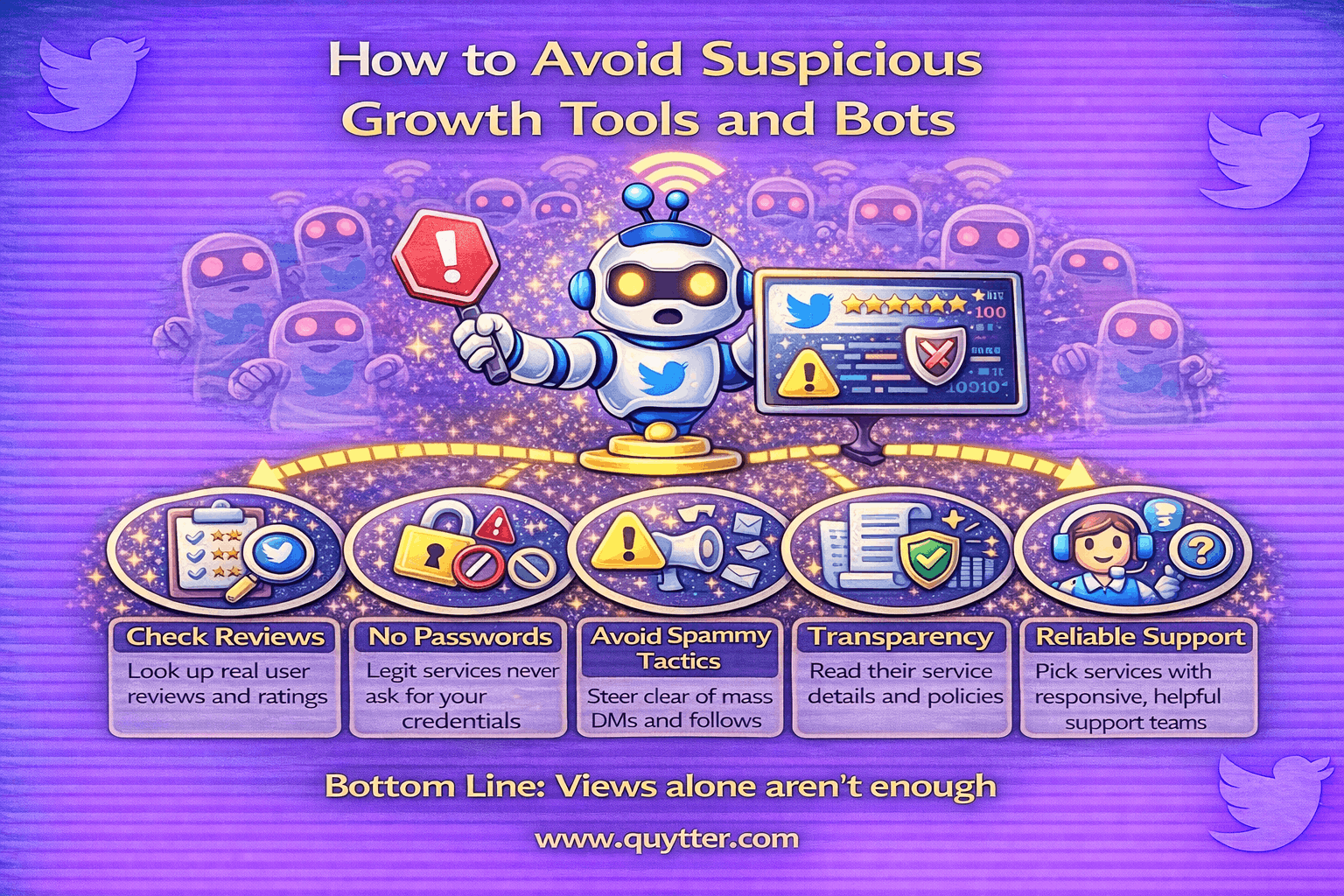
Suspicious growth tools are not always obvious. Most of them don’t present themselves as bots or spam software. Instead, they position themselves as “growth automation” or “smart engagement tools,” designed to sound safe and compliant.
In reality, these tools rely on artificial activity to simulate popularity. They automate following and unfollowing behavior, generate likes, retweets, or replies at scale, and often distribute engagement through networks of low-quality or inactive accounts. The activity may look acceptable on the surface, but it is driven by systems optimized for volume, not intent.
This is where the risk begins. Twitter is not evaluating whether engagement happened. It is evaluating why it happened. Automated systems cannot replicate genuine interest, context, or variation in behavior over time. As a result, even “safe automation” creates patterns that diverge from how real users interact with content.
Many of these tools operate in legal or technical gray areas. They follow the letter of Twitter’s rules while violating the spirit, or exploit temporary enforcement gaps until those gaps are closed. When that happens, accounts using the tools are left exposed.
The defining characteristic of suspicious growth tools is not speed, but priority. When a service focuses on delivering large volumes of activity instead of meaningful engagement, it is not supporting growth—it is manufacturing signals. And manufactured signals are exactly what Twitter’s detection systems are designed to discount.
If a tool treats engagement as a number to increase rather than a behavior to support, it is a risk to your account.
Common Red Flags of Twitter Growth Bots
Not all Twitter growth tools are obvious scams. Many look professional on the surface, but their behavior leaves clear signals. Knowing these red flags helps you avoid tools that can quietly harm your account.
Unrealistic Growth Promises
One of the clearest warning signs is unrealistic growth guarantees.
Be cautious of tools or services that promise:
- Thousands of followers overnight
- Guaranteed engagement numbers (likes, retweets, replies)
- Instant viral reach regardless of content quality
Twitter growth does not work on fixed guarantees. Visibility depends on multiple variables, including:
- Content relevance and quality
- Posting consistency
- Audience targeting
- Current algorithm conditions
Any service claiming predictable, instant results is likely using automation, fake accounts, or spam networks. These methods may inflate numbers temporarily, but they almost always trigger long-term penalties such as reduced reach or account flagging.
If growth sounds too easy, it usually involves manipulation.
Unnatural Activity Patterns
Twitter monitors behavior patterns more than individual actions. Bot-driven tools often create activity that looks statistically impossible for a real human account.
Common unnatural patterns include:
- Mass following and unfollowing cycles within short timeframes
- Repetitive engagement actions performed at identical intervals
- Identical replies posted across multiple tweets or accounts
- Engagement happening continuously, 24/7, without normal breaks
- Sudden spikes in activity without any change in content quality or posting frequency
These patterns indicate automation, not genuine interest. Even if engagement looks high on the surface, Twitter’s systems can detect timing, repetition, and behavioral symmetry.
Once flagged, accounts may experience shadowbans or long-term reach suppression.
Low-Quality Followers and Engagement
Follower quality is one of the most overlooked—but most damaging—signals.
Suspicious growth services often deliver:
- Accounts with no profile photos or banners
- Usernames filled with random numbers or generic words
- Little or no tweet history
- No bio or copied bios across multiple accounts
Low-quality engagement usually:
- Does not lead to profile visits
- Does not generate replies or conversations
- Does not increase clicks or conversions
While these followers inflate vanity metrics, they provide no real audience value. Worse, large numbers of low-quality accounts interacting with your profile can reduce trust in the algorithm and weaken future reach.
Real growth improves visibility and engagement quality—not just numbers.
Why These Red Flags Matter Long-Term
Using growth tools with these warning signs doesn’t just risk short-term penalties. Over time, they can:
- Train the algorithm to show your content to the wrong audience
- Reduce organic reach even after stopping the tool
- Damage credibility with real users
- Make future growth significantly harder
Twitter rewards consistency and authenticity. Bot-driven signals work against both.
How Twitter Detects Bot and Fake Growth Activity?
Twitter does not detect fake growth by looking at individual actions in isolation. The platform evaluates behavioral consistency over time and assigns trust levels to accounts based on how closely they resemble real human usage.
This is why many unsafe growth tools don’t cause immediate bans. Instead, they slowly push an account outside of normal behavioral boundaries until the algorithm no longer trusts it.
The detection system is designed to answer one core question: Does this account behave like a real person, interacting out of genuine interest?
Behavior Patterns Matter More Than Volume
A common misconception is that Twitter flags accounts for doing “too much.” In reality, it flags accounts for doing things too predictably.
Real users behave inconsistently. They scroll, stop, engage randomly, and disappear for hours or days. Automation tools, even when throttled, tend to produce:
- Regular timing between actions
- Repeated engagement sequences
- Similar daily activity curves
Over time, these patterns form a behavioral fingerprint. Twitter doesn’t need to identify a bot directly—it only needs to recognize behavior that no longer matches human attention.
This is why slowing down a bot rarely makes it safe. Consistency itself becomes the signal.
Engagement Quality Reveals Whether Growth Is Real
Twitter also evaluates what happens after engagement.
When real people like or retweet content, their behavior usually continues. They visit the profile, read more tweets, reply, or follow later. These downstream actions help confirm that engagement came from genuine interest.
Bot-driven engagement often stops at the surface level. Likes and retweets happen in volume, but:
- Profile visits remain low
- Replies are minimal or generic
- Follows do not come naturally
When engagement volume increases without meaningful interaction depth, Twitter interprets this as artificial amplification. The result is not punishment at first—but reduced distribution.
This is why fake growth often coincides with declining reach.
Coordinated Networks Are Easier to Detect Than Individual Bots
Modern fake growth rarely relies on a single automated account. It relies on networks of coordinated accounts designed to look independent.
Twitter analyzes how groups of accounts move together:
- Engaging with the same tweets at similar times
- Repeating the same interaction patterns
- Appearing and disappearing in bursts
Even if each account appears legitimate on its own, coordinated behavior across many accounts is statistically improbable in organic growth.
Twitter does not need proof of automation. Coordination alone is enough to reduce trust.
Why Penalties Usually Come Later ?
The most dangerous phase of bot-based growth is the period where “nothing seems wrong.”
Twitter often allows suspicious behavior to continue while collecting data. Once an account crosses internal risk thresholds, enforcement happens quietly:
- Distribution is reduced
- Search visibility drops
- Engagement stalls
By the time users notice the damage, the algorithm has already adjusted its expectations downward.
What This Means for Sustainable Twitter Growth ?
Safe growth doesn’t attempt to manipulate visibility. It aligns with how real users behave:
- Engagement driven by interest, not automation
- Growth that follows content performance
- Interactions that create real signals beyond vanity metrics
If growth feels boring and slow, it’s usually healthy.
How to Choose Safe Twitter Growth Solutions?
Choosing a safe Twitter growth solution is less about features and more about understanding how growth is actually produced. Most risky services don’t fail because they are “too aggressive,” but because they hide the mechanics behind vague promises and marketing language.
Transparency is the first and most important signal. A legitimate service should be able to explain, in plain terms, how engagement is generated, whether actions are handled manually or assisted by tools, and how the process aligns with Twitter/X rules. Safe providers don’t rely on mystery. They rely on clarity. When a service avoids specifics, refuses to explain delivery methods, or hides behind phrases like “proprietary system,” it usually means there is something they don’t want you to examine too closely.
Beyond transparency, the quality of accounts involved matters more than the numbers delivered. Safe growth is built on real users, not just “real-looking” profiles. Real accounts have history, varied behavior, and interact with content in context. Their engagement makes sense. They don’t just like everything they see or retweet without relevance. When engagement feels disconnected from your content or audience, it signals artificial amplification rather than genuine interest.
This distinction is critical because Twitter evaluates engagement depth, not surface activity. Growth that looks human tends to behave human. Growth that is manufactured tends to stop at the action itself, without follow-through. Over time, Twitter learns which signals to trust and which to discount.
The final factor is pacing. Healthy Twitter growth is rarely explosive. It follows the rhythm of content performance, audience discovery, and gradual visibility increases. When growth jumps dramatically without any corresponding change in content quality or posting strategy, it raises suspicion. Sustainable growth compounds slowly. It aligns with your niche, your messaging, and your existing audience signals.
In practice, safe Twitter growth often feels underwhelming at first. It doesn’t promise overnight success. It doesn’t guarantee numbers. But it protects your account’s long-term trust and ensures that every increase in engagement actually supports future reach.
Slow growth is not a weakness. On Twitter, it is a sign that growth is real.
Better Alternatives to Bot-Based Twitter Growth
Instead of bots, focus on strategies Twitter rewards:
- Posting high-quality, niche-specific content
- Getting real likes, retweets, and replies from active users
- Building social proof around key tweets
- Increasing visibility without manipulating behavior
Authentic engagement compounds. Fake engagement collapses.
How Quytter Supports Safe Twitter Growth?
Quytter was built around a simple observation: most Twitter growth tools fail not because Twitter is “too strict,” but because those tools try to manufacture activity instead of supporting real interaction.
Rather than relying on bots or mass automation, Quytter focuses on facilitating engagement from real Twitter users. This distinction matters because Twitter evaluates not just the presence of engagement, but the behavior behind it. When real users interact with content, their actions carry context, variation, and intent—signals that automated systems struggle to replicate at scale.
Engagement delivered through Quytter is designed to resemble how visibility actually spreads on Twitter. Likes, retweets, replies, views, and followers come from active accounts that behave independently, not from coordinated bot networks. This creates engagement patterns that look natural because they are driven by real user activity, not scripts.
Another key difference is pacing. Quytter does not attempt to force growth in unnatural bursts. Delivery is gradual, allowing engagement to accumulate in a way that aligns with normal content performance. This protects account trust while still improving reach and discoverability.
Most importantly, Quytter treats social proof as a supporting signal, not a shortcut. The goal is not to inflate numbers, but to help quality content gain the visibility it deserves. When engagement reinforces real interest instead of replacing it, growth becomes sustainable.
Quytter exists to support that kind of growth—growth that strengthens credibility, improves long-term reach, and keeps accounts safe.
Final Checklist: Avoiding Suspicious Twitter Growth Tools
Before using any Twitter growth service, the most important thing to understand is that safety is rarely advertised directly. It has to be inferred from how a service operates, communicates, and delivers results.
A safe service should make it clear that the accounts involved are real and active, not recycled profiles or engagement farms. Engagement should make sense in the context of your content and niche, not appear disconnected or generic. Growth should feel gradual and proportional to your activity, not sudden or explosive without explanation. Most importantly, account safety should be treated as a priority, not a trade-off for speed.
When these answers are vague, hidden behind marketing language, or dismissed as “not something you need to worry about,” that uncertainty itself is a warning sign. Twitter growth tools that are genuinely safe have nothing to hide, because their methods don’t rely on manipulation.
If you’re looking for safe, real Twitter growth without bots, Quytter is designed for exactly that.