
Buying Twitter views is a common growth tactic, but many users are unsure whether it affects account health. Some worry it could lead to shadowbans or reduced reach, while others believe views are completely harmless because they don’t require direct engagement.
This article explains how Twitter views actually work inside the algorithm, when buying views can harm account health, and when it can safely support visibility without putting your account at risk.
What Twitter Views Actually Represent in the Algorithm ?
Twitter views are a passive signal. A view simply means that a tweet was loaded on someone’s screen. It does not require intent, interaction, or approval from the user.
Because of this, views are treated very differently from likes, replies, or follows. Twitter does not use views to decide whether an account is trustworthy. Instead, it uses views to evaluate distribution and exposure.
When a tweet receives views, Twitter observes what happens next. Do people scroll past it immediately, or do they pause? Do they click the profile, reply, like, or retweet? Views are the first step in a testing process, not the final judgment.
This distinction is important. Views alone do not create trust. They create opportunity.
Why Buying Twitter Views Feels Risky to Many Users ?
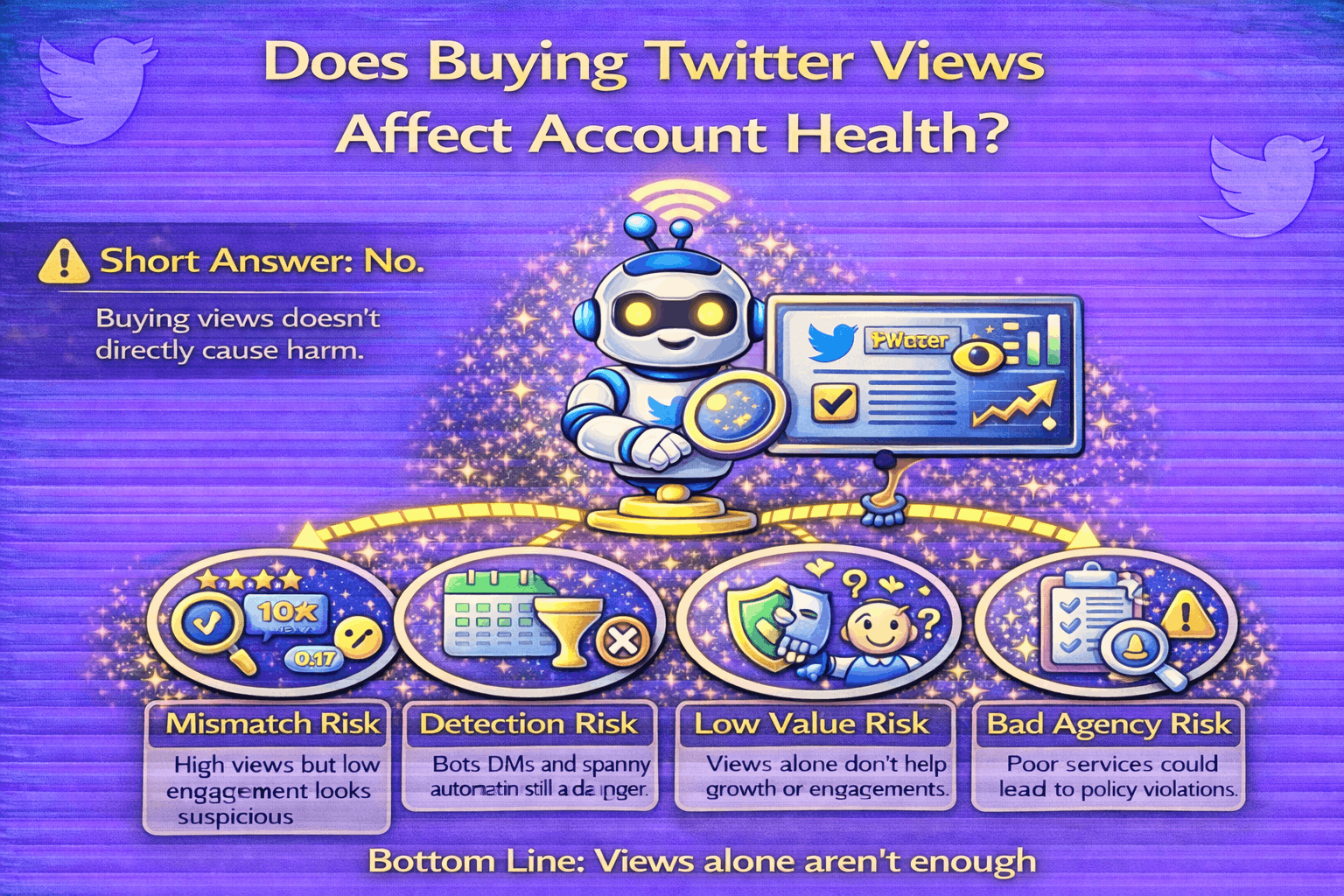
The fear surrounding buying Twitter views is largely inherited from years of abuse by bot-driven growth tools. Many users have witnessed accounts lose reach, get flagged, or collapse entirely after using fake followers, automated engagement, or aggressive growth software. Over time, these experiences blurred the distinction between different types of paid activity.
As a result, all paid growth methods are often grouped into the same category of “dangerous,” even though Twitter treats different signals very differently. Views, likes, replies, and follows do not carry equal weight in the algorithm, but they are frequently discussed as if they do.
Another major source of confusion comes from misunderstanding what views represent. Engagement actions such as likes or replies simulate intent and opinion, which makes them sensitive and high-risk when manipulated. Views do not simulate intent. They represent exposure. Twitter expects views to fluctuate naturally as content enters or exits distribution, making them fundamentally less risky when handled correctly.
When users report negative outcomes after buying Twitter views, the root cause is rarely the presence of views themselves. In most cases, the issue lies in how those views were delivered. Sudden, concentrated bursts from coordinated bot networks create abnormal distribution patterns that conflict with normal content exposure. These patterns can indirectly affect account health by reducing trust in future distribution.
The fear is understandable given the platform’s history, but it is often aimed at the wrong signal. The real risk is not visibility—it is artificial behavior that breaks how Twitter expects visibility to occur.
When Buying Twitter Views Can Harm Account Health ?
Buying Twitter views becomes risky when views are treated as a shortcut rather than a supporting signal. The issue is not the presence of paid visibility, but the behavioral distortion it creates.
The most common problem is source quality. Views delivered through bot networks or recycled accounts generate exposure patterns that don’t resemble real content discovery. These views arrive in concentrated bursts, disappear quickly, and rarely lead to any downstream behavior. Twitter may not apply an immediate penalty, but it learns that increased exposure does not result in meaningful interaction, which reduces confidence in future distribution.
Unnatural pacing introduces another layer of risk. When a tweet suddenly receives a large volume of views without any corresponding change in content quality, posting frequency, or audience size, the distribution curve looks artificial. Twitter does not need to classify the activity as fake to respond. It simply stops expanding reach once the testing phase produces weak behavioral feedback.
The most damaging scenario occurs when views are used to replace engagement rather than support it. Views that never lead to profile visits, replies, or follows signal that users are seeing the content but choosing to ignore it. Over time, this trains the algorithm to treat the account’s output as low-value, which suppresses reach instead of improving it.
In short, buying Twitter views becomes harmful when visibility distorts natural behavior instead of reinforcing it.
When Buying Twitter Views Does NOT Damage Your Account ?
Buying Twitter views does not damage account health when views behave like real exposure.
When views come from real users, are delivered gradually, and align with normal activity patterns, they function as an amplification layer rather than a manipulation tactic. They increase the number of people who see the tweet, allowing Twitter’s testing process to work as intended.
If content resonates, real engagement follows. If it doesn’t, distribution naturally slows down. In both cases, the algorithm receives honest feedback.
The key difference is intent. Views should help content reach more screens, not force engagement signals that don’t exist. When views are treated as visibility support, they remain neutral or beneficial rather than risky.
How Twitter Uses Views to Adjust Distribution ?
Twitter distributes content in stages. A tweet is first shown to a small sample of users. Views help determine whether that sample is large enough to justify broader exposure.
If a tweet receives views but no interaction, Twitter assumes the content lacks relevance and limits distribution. If views lead to engagement, the algorithm expands reach incrementally.
This is why views alone never guarantee success. They only unlock the possibility of it.
Buying views can support this process by helping tweets overcome early visibility barriers, especially for new or low-reach accounts. But the algorithm still relies on real engagement to continue distribution. Views open the door. Engagement decides whether Twitter walks through it.
Buying Twitter Views as Social Proof, Not a Shortcut
The healthiest way to approach buying Twitter views is to treat them as social proof at the very top of the funnel, not as a replacement for growth fundamentals. Views increase perceived activity around a tweet, which can reduce the hesitation users feel when deciding whether content is worth their attention.
At the algorithmic level, views help content pass the initial visibility threshold. They signal that a tweet is being seen, not that it is being trusted or endorsed. Trust is earned later, through relevance, consistency, and real interaction over time. Views alone cannot create credibility, and Twitter does not treat them as such.
Problems arise when views are used as a shortcut rather than support. When users rely on views to compensate for weak content, poor timing, or lack of audience alignment, the exposure fails to convert into meaningful engagement. This creates a disconnect between visibility and behavior, which limits long-term distribution.
When used correctly, views reinforce what already works. They help good content overcome early friction, reach more real users, and give organic engagement a chance to occur naturally. Visibility without substance fades quickly, but visibility that amplifies substance compounds over time.
How Quytter Delivers Twitter Views Safely ?
Quytter treats Twitter views as a visibility mechanism, not a shortcut to growth. The purpose of views is to help content enter Twitter’s distribution system naturally, not to override it or simulate engagement that does not exist.
Views delivered through Quytter come from real user activity rather than automated scripts or coordinated bot networks. This matters because real users behave inconsistently. They scroll at different speeds, appear at different times, and interact with content independently. These variations create exposure patterns that align with how Twitter expects views to occur during organic discovery.
Delivery is intentionally paced to mirror natural exposure. Instead of forcing large bursts in a short time window, views are distributed gradually, allowing Twitter’s algorithm to evaluate signals without disruption. This prevents the abnormal distribution curves that often trigger reach suppression or long-term trust reduction.
Equally important is what Quytter does not do. Views are not bundled with artificial likes, replies, or follows. There is no attempt to simulate intent or push downstream actions. Twitter is allowed to observe genuine behavior after exposure, whether that leads to engagement or not. This keeps engagement signals honest and preserves account health.
The goal is not to make content look popular at any cost. It is to remove visibility friction so real users can discover the content on their own. Quytter helps tweets be seen, not pretends they are liked, which is why views function as support rather than manipulation.
See more: The Complete Safety Guide for Growing on X (Twitter)
Final Answer
Buying Twitter views does not inherently harm account health.
What harms accounts is artificial behavior, poor-quality sources, and attempts to replace real engagement with manufactured signals. Views are passive. They become risky only when they are delivered in ways that distort normal distribution patterns.
When views are real, gradual, and aligned with content performance, they act as a visibility tool, not a liability. Account health is not determined by numbers alone, but by consistency, behavior, and the quality of signals over time.
Used correctly, buying Twitter views is not a shortcut. It is a support mechanism. And like any support mechanism, it only works when the foundation underneath is solid.