
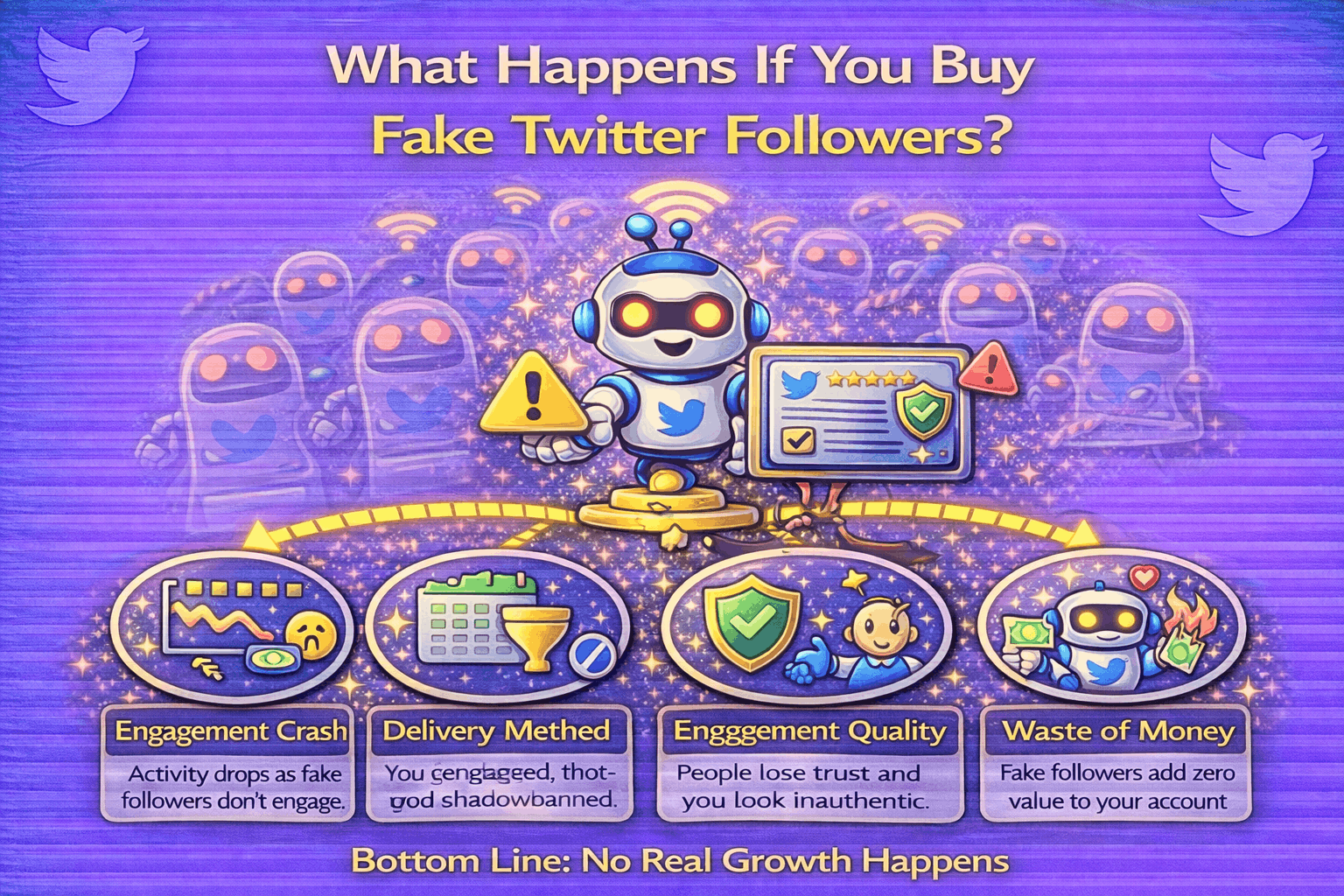
Buying fake Twitter followers does not improve account performance and often leads to long-term reach and engagement decline. While follower counts increase, Twitter’s algorithm receives weaker behavioral signals that negatively affect distribution.
This article explains what fake Twitter followers actually are, how Twitter uses follower data to evaluate content, and why buying fake followers quietly damages account health over time.
What Fake Twitter Followers Actually Are ?
Fake Twitter followers are not simply “fake accounts” in the obvious sense. They include automated bots, inactive or abandoned profiles, and recycled accounts designed to look real but operate without genuine attention or intent. What unifies them is not their appearance, but their inability to behave like real audience members.
Within Twitter’s system, followers are not a credibility badge. They define the first layer of content distribution. When a tweet is published, Twitter uses a subset of followers as an initial testing group to measure attention, relevance, and interaction. These early signals shape how the algorithm evaluates the tweet’s potential beyond the follower base.
Fake or inactive followers fail at this role. They do not pause to read, scroll past without context, and rarely produce downstream actions such as profile visits or replies. As a result, the algorithm receives weak or absent feedback at the most critical evaluation stage. Over time, this teaches Twitter that the account’s content struggles to earn attention even from its own audience, which reduces future distribution regardless of content quality.
Why People Still Buy Fake Followers ?
Despite the risks, many users still buy fake followers for reasons that are more psychological than strategic. Early-stage accounts often struggle with visibility, and low follower counts create a sense of invisibility. When content receives little attention, inflated numbers can feel like a way to validate effort or signal legitimacy.
Another factor is the persistent myth that follower count directly unlocks reach. Some users believe that once an account passes a certain size, Twitter will automatically distribute content more widely. This assumption comes from older social media models and surface-level observations, not from how Twitter’s current system actually evaluates content.
There is also social pressure at play. On Twitter, follower count acts as a visible status marker. When accounts with similar content show higher numbers, it creates the impression that numbers themselves drive success. This pushes users to optimize for appearance rather than performance.
The desire to grow is not the problem. The mistake is treating follower count as an outcome shortcut instead of understanding it as a responsibility. An audience is not just something you have—it is something your content must repeatedly satisfy.
How Fake Followers Affect Twitter’s Algorithm ?
Twitter’s algorithm is built around behavioral feedback loops. When a tweet is published, the platform does not distribute it widely by default. Instead, it tests the content by showing it to a limited group of users who are most likely to respond, starting with a segment of the account’s followers.
Those early responses act as training data. If users pause, engage, click through, or interact meaningfully, the algorithm increases confidence and expands distribution. If users ignore the tweet, scroll past quickly, or produce no downstream behavior, the algorithm reduces further testing.
Fake followers significantly increase the likelihood of negative feedback at this critical stage. Because they do not behave like real users, they generate silence rather than signals. This teaches the algorithm that the content fails to earn attention, even from an audience that explicitly chose to follow the account.
Over time, this pattern compounds. The algorithm begins to associate the account’s output with low engagement probability, which reduces how often tweets are tested and how far they travel. This suppression is not a punishment—it is an efficiency decision based on repeated behavioral outcomes.
Fake followers don’t simply fail to help growth. They actively distort the learning process that determines future visibility, making each new tweet harder to distribute than the last.
Engagement Collapse and Reach Suppression
One of the most visible consequences of fake followers is engagement collapse. As follower count rises, engagement rate drops. Tweets receive fewer likes, replies, and clicks relative to audience size.
This mismatch is a strong negative signal. Twitter doesn’t reward accounts with large audiences that consistently fail to generate interaction. Instead, it narrows reach to reduce wasted exposure.
Many users notice this pattern only after it’s established: more followers, fewer impressions, and declining reach despite consistent posting. The damage compounds because every tweet reinforces the same weak feedback loop.
Can Buying Fake Followers Trigger Penalties?
Buying fake followers does not usually result in immediate bans or suspensions. Twitter rarely takes direct enforcement action based solely on inflated follower counts, which is why many users assume the practice is relatively safe.
However, the lack of an instant penalty is misleading. Twitter regularly runs cleanup processes that remove fake, inactive, or policy-violating accounts at scale. When these removals occur, follower counts can drop sharply, often exposing the artificial nature of previous growth.
More importantly, the real impact happens long before any visible cleanup. While fake followers are present, the algorithm continuously learns from their lack of interaction. Tweets are tested, ignored, and deprioritized repeatedly. By the time followers are removed, the account’s distribution confidence may already be weakened due to sustained engagement failure.
In this sense, fake followers rarely cause a dramatic punishment. Instead, they create a slow erosion of reach and visibility that persists even after the numbers disappear. The absence of a visible penalty does not mean the absence of lasting consequences.
Why Fake Followers Are Worse Than Fake Views ?
Not all paid growth signals carry the same level of risk, and fake followers are among the most damaging. The reason is persistence. Followers are a structural signal that influences every tweet an account publishes.
Once fake followers are added, they become part of the initial testing audience for all future content. Each tweet is evaluated against a follower base that cannot respond meaningfully, reinforcing negative feedback loops over time.
Views operate differently. They are transient signals tied to individual tweets. While fake views can distort short-term exposure, they do not permanently alter the audience layer used for distribution testing. A single poor visibility tactic can fade, but a corrupted follower base continues to affect performance indefinitely.
This difference explains why some accounts can recover from short-term visibility manipulation, yet struggle for months after inflating follower counts. Fake followers don’t just inflate numbers—they reshape the environment in which every piece of content is judged.
Can You Recover After Buying Fake Followers?
Recovery is possible, but it is rarely quick. The damage caused by fake followers is behavioral, not cosmetic, which means recovery depends on retraining how Twitter interprets your account’s signals over time.
The first step is reducing the influence of fake followers, either by removing them directly or diluting them through consistent organic audience growth. This matters because every new tweet is still evaluated against the existing follower base. As long as fake or inactive accounts dominate that base, negative feedback continues.
The second step is rebuilding engagement consistency. Twitter needs repeated evidence that real users pause, interact, and respond meaningfully to your content. This does not happen in a single viral tweet. It happens through steady posting, improved relevance, and predictable interaction patterns that allow the algorithm to relearn audience behavior.
Recovery takes time because algorithmic trust is cumulative. Past engagement failures do not reset instantly, and there is no manual switch that restores reach. Accounts that address fake followers early recover faster because fewer negative signals need to be overwritten.
Better Alternatives to Fake Twitter Followers
Sustainable Twitter growth prioritizes visibility and engagement quality over inflated follower counts. Instead of manipulating who appears to follow an account, healthier strategies focus on ensuring content is seen by real users who can respond naturally.
Real views, contextual interactions, and gradual audience building align with how Twitter evaluates performance. These signals support discovery without distorting feedback loops or corrupting distribution data.
Rather than asking how to increase follower count quickly, a more effective question is how to increase meaningful exposure and interaction. When content consistently earns attention from real users, follower growth becomes a natural outcome instead of an artificial goal.
Shortcuts that inflate numbers without behavior may look impressive, but they rarely lead to durable reach, engagement, or long-term account health.
How Quytter Helps You Grow on Twitter Without Fake Followers?
Quytter provides Twitter growth services built around real user activity, not fake or recycled followers. Instead of inflating follower counts with inactive accounts, Quytter focuses on improving visibility and engagement from real Twitter users who can interact naturally with your content.
Quytter offers services such as Twitter views, likes, retweets, replies, and followers delivered from active accounts. All actions are paced gradually to match natural exposure patterns, allowing Twitter’s algorithm to process behavioral signals without disruption.
Unlike fake follower services, Quytter does not rely on bots or forced automation. Engagement is not designed to simulate intent or manipulate downstream behavior. This approach helps accounts increase reach, build credibility, and grow an authentic follower base while protecting long-term account health.
Quytter’s goal is simple: support real discovery and real engagement, so follower growth happens as a result of genuine interest rather than artificial inflation.
Final Answer
Buying fake Twitter followers doesn’t usually destroy an account instantly. What it does is far more subtle and damaging. It teaches Twitter that your content fails to engage even its own audience.
Over time, this weakens reach, suppresses distribution, and makes growth harder instead of easier. High numbers may look impressive, but they come at the cost of visibility and trust.
On Twitter, audience quality shapes performance. Fake followers inflate appearance, but they quietly drain reach where it matters most.
See more: The Complete Safety Guide for Growing on X (Twitter)