
Cheap Twitter growth panels are everywhere, and most people encounter them before they understand how Twitter actually evaluates engagement. In this article, Quytter breaks down why these panels look attractive at first, and why they quietly damage reach over time.
The issue is not cost. The issue is behavior.
Twitter does not reward engagement in isolation. It evaluates patterns, timing, and historical consistency. Engagement must look human, unfold naturally, and fit what the account has shown before. Cheap growth panels fail because they ignore these fundamentals.
This article explains how those failures happen, what Twitter reacts to, and why sustainable growth requires a different approach.
How Cheap Twitter Growth Panels Actually Work ?
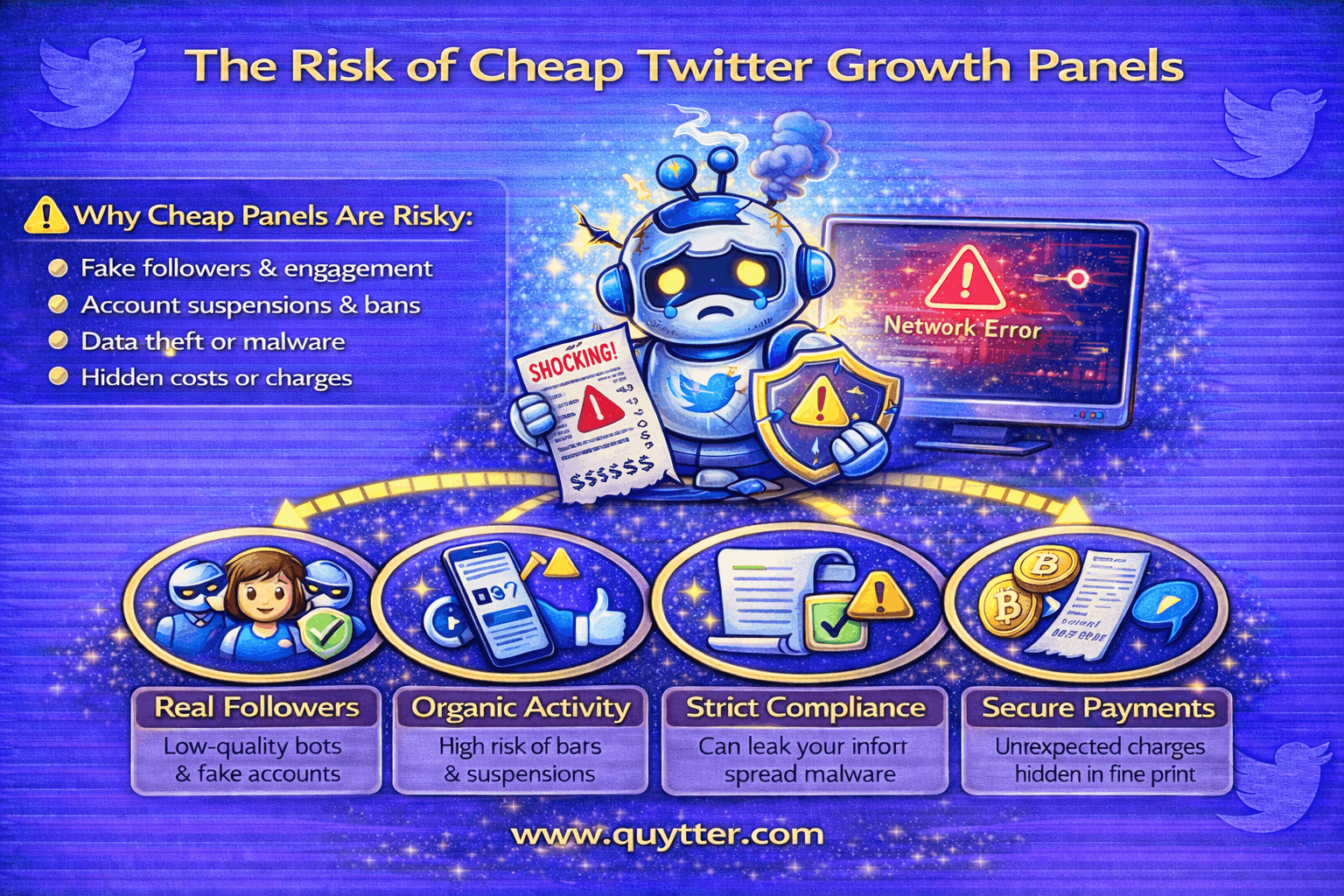
Most cheap Twitter growth panels operate on scale. To keep costs low, they reuse the same pools of accounts across thousands of orders. Delivery is automated, timing is compressed, and variation is minimal.
From the outside, the engagement looks real. The accounts exist. The likes register. The numbers move.
From the algorithm’s perspective, the behavior is repetitive.
The same accounts appear across unrelated tweets. Engagement arrives in similar windows. Interaction lacks depth beyond surface actions. Over time, Twitter learns that engagement from these sources does not predict real user interest.
The system does not need to identify the provider. It only needs to recognize that the signals are unreliable.
Why Twitter Discounts Cheap Panel Engagement ?
Twitter does not treat all engagement equally. It assigns weight to engagement based on where it comes from and how it behaves over time.
When engagement repeatedly comes from overlapping networks with similar behavior, its value declines. These accounts may be real in the technical sense, but their activity looks more like infrastructure than individual users. They appear across unrelated tweets, interact in predictable ways, and show limited variation in behavior.
From the algorithm’s perspective, this type of engagement stops being informative. It does not help Twitter predict whether real users will find the content interesting, so its signal value drops.
This discounting happens gradually. Twitter does not need to remove the accounts or take visible action. It simply learns that engagement from those sources does not correlate with meaningful downstream interaction, such as replies, profile visits, or sustained attention.
As the same networks are reused across campaigns, the effect compounds. Each new order reinforces the pattern, and the engagement weight collapses further. Accounts relying on these panels notice that newer engagement produces weaker results than earlier purchases.
This is why cheap engagement often works once. Early on, the algorithm has not yet classified the pattern. Once it does, the same inputs stop moving reach and eventually contribute to reduced distribution.
Twitter is not punishing the account. It is optimizing the feed by ignoring signals it no longer trusts.
Timing and Pattern Risks
Timing is where most cheap panels do the most damage.
Human interaction is uneven. Some tweets pick up slowly. Others spike briefly and fade. There are pauses, delays, and randomness.
Cheap panels prioritize speed. Engagement arrives too quickly or too evenly. Even when delivered gradually, the pattern often lacks natural variation.
Twitter does not need to prove manipulation. Statistical anomalies are enough to trigger trust recalibration.
When timing breaks expectation, reach contracts.
Account History Mismatch
Every Twitter account has a behavioral baseline. The algorithm knows what normal performance looks like for that account.
Cheap panels ignore this. The same delivery logic is applied to small accounts, new accounts, and established profiles. Engagement often exceeds anything the account has ever demonstrated organically.
When this happens, Twitter does not interpret it as growth. It interprets it as noise.
Instant delivery packages are especially dangerous because they overwrite history instead of respecting it.
What Usually Happens After Using Cheap Panels?
Most users expect visible penalties. Suspensions. Warnings. Something obvious.
What actually happens is much quieter.
Tweets still publish normally. The account appears active. Nothing looks broken on the surface. But distribution changes. Tweets reach fewer non followers. Appear less often in recommendations. Even followers may stop seeing content consistently.
This leads many users to assume they are shadowbanned.
In reality, this is trust recalibration.
Twitter constantly adjusts how much exposure an account receives based on how confident it is that engagement represents real interest. When cheap panel engagement weakens that confidence, distribution is reduced automatically. No manual action is required.
The platform is not punishing the account. It is protecting the feed from signals it no longer fully trusts.
Why Cheap Engagement Often Works Once?
The first order often feels successful.
Numbers move. Likes appear. Reach improves briefly. This creates the impression that the panel works.
This happens because the algorithm has not yet learned the pattern.
Early engagement is treated as neutral input. Twitter observes how it behaves and whether it leads to meaningful downstream interaction. When the same engagement sources appear again and again, and fail to produce deeper signals, the system adapts.
Engagement weight drops. The same number of likes produces less reach. The same tactic stops moving distribution.
Users respond by buying more engagement or switching providers. This repeats the pattern and accelerates the decline.
The algorithm learns faster than the panels can adjust. Once classified, the signal rarely regains its original weight.
The Hidden Cost of Cheap Twitter Growth
The real cost of cheap growth is not financial. It is time.
Recovery from trust damage is slow. During recalibration, organic tweets underperform. New content struggles to break out. Even good posts feel ignored.
This phase can last weeks or months, depending on how aggressively cheap engagement was used. During that time, growth feels stalled, even if posting quality improves.
The money saved on cheap engagement is often paid back through lost momentum and slower recovery later.
A Safer Approach to Twitter Growth
Safer growth respects behavior.
Engagement should arrive gradually, vary naturally, and stay aligned with the account’s historical performance. It should come from diverse, active accounts and blend into existing activity rather than replacing it.
Growth works best when it reinforces signals Twitter already trusts. When engagement supports real conversations, consistent posting, and normal interaction patterns, the algorithm has no reason to pull back.
On Twitter, sustainable reach does not come from forcing numbers. It comes from maintaining credibility while visibility increases.
That difference determines whether growth compounds or quietly collapses.
Where Quytter Fits In ?
Quytter was built to solve the exact problems that cheap growth panels create.
Most services focus on outcomes. More likes. More followers. Faster delivery. Those numbers look good on the surface, but they ignore how Twitter actually evaluates behavior. When growth overrides timing, context, and account history, trust erodes, even if the engagement comes from real accounts.
At Quytter, growth is treated as signal management.
Every engagement campaign is designed around the account’s historical performance. Delivery stays within believable ranges, timing varies naturally, and engagement comes from real, active accounts that behave like normal users, not infrastructure.
The goal is not to manufacture spikes. It is to support visibility without rewriting the account’s behavioral profile.
This approach is especially important for users who have already experienced reach drops, inconsistent impressions, or trust recalibration after using low quality services. Growth only works when the algorithm can still recognize the account as predictable and credible.
If you are considering paid engagement, the real question is not whether the engagement is real. It is whether it behaves in a way Twitter is willing to trust over time.
That is why Quytter focuses on controlled Twitter engagement, gradual Twitter likes, and algorithm safe Twitter growth, rather than volume based packages.
This is the gap Quytter exists to fill, growth that supports long term reach instead of trading it away for short term numbers.
Final Thoughts
Cheap Twitter growth panels are not risky because they are inexpensive. They are risky because they ignore how Twitter evaluates behavior.
Growth that looks human, arrives naturally, and fits account history does not need to hide. Growth that breaks those rules forces the algorithm to pull back.
On Twitter, sustainable reach is built on trust. Anything that undermines that trust costs far more than it saves.