
Buying Twitter engagement from the wrong provider can feel like irreversible damage. One day your tweets are performing normally, the next your likes disappear, impressions collapse, and engagement feels artificially capped.
If this sounds familiar, you’re not alone — and more importantly, your account is not doomed.
At Quytter, we regularly help users recover after buying fake or low-quality Twitter engagement. This guide explains what actually happens when you buy from a scam service, how Twitter responds, and how to rebuild reach and trust step by step.
First, Understand What Went Wrong
Scam Twitter engagement services prioritize speed and volume over sustainability. They typically rely on automation, disposable bot networks, or recycled low-quality accounts. While this engagement may look impressive at first, it often collapses just as quickly.
The real issue isn’t the disappearing likes — it’s the signals left behind.
When engagement arrives in unnatural bursts, comes from untrusted accounts, or lacks any real follow-through behavior, Twitter’s algorithm begins to classify it as engagement manipulation. This doesn’t always trigger an immediate penalty, but it does affect how much the platform trusts your account moving forward.
Recovery starts with understanding that the algorithm responds to patterns over time, not single actions.
Tips: The Complete Safety Guide for Growing on X (Twitter)
What Happens to Your Account After Buying Fake Engagement ?
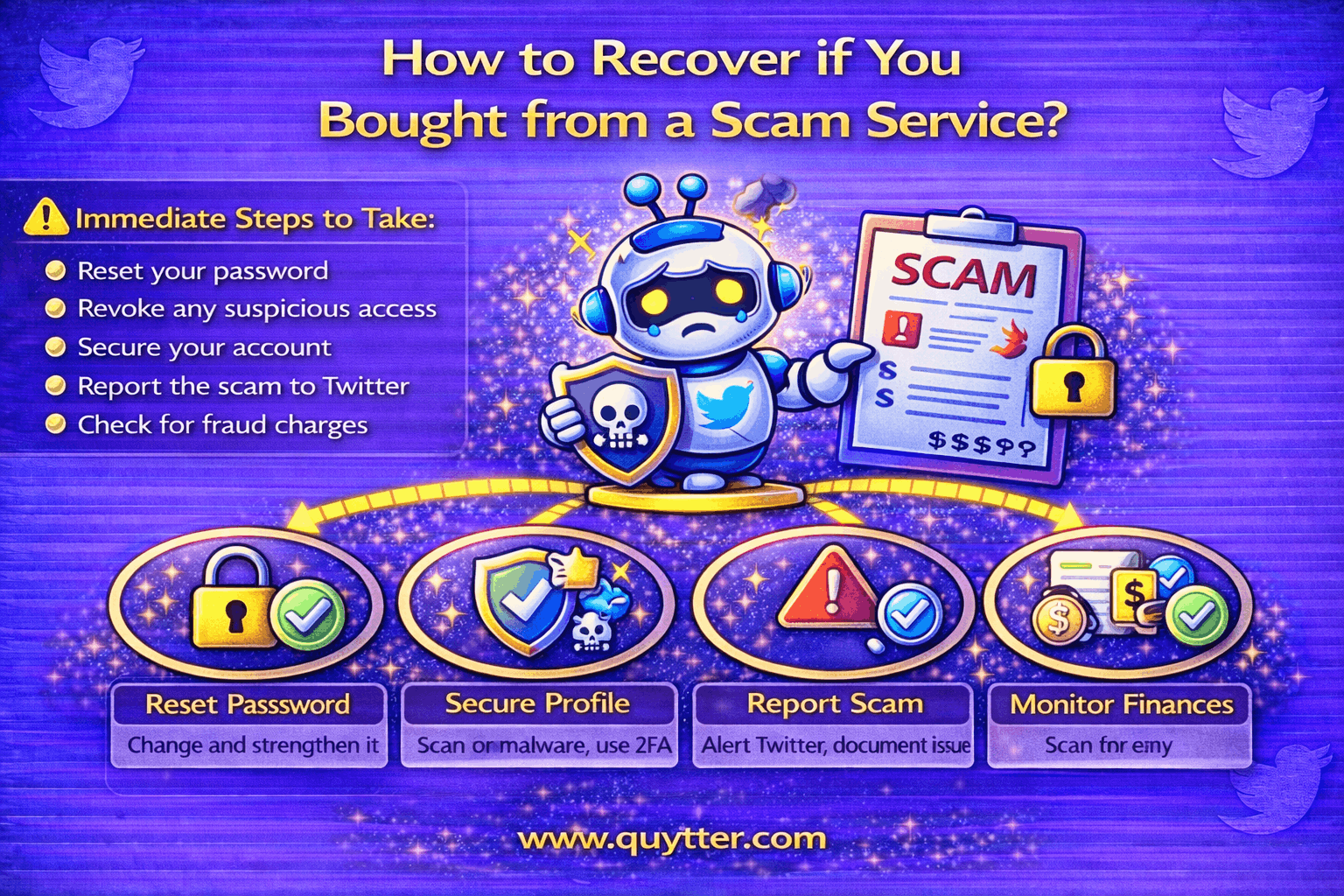
Most consequences of fake engagement are algorithmic, not manual.
Twitter may remove low-quality likes or retweets, but the more impactful change usually happens behind the scenes. Distribution weight is reduced. Tweets are shown to fewer people. Even followers may stop seeing your content consistently.
Many users describe this phase as a shadowban, but in most cases it’s better understood as algorithmic suppression. Your account still functions normally, but its reach is quietly limited due to reduced trust.
The longer low-quality engagement continues, the deeper this suppression can become.
Can a Twitter Account Recover After Scam Engagement?
In the majority of cases, yes.
Twitter’s trust model is not permanent. It adapts based on ongoing behavior. Accounts that stop triggering manipulation signals and begin generating consistent, high-quality interaction can gradually regain reach.
Recovery depends on several factors:
- How aggressive the fake engagement was
- How long it continued
- What actions you take immediately afterward
The most important factor is what you do next.
Step-by-Step: How to Recover Your Twitter Account ?
Recovering a Twitter account after buying fake or low-quality engagement is not about “fixing” one tweet or undoing one mistake. It’s about changing the signal environment your account operates in and giving the algorithm enough clean data to update its trust model.
Each step below exists for a reason. Skipping or rushing any of them is the most common reason recovery fails.
Step 1: Stop All Paid Engagement Immediately
The first step feels almost too simple, which is why many people underestimate it.
If your account has triggered engagement manipulation signals, continuing to buy engagement — even from different providers — doesn’t reset anything. From the algorithm’s perspective, it’s the same behavior repeating under a new label.
Twitter doesn’t evaluate intent. It evaluates patterns.
Every new wave of low-quality engagement reinforces the same conclusions:
- Your engagement timing is unnatural
- Your interacting accounts are unreliable
- Your growth curve cannot be trusted
At this stage, doing nothing is often the most corrective action you can take. Silence breaks patterns. It gives the algorithm a clean stopping point from which decay can begin.
Many accounts fail recovery here because the owner panics and tries to “fix” low reach with more paid engagement. That reaction almost always deepens suppression.
Step 2: Let the Algorithm Cool Down
Twitter’s enforcement system is not binary. It doesn’t flip from “punished” to “forgiven.” Instead, it operates on signal decay.
When manipulation signals stop appearing, their influence weakens gradually over time. The algorithm recalculates trust based on the absence of bad signals and the presence of neutral or positive ones.
This is why recovery takes time.
In practice:
- Light suppression often begins easing within a few weeks
- Deeper trust damage can take one to three months to normalize
During this phase, the worst thing you can do is force performance. Posting aggressively, changing content style radically, or chasing virality introduces volatility — and volatility slows recalibration.
Consistency beats intensity. The goal is not to grow yet, but to stabilize.
Step 3: Reset Your Engagement Baseline with Organic Signals
Once the account stops deteriorating, recovery shifts from passive to active.
At this point, you’re not trying to impress the algorithm — you’re trying to teach it what “normal” looks like again.
Organic signals matter because they are harder to fake and more predictive of real value. Replies, conversations, and contextual interactions carry more weight than passive metrics like likes.
Focus on:
- Posting at a steady, sustainable cadence
- Replying to real users in your niche
- Participating in discussions rather than broadcasting
- Prompting responses instead of chasing vanity metrics
These behaviors help rebalance engagement quality metrics and restore believable distribution patterns. Over time, the algorithm learns that your account can generate interaction without artificial reinforcement.
This step often feels slow — but it’s where real recovery begins.
Step 4: Avoid “Recovery Services” That Promise Instant Fixes
After performance drops, many users search for shortcuts. This is where the second mistake happens.
There is no tool, API, or service that can manually “remove” a shadowban or instantly restore trust. Twitter does not expose that level of control to third parties.
Services promising immediate recovery typically reuse automation, artificial engagement, or bulk actions. While these may temporarily inflate numbers, they introduce the same manipulation signals that caused the damage originally.
Recovery isn’t blocked by a switch — it’s limited by data quality over time.
The algorithm needs consistent evidence that your account behaves like a real, trusted user. Anything that bypasses that process usually resets the damage instead of fixing it.
Step 5: Reintroduce Paid Engagement Carefully (If Needed)
Paid engagement is not always forbidden after recovery — but it must be treated as support, not acceleration.
Before reintroducing it, several conditions should be met:
- Impressions are stable week over week
- Engagement no longer drops suddenly
- Organic interactions feel predictable again
If paid engagement is used, it should:
- Be delivered gradually
- Come from real, active accounts
- Mirror your historical performance, not exceed it
- Include human-like behavior, not just surface actions
The purpose here is to rebuild algorithmic confidence, not to chase growth. When done correctly, paid engagement blends into organic activity. When done incorrectly, it reactivates suppression.
This step is where most users either complete recovery — or get flagged again.
Twitter doesn’t punish accounts for mistakes. It withholds amplification from accounts it can’t trust. Recovery is the process of restoring that trust through consistent, believable behavior. There are no hacks, only signals.
Understanding this mindset shift is what separates accounts that recover quietly from those that remain permanently capped.
How Quytter Helps Accounts Recover Safely ?
At Quytter, we don’t just provide Twitter engagement — we help accounts repair trust after bad experiences.
Our recovery-focused approach emphasizes:
- Controlled, gradual engagement delivery
- Real, aged, active accounts
- Behavior aligned with organic interaction patterns
- Risk-aware scaling based on account history
We never promise instant fixes, because real recovery doesn’t work that way. Instead, we focus on rebuilding algorithmic confidence step by step.
If you’ve bought engagement from a scam service and your Twitter reach has suffered, Quytter can help you move forward — without repeating the same mistakes.
Explore Quytter’s Safe Twitter Engagement Services and start rebuilding with confidence.