
If you’ve ever considered boosting your Twitter (X) posts with paid likes or retweets, you’ve probably asked yourself one uncomfortable question:
Does Twitter detect bought engagements?
The short answer is yes — Twitter can detect bought engagement.
But the full answer is more nuanced, and understanding that difference is critical if you care about long-term growth, reach, and account safety.
At Quytter, we work with creators, founders, and brands who want visibility without risking their accounts. This article breaks down exactly how Twitter detects fake engagement, what actually triggers penalties, and why some engagement never gets flagged at all.
Short Answer: Yes – But Not All Bought Engagement Is the Same
Twitter’s algorithm is designed to detect engagement manipulation, not payments themselves.
In other words:
- Twitter doesn’t know you “paid” for engagement
- Twitter detects unnatural behavior patterns, fake accounts, and low-quality interactions
That’s why some accounts get shadowbanned or suspended, while others safely scale their reach using paid engagement as a growth accelerator.
The difference lies in quality, delivery, and behavior signals.
How Twitter Detects Bought Engagement ?
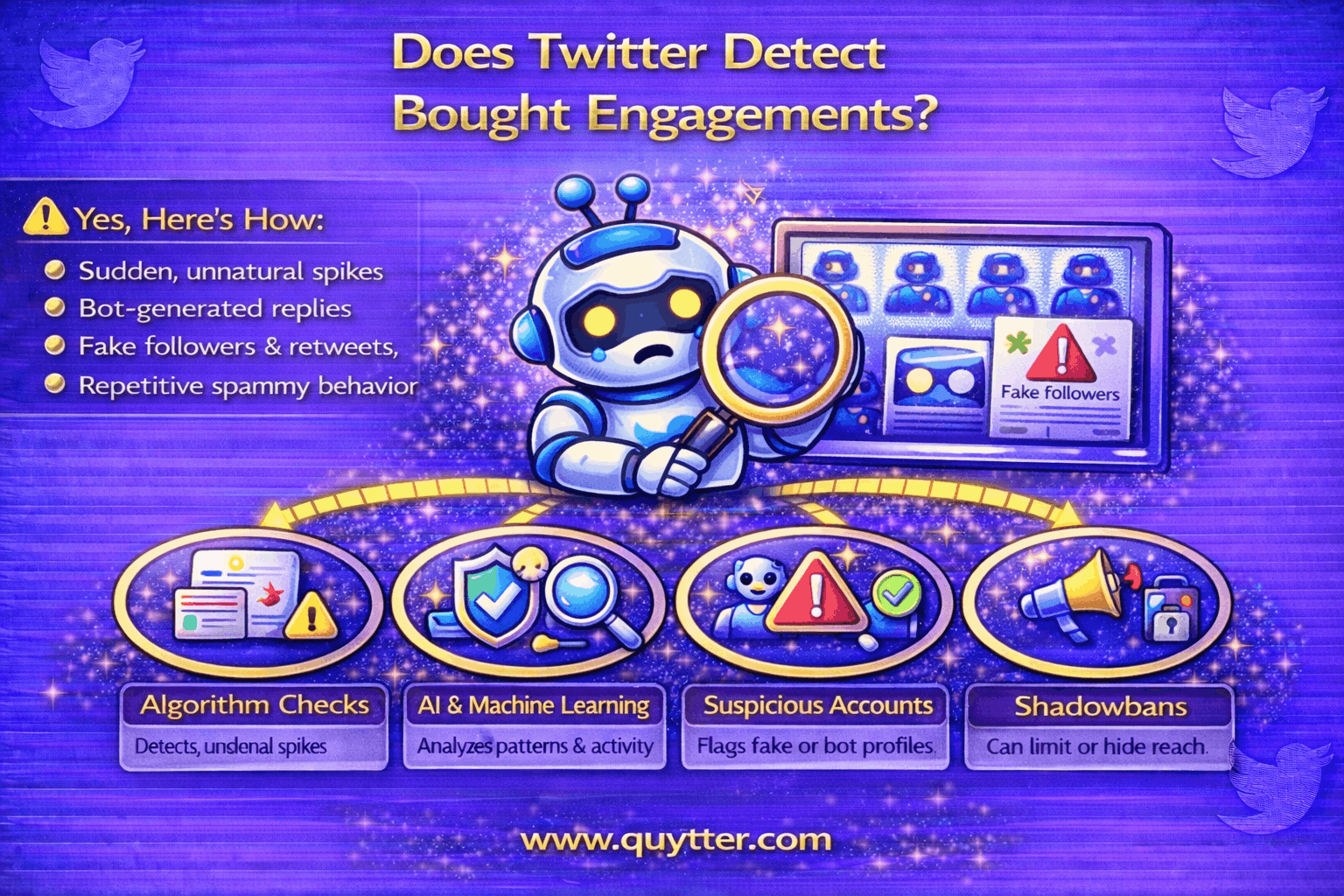
To accurately assess the risk of buying engagement, it’s not enough to know that Twitter can detect it — you need to understand how the detection actually works at a behavioral level.
Twitter doesn’t rely on a single signal or a simple rule like “paid engagement = ban.” Instead, it evaluates patterns, context, and consistency across time. Most detection happens algorithmically, long before any human moderation is involved.
Below are the core mechanisms Twitter uses to identify bought or manipulated engagement — explained in depth.
Unnatural Activity Patterns and Engagement Velocity
One of the clearest indicators of manipulated engagement is abnormal engagement velocity.
Organic engagement tends to grow in waves. A tweet may receive a few likes early, then gradually pick up momentum as it gets reshared, recommended, or discovered by adjacent audiences. Even viral tweets follow recognizable growth curves.
Bought engagement often breaks those patterns.
When a tweet jumps from single-digit likes to hundreds or thousands within minutes — especially on a small or inactive account — it creates a statistical anomaly. The problem isn’t the number itself, but the speed and synchronization. Dozens or hundreds of interactions arriving at the exact same moment strongly suggest automation rather than human behavior.
Twitter’s algorithm continuously compares new engagement against:
- The account’s historical performance
- Typical engagement timing for similar accounts
- Platform-wide behavioral baselines
When engagement growth deviates too sharply from those norms, it becomes a strong automation signal.
Bot and Low-Quality Account Detection
Twitter doesn’t evaluate engagement in isolation. It evaluates who is engaging.
Every like, retweet, or reply carries metadata about the account behind it. Over time, Twitter builds trust profiles for users based on activity history, content creation, follower relationships, and interaction diversity.
Low-quality or fake engagement often comes from accounts that share similar weaknesses:
- Recently created profiles with minimal history
- Empty timelines or copied content
- Generic avatars and bios
- Little to no real follower network
When a large percentage of engagement on a tweet originates from accounts like these, the engagement cluster becomes easy to classify. Even if each individual account looks harmless on its own, patterns across many accounts expose the network.
This is why mass bot farms fail long-term — Twitter detects the ecosystem, not just individual actors.
IP, Device, and Network-Level Signals
Beyond visible account behavior, Twitter analyzes infrastructure-level signals.
Many low-cost engagement providers rely on automation frameworks that reuse:
- IP address ranges
- Device fingerprints
- Browser or OS configurations
When hundreds of accounts perform similar actions from the same technical environment, the correlation becomes statistically obvious. Even when providers rotate accounts, shared infrastructure leaves a detectable footprint.
Twitter’s systems are designed to identify these network similarities and link them back to coordinated activity, making detection increasingly efficient at scale.
Engagement Quality and Trust Signals
Perhaps the most overlooked factor is engagement quality.
Twitter doesn’t just count likes and retweets — it evaluates what happens after those actions. Real users behave inconsistently and unpredictably. They click profiles, scroll timelines, occasionally reply, sometimes follow, and often do nothing at all.
Fake engagement, on the other hand, is usually shallow. It stops at surface-level interactions, such as likes or retweets, without any secondary behavior. When a tweet shows high engagement numbers but almost no profile visits, replies, or downstream actions, the imbalance becomes a trust signal violation.
Over time, these low-quality engagement patterns train the algorithm to discount or suppress future reach from the account.
What Happens If Twitter Detects Bought Engagement?
When Twitter detects engagement manipulation, the consequences are rarely instant or dramatic. In most cases, there is no notification, no warning, and no obvious punishment. Instead, the platform responds quietly through its algorithms.
The first and most common outcome is engagement nullification. Twitter may simply remove low-quality likes or retweets from a tweet, sometimes within hours, sometimes days later. To the account owner, it looks like engagement “dropped,” but in reality, it was never fully trusted by the system in the first place.
More often, however, the impact shows up in future performance rather than past metrics.
When an account repeatedly triggers manipulation signals, Twitter begins to reduce its distribution weight. Tweets from that account are less likely to appear in timelines, search results, or recommendation surfaces. Even strong content may struggle to gain traction because the algorithm has learned to discount the account’s engagement signals.
This is where many users experience what feels like a shadowban. Tweets still publish normally, but impressions collapse. Engagement becomes unusually low, even among followers. Because this suppression is algorithmic, Twitter provides no explanation — the account simply stops performing.
In more severe or repeated cases, Twitter may apply temporary visibility restrictions. Replies may be hidden, tweets may be excluded from search, or the account’s ability to trend may be disabled. These limitations are designed to contain manipulation without immediately resorting to account-level punishment.
Account suspension is possible, but it is relatively rare and usually reserved for extreme cases. This typically involves:
- Large-scale, repeated engagement manipulation
- Use of obvious bot networks
- Prior violations of Twitter’s platform policies
For most users, the real risk isn’t losing the account — it’s losing reach, momentum, and algorithmic trust.
Because nearly all enforcement is handled automatically, there is often no clear moment when something “goes wrong.” Performance simply declines, and recovery can take weeks or months. This silent suppression is why many accounts fail without ever understanding what triggered the drop.
The key takeaway is simple: when Twitter detects bought engagement, it doesn’t punish loudly — it stops amplifying. And on a distribution-driven platform like Twitter, that outcome is often more damaging than a visible penalty.
Why Some Bought Engagement Is Never Detected ?
Here’s the part most blogs avoid saying:
Not all bought engagement triggers detection.
At Quytter, we’ve analyzed thousands of campaigns and found that safe engagement shares several characteristics.
1. Real Accounts, Not Bot Networks
Engagement from real, aged, active accounts behaves fundamentally differently from bots. These accounts have:
- Posting history
- Followers
- Varied interaction patterns
Twitter trusts them more.
2. Gradual, Natural Delivery
Safe engagement follows human-like timing:
- No instant spikes
- No synchronized actions
- Engagement ramps naturally over hours or days
This mirrors organic virality.
3. Niche-Relevant Engagement
When engagement comes from users genuinely aligned with your niche, it reinforces Twitter’s trust signals rather than breaking them.
Random crypto bots liking SaaS content? Red flag.
Relevant users interacting naturally? Completely different story.
4. Human Behavior Simulation
High-quality engagement includes:
- Profile visits
- Occasional follows
- Irregular interaction timing
This is how real users behave — and Twitter’s algorithm recognizes it.
Is Buying Twitter Engagement Always Risky?
Buying Twitter engagement is risky only when done poorly.
High risk:
- Cheap bulk services
- “Instant 10,000 likes”
- No transparency on account sources
Lower risk:
- Gradual delivery
- Real-account based engagement
- Behavior aligned with organic growth patterns
Paid engagement should support momentum, not replace real content and audience building.
How to Buy Twitter Engagement Safely (If You Do) ?
Buying Twitter engagement is not inherently dangerous — buying it the wrong way is. The difference between a safe campaign and a harmful one isn’t the act of paying, but whether the engagement aligns with how real users behave on the platform.
If you decide to buy Twitter likes or retweets, safety comes down to understanding what Twitter expects to see — and avoiding anything that breaks those expectations.
The biggest mistake people make is chasing speed. Services that promise instant delivery may sound attractive, but they are almost always built on automation. Real users don’t appear all at once, interact simultaneously, and disappear forever. When engagement arrives in perfectly synchronized bursts, it creates the exact patterns Twitter’s detection systems are designed to flag.
Another red flag is opacity. If a provider can’t explain where engagement comes from, how accounts are sourced, or how delivery is controlled, that silence usually hides low-quality networks. One-size-fits-all packages are especially risky because they ignore account size, posting history, and niche relevance — all critical variables in Twitter’s trust model.
Safe engagement, by contrast, is intentionally boring.
It arrives gradually, often over hours or days, following a growth curve that mirrors organic discovery. The accounts interacting with your content look and behave like real users because they are real users — active profiles with history, followers, and varied interaction patterns. Engagement doesn’t vanish after a few days, because it wasn’t generated by disposable bot accounts.
Just as important, high-quality providers understand that engagement is more than a number. Likes and retweets should be accompanied by secondary signals such as profile visits, occasional follows, and irregular timing. These micro-behaviors help reinforce authenticity and prevent imbalance in Twitter’s engagement quality metrics.
Ultimately, buying engagement safely means choosing a provider that understands Twitter’s detection systems, not just its surface metrics. The goal isn’t to inflate numbers — it’s to support visibility without breaking algorithmic trust.
This is the approach we follow at Quytter. Our focus isn’t on instant results or exaggerated promises, but on controlled, human-like engagement that integrates naturally into Twitter’s ecosystem. When engagement behaves like it belongs, it doesn’t raise alarms — it simply works.
Final Verdict: Does Twitter Detect Bought Engagement?
Yes — Twitter detects low-quality, manipulative engagement.
But engagement that looks, behaves, and evolves like real human interaction often blends seamlessly into the platform’s ecosystem.
The question isn’t “Should I buy engagement?”
It’s “Am I doing it in a way that aligns with Twitter’s trust signals?”
How Quytter Helps You Grow Safely on Twitter ?
At Quytter, we don’t sell fake hype.
We help creators, founders, and brands:
- Increase visibility without triggering detection
- Use real, human-like engagement
- Maintain long-term account health
- Build momentum that compounds organically
If you’re looking for a safe Twitter engagement service designed around how Twitter actually works — not shortcuts that get accounts burned — Quytter is built for you.
Explore Quytter’s Twitter Marketing Services and grow with confidence.