
The rise of ethical Twitter bots has created a major shift in how marketers approach automation. While bots have long been associated with spam, fake engagement, and manipulation, the reality is far more nuanced. Today, businesses and creators are increasingly focused on ethical use of bots in Twitter marketing to scale operations without damaging trust. The real challenge is not whether to use automation, but how to use it responsibly. When done right, ethical Twitter automation can enhance user experience, streamline workflows, and improve engagement quality. When done wrong, it leads to spam, account penalties, and long-term brand damage.
This article breaks down what ethical Twitter bots actually mean, why they matter, and how to apply safe Twitter bot practices without crossing into manipulation. You will learn how to distinguish between authentic interaction and bot abuse, how to avoid common mistakes like spam bots or fake engagement, and how to build a sustainable Twitter automation strategy that aligns with both platform expectations and user trust. If you want to scale your presence without sacrificing credibility, this guide gives you the framework to do it properly.
What Does “Ethical” Mean in Twitter Automation?
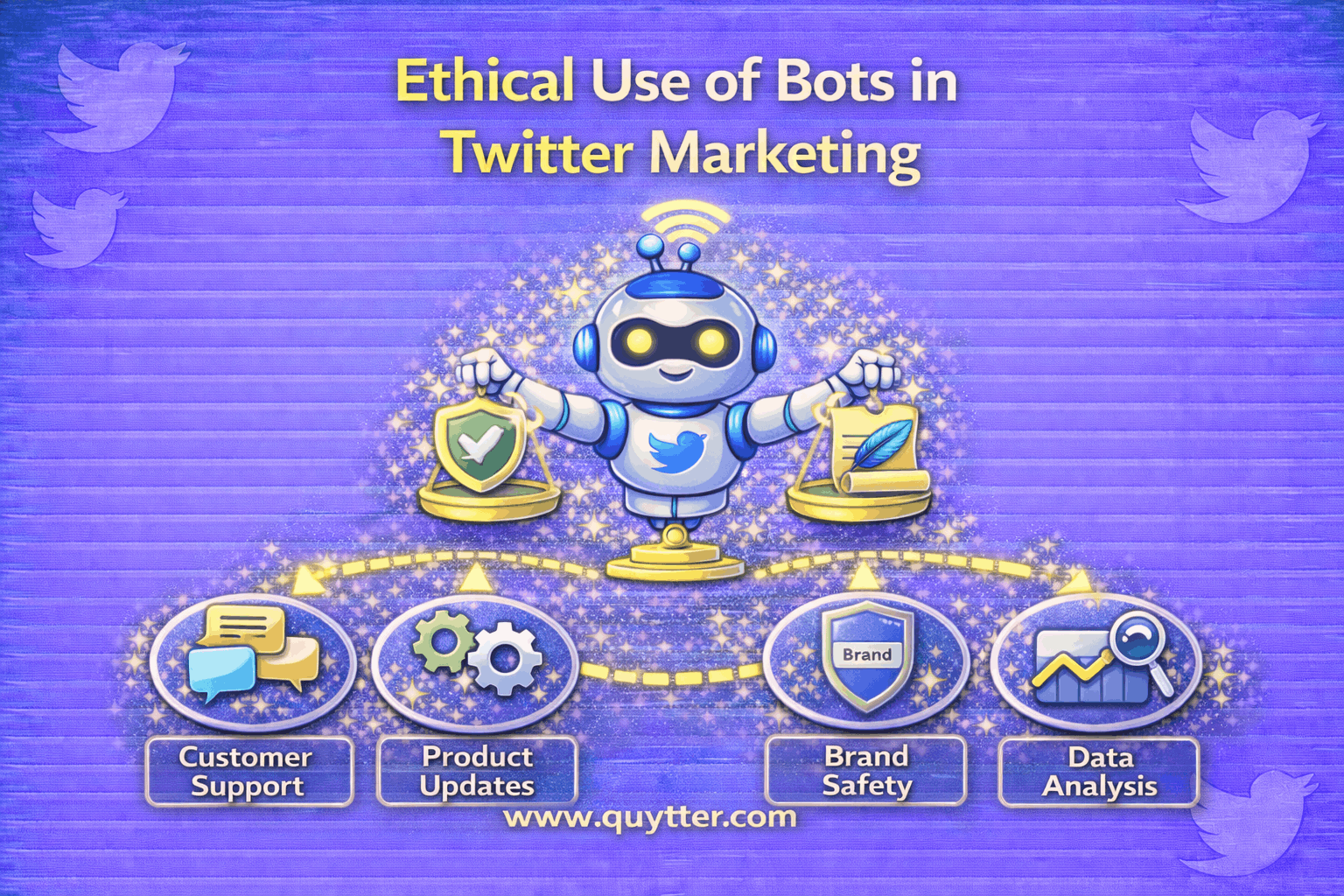
To understand ethical use of bots in Twitter marketing, you first need to separate automation itself from intent. Automation is neutral. Ethics is about how that automation is applied.
At its core, ethical Twitter automation means using bots in a way that:
- Respects users’ time and attention
- Provides value instead of noise
- Avoids deception or manipulation
- Maintains transparency and control
Most marketers misunderstand this. They assume that if a tool works, it is acceptable. That is not how platforms or users evaluate behavior. Ethical automation is judged based on outcomes, not just inputs.
For example, scheduling tweets through a bot is widely accepted because it improves consistency without harming users. On the other hand, sending identical messages to hundreds of users through an auto DM system is considered intrusive and spammy, even if technically automated in the same way.
Another critical distinction is between authentic interaction and synthetic engagement. Ethical bots should enhance real communication, not replace it entirely. If your automation produces interactions that feel generic, irrelevant, or repetitive, users will quickly recognize the pattern.
A useful mental model is this:
- Automation that scales value = ethical
- Automation that scales volume without value = unethical
This is where many campaigns fail. They focus on maximizing output instead of improving experience.
It is also important to consider perception. Even if a tactic is technically allowed, it may still feel unethical to users. For instance, aggressively automated replies that hijack conversations can damage trust even if they follow platform guidelines.
In practice, ethical social media bots operate within three boundaries:
- They support human intent, not replace it
- They deliver context-aware responses
- They avoid misleading users
If your automation meets these criteria, you are moving in the right direction.
Why Ethical Bot Usage Matters for Long-Term Growth?
Short-term growth tactics often rely on aggressive automation. You can gain followers quickly, inflate engagement metrics, and create the illusion of popularity. But this approach rarely sustains itself.
The reason is simple: platforms and users both prioritize quality over quantity.
Trust as a Growth Multiplier
Trust is the foundation of any successful Twitter strategy. When users perceive your account as trustworthy, they are more likely to:
- Engage with your content
- Respond to your messages
- Share your posts organically
Ethical Twitter bots help reinforce this trust by ensuring that every automated interaction still feels relevant and intentional.
In contrast, spammy automation breaks trust almost instantly. Once users associate your account with spam bots or fake engagement, recovery becomes extremely difficult.
Algorithmic Impact
The platform’s algorithm is designed to surface meaningful interactions. Metrics like:
- Replies with substance
- Conversation depth
- Time spent on content
carry more weight than raw likes or retweets.
When you rely on low-quality automation, you may see an initial spike in numbers, but the algorithm eventually downgrades your content due to lack of genuine engagement.
Brand Reputation and Positioning
Your automation strategy directly reflects your brand. Ethical usage signals professionalism, while aggressive tactics signal desperation.
Consider two scenarios:
- Account A uses transparent automation, provides helpful replies, and engages selectively
- Account B uses mass automation, generic replies, and constant self-promotion
Over time, Account A builds authority. Account B gets ignored or flagged.
Sustainability vs Burnout
Unethical automation often leads to diminishing returns. You need to constantly increase volume to maintain results, which increases risk.
Ethical automation, on the other hand, compounds over time. Each interaction contributes to a stronger network, better relationships, and higher retention.
Key Takeaway
If your goal is long-term growth, ethical Twitter automation is not optional. It is a requirement. Without it, any growth you achieve will be fragile and short-lived.
Common Unethical Bot Practices to Avoid
Understanding what not to do is just as important as knowing best practices. Many marketers fall into unethical patterns without realizing it.
Below are the most common forms of bot abuse that damage both performance and credibility.
Mass Follow and Unfollow Cycles
This tactic aims to artificially inflate follower counts by following large numbers of users and then unfollowing them later.
Why it fails:
- Creates irrelevant audiences
- Signals manipulative intent
- Triggers platform detection systems
It is one of the clearest examples of low-quality automation.
Auto DM Spam
Automated direct messages can be useful in limited cases, but most implementations are spam-driven.
Typical problems:
- Identical messages sent to all users
- No personalization or context
- Immediate sales pitches
Users recognize these patterns instantly and often respond negatively.
Fake Engagement
Buying likes, retweets, or using bots to simulate engagement does not create real value.
Consequences include:
- Distorted analytics
- Reduced algorithm trust
- Poor conversion rates
Fake engagement might make numbers look good, but it weakens your strategy at every level.
Generic Auto Replies
Replying automatically to tweets without understanding context leads to irrelevant interactions.
Examples:
- Posting the same comment under multiple tweets
- Responding with unrelated links
- Interrupting conversations with automation
This is a direct violation of authentic interaction principles.
Content Duplication
Recycling the same message repeatedly across different users or threads reduces perceived quality.
It signals:
- Lack of effort
- Automation overuse
- Low credibility
Quick Self-Audit
If you are unsure whether your automation is ethical, evaluate it against these questions:
- Does this interaction provide real value to the user?
- Would I send this message manually?
- Does this feel natural in the conversation?
- Would I appreciate receiving this myself?
If the answer is no to any of these, your approach likely needs adjustment.
Core Principles of Ethical Twitter Automation
To build a sustainable Twitter automation strategy, you need a clear framework. Ethical automation is not about avoiding risk entirely. It is about operating within boundaries that preserve value and trust.
Below are the core principles that define safe Twitter bot practices.
Transparency
Transparency does not mean labeling every action as automated. It means avoiding deception.
Users should never feel misled about who or what they are interacting with.
Practical applications:
- Avoid pretending bots are real people
- Make automated responses clearly informational
- Do not simulate human emotion artificially
Transparency builds credibility, especially in long-term engagement strategies.
Value-First Automation
Every automated action should serve a purpose beyond promotion.
Examples of value-driven automation:
- Sharing useful resources
- Answering frequently asked questions
- Providing timely updates
This aligns with non-spam engagement principles and improves overall user experience.
Human Oversight
Fully autonomous systems often drift into unethical behavior over time.
Maintaining control ensures that your automation stays aligned with your goals.
Best practices:
- Monitor bot performance regularly
- Adjust rules based on feedback
- Pause automation when anomalies appear
Human oversight is what separates ethical social media bots from uncontrolled spam systems.
Respect for Limits and Behavior Patterns
Automation must mimic realistic usage patterns.
Aggressive activity levels are a major red flag for both users and platforms.
Key considerations:
- Space out actions naturally
- Avoid repetitive patterns
- Limit daily interactions
This reduces the risk of being categorized as bot abuse.
Context Awareness
One of the most overlooked aspects of ethical automation is relevance.
Bots should not operate blindly. They need to respond based on context.
For example:
- Replying only when keywords match intent
- Avoiding unrelated conversations
- Filtering irrelevant interactions
Context-aware automation significantly improves engagement quality.
Balance Between Automation and Manual Interaction
The most effective strategies combine both.
Automation handles repetitive tasks, while humans handle nuanced interactions.
This hybrid approach ensures:
- Efficiency
- Personalization
- Scalability
Ethical automation is not a limitation. It is a competitive advantage. By focusing on authentic interaction, transparent automation, and value-driven engagement, you create a system that scales without compromising trust.
Ethical Ways to Use Bots in Twitter Marketing
Once you understand the principles behind ethical Twitter bots, the next step is applying them in real marketing workflows. The goal is not to remove automation, but to use it in ways that enhance authentic interaction and deliver consistent value.
Below are the most effective and ethical use cases that align with a sustainable Twitter automation strategy.
Content Scheduling and Publishing
Scheduling is one of the safest and most widely accepted forms of transparent automation.
Instead of posting manually at inconsistent times, bots can:
- Publish content at optimal engagement windows
- Maintain a consistent posting rhythm
- Support multi-timezone audiences
This type of automation does not interfere with user experience. It improves it.
More importantly, it allows marketers to focus on content quality instead of timing logistics.
Smart Auto Replies for Support and Engagement
Auto replies can be ethical when they are:
- Context-aware
- Helpful
- Limited in scope
For example:
- Answering frequently asked questions
- Providing links to relevant resources
- Guiding users to the next step
This aligns with non-spam engagement because the response is useful, not intrusive.
However, the key is control. Replies should only trigger under specific conditions, not across all conversations.
Lead Nurturing Without Spam
Many marketers misuse bots for aggressive selling. Ethical automation takes a different approach.
Instead of pushing offers immediately, bots can:
- Deliver educational content
- Share onboarding resources
- Segment users based on interest
This creates a gradual funnel rather than a forced conversion.
Ethical lead nurturing improves trust and increases the likelihood of meaningful engagement.
Engagement Filtering and Targeting
Another powerful use of ethical social media bots is filtering.
Instead of interacting with everyone, bots can:
- Identify relevant conversations
- Highlight high-intent users
- Prioritize meaningful engagement opportunities
This ensures that automation supports strategy rather than replacing it.
Workflow Automation
Bots can also handle backend tasks that users never see, such as:
- Tracking mentions
- Organizing replies
- Categorizing interactions
This improves efficiency without affecting the user experience.
Key Insight
The difference between ethical and unethical usage is not the tool. It is the intent and execution.
If your automation improves clarity, relevance, and value, it is ethical. If it creates noise, interruption, or deception, it is not.
Ethical vs Unethical Automation
To fully understand ethical Twitter automation, it helps to directly compare it with unethical practices.
| Ethical Automation | Unethical Automation |
|---|---|
| Value-driven interactions | Volume-driven spam |
| Context-aware replies | Generic responses |
| Controlled activity | Aggressive automation |
| Transparent behavior | Deceptive tactics |
| Supports human interaction | Replaces human interaction |
This comparison highlights a critical point.
Unethical automation focuses on scaling output. Ethical automation focuses on scaling impact.
Another key distinction is sustainability.
- Ethical systems improve over time
- Unethical systems degrade over time
For example, a bot that delivers relevant content will attract better engagement. A bot that spams links will gradually lose reach and credibility.
Behavioral Differences
Ethical bots behave more like assistants. Unethical bots behave like amplifiers.
Assistants:
- Help users
- Provide context
- Enhance conversations
Amplifiers:
- Increase noise
- Repeat messages
- Ignore context
Strategic Implications
If your strategy relies on unethical automation, you will constantly face:
- Decreasing performance
- Increasing risk
- Lower trust
In contrast, ethical strategies create:
- Compounding engagement
- Higher retention
- Stronger brand positioning
How to Stay Ethical While Scaling Automation
Scaling is where most strategies break. As volume increases, it becomes harder to maintain quality.
To scale ethical Twitter bots effectively, you need structure.
Set Clear Activity Limits
One of the simplest ways to avoid bot abuse is to control volume.
Instead of maximizing actions, define boundaries:
- Daily interaction caps
- Reply limits
- Follow thresholds
This keeps behavior within natural ranges.
Segment Your Audience
Not all users should be treated the same.
Ethical automation requires segmentation:
- New followers
- Engaged users
- High-intent prospects
This allows for more relevant and authentic interaction.
Combine Automation with Manual Oversight
Scaling does not mean removing human input.
A strong system includes:
- Automated triggers
- Manual review checkpoints
- Feedback loops
This ensures quality control at every stage.
Monitor Engagement Quality
Metrics matter, but not all metrics are equal.
Focus on:
- Meaningful replies
- Conversation depth
- Click-through behavior
Avoid overvaluing vanity metrics like raw likes.
Adjust Based on Feedback
Ethical automation is adaptive.
If users:
- Ignore replies
- Respond negatively
- Stop engaging
you need to adjust your system.
Scaling Framework
A simple structure for scaling safely:
- Start with low-volume automation
- Validate engagement quality
- Gradually increase activity
- Continuously monitor results
This prevents sudden spikes that trigger detection or reduce quality.
Ethical Automation Tools and Features to Look For
Choosing the right tools is critical for maintaining safe Twitter bot practices.
Not all automation tools are built for ethical use. Some are designed purely for aggressive growth.
Key Features to Prioritize
When evaluating tools, look for:
- Smart delays and timing controls
- Context-based triggers
- Customizable workflows
- Analytics and reporting
- Anti-spam safeguards
These features support transparent automation and reduce risk.
Features to Avoid
Be cautious of tools that emphasize:
- Mass actions with no limits
- One-click growth hacks
- Bulk messaging without filters
These are often associated with low-quality automation.
Importance of Flexibility
Your strategy will evolve. Your tools should adapt with it.
Look for platforms that allow:
- Rule customization
- Behavior adjustments
- Integration with other systems
This ensures long-term scalability.
Scale Your Twitter Growth with Ethical Automation Services
If you want to implement ethical Twitter bots at scale, doing everything manually can become inefficient. This is where professional automation services come in.
However, not all services are built with ethics in mind. Many focus on aggressive growth tactics that lead to short-term gains and long-term damage.
A high-quality service should prioritize:
- ethical Twitter automation over raw volume
- authentic interaction instead of fake engagement
- Long-term account safety instead of risky shortcuts
What a Professional Service Should Offer
When choosing a service, look for:
- Strategy-first approach, not tool-first
- Customized automation workflows
- Audience segmentation and targeting
- Built-in safeguards against spam behavior
- Ongoing optimization and monitoring
These elements ensure that your automation aligns with both user expectations and platform standards.
Why Ethical Automation Services Matter
Building an ethical system requires:
- Time
- Testing
- Continuous refinement
A specialized service accelerates this process by:
- Avoiding common mistakes
- Implementing proven frameworks
- Maintaining consistent performance
This is especially important if you are managing multiple accounts or scaling campaigns.
Positioning Your Strategy for Long-Term Success
If your goal is sustainable growth, your focus should be:
- High-quality engagement
- Trust-based relationships
- Consistent value delivery
This is exactly what ethical social media bots are designed to support when implemented correctly.
Final Thoughts: Automation Without Losing Authenticity
The debate around bots often focuses on whether they should be used at all. That is the wrong question.
The real question is how to use them responsibly.
Ethical use of bots in Twitter marketing is about balance. It combines automation efficiency with human judgment. It prioritizes value over volume and trust over shortcuts.
When you apply ethical Twitter automation, you are not limiting your growth. You are strengthening it.
Instead of chasing quick wins, you build systems that:
- Scale naturally
- Engage meaningfully
- Convert effectively
In the long run, this approach outperforms any aggressive tactic.
If you want to succeed with automation, focus on:
- transparent automation
- authentic interaction
- non-spam engagement
Everything else is secondary.