
Managing multiple Twitter bots with one dashboard has become a critical challenge for marketers, agencies, and businesses that rely on automation to scale visibility and engagement. As automation expands beyond a single account, the complexity increases exponentially. Each bot brings its own posting schedule, engagement patterns, proxy requirements, and risk profile. Without a centralized system, managing multiple bots often turns into chaos, leading to inconsistent actions, duplicated behavior, account suspensions, and wasted resources. Many users underestimate how quickly automation can spiral out of control when every bot is managed separately without unified oversight.
This guide explains how managing multiple Twitter bots with one dashboard transforms automation from a risky experiment into a structured, scalable system. This article breaks down what multi bot management really means, why manual approaches fail at scale, and how a centralized Twitter bot management dashboard provides visibility, control, and safety. By understanding the systems behind professional automation, you will see why advanced users no longer treat bots as isolated tools but as coordinated assets within a single control environment.
What Does Managing Multiple Twitter Bots Really Mean?
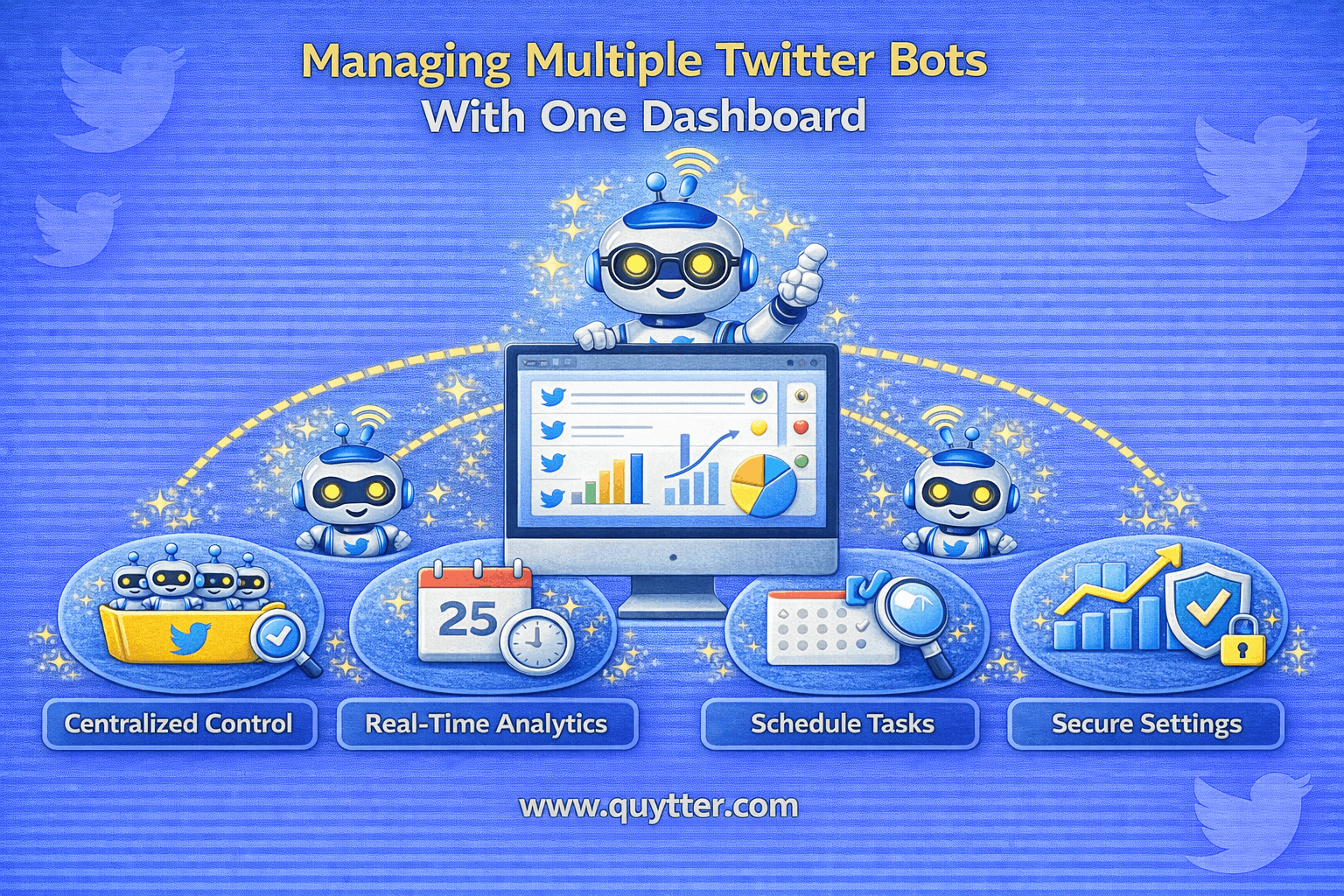
At its core, managing multiple Twitter bots is not simply about running several automated accounts at the same time. True multi account Twitter automation involves coordinating actions across accounts while ensuring that each one behaves independently, naturally, and within safe operational boundaries. Many beginners assume that launching multiple bots is as simple as duplicating a script or tool. In reality, this approach is exactly what causes detection issues and account bans.
Managing bots properly means controlling how each account posts, likes, retweets, follows, and replies without overlapping behavioral signals. It requires separating session data, assigning unique proxies, staggering action timing, and monitoring activity patterns in real time. A professional approach treats each bot as a digital persona rather than a cloned machine.
Without a centralized system, users are forced to jump between tools, spreadsheets, and browser sessions. This fragmented workflow makes it nearly impossible to spot issues early or adjust campaigns efficiently. A centralized Twitter bot control system solves this by consolidating all bot activities into a single interface. From one dashboard, operators can monitor account health, pause risky behavior, adjust automation limits, and analyze performance trends across all bots.
This shift from individual bot operation to system level orchestration is what separates amateur automation from scalable automation. It is also where Twitter automation dashboards become essential rather than optional.
Common Problems When Managing Twitter Bots Without a Dashboard
Running multiple bots without a dashboard creates problems that compound over time. These issues rarely appear immediately, which is why many users only realize the damage after accounts start getting restricted or banned.
One of the most common problems is loss of visibility. When bots operate independently, there is no single place to see what actions have already been performed. This leads to repeated likes, excessive follows, or identical replies across multiple accounts. Such patterns are easy for platform systems to detect and flag.
Another major issue is poor rate limit control. Without centralized oversight, bots may exceed safe thresholds for actions like liking or retweeting. Even if each bot individually appears to operate within limits, collective behavior can still trigger platform defenses. A lack of rate limit control Twitter automation is one of the fastest ways to burn entire bot networks.
Manual management also increases human error. Logging into multiple accounts, switching proxies, and updating scripts manually introduces inconsistencies. One misconfigured proxy or reused session can compromise several accounts at once. This is especially dangerous when scaling beyond a small number of bots.
Additionally, performance tracking becomes nearly impossible. Without consolidated reporting, users cannot tell which bots contribute meaningful engagement and which ones add risk without value. Over time, this leads to inefficient campaigns and unnecessary account losses.
These problems highlight why unmanaged automation is not just inefficient but actively dangerous when scaled.
Why a Centralized Dashboard Is Essential for Twitter Bot Management?
A centralized dashboard changes the way automation operates by turning scattered bot actions into a cohesive system. Instead of reacting to issues after they occur, operators gain proactive control over every aspect of bot behavior.
One major benefit is unified visibility. A Twitter bot management dashboard provides real time insight into what each account is doing at any given moment. This includes scheduled actions, completed actions, and flagged risks. With everything visible in one place, abnormal behavior becomes immediately apparent.
Another advantage is consistency. Dashboards allow users to apply standardized rules across all bots while still maintaining individual variation. This balance is critical for safe Twitter bot management. Consistency ensures compliance with limits, while variation prevents pattern detection.
Centralized systems also improve scalability. Managing five bots manually may be possible, but managing fifty or a hundred without automation infrastructure quickly becomes impossible. A dashboard allows operators to scale campaigns without increasing operational complexity at the same rate.
Finally, dashboards support faster decision making. When campaign results and account health data are consolidated, adjustments can be made instantly. This responsiveness is essential for scalable Twitter automation in competitive environments.
Core Features of a Twitter Bot Management Dashboard
A professional dashboard is not just a visual interface. It is an operational control center designed to manage risk, efficiency, and growth simultaneously. Understanding its core features helps clarify why dashboards are indispensable.
Account management is the foundation. A dashboard must allow operators to add, remove, pause, and categorize accounts easily. Grouping accounts by purpose or campaign simplifies large scale operations.
Action scheduling is another critical feature. Instead of running bots continuously, dashboards enable structured scheduling. This reduces behavioral spikes and supports more natural activity patterns.
Proxy and session management are equally important. Assigning unique proxies and managing sessions through a centralized system reduces the risk of cross account contamination. This is especially vital for proxy management for Twitter bots at scale.
Monitoring and logging complete the system. Detailed logs provide transparency into every action taken by each bot. This historical data is invaluable for diagnosing issues and improving future campaigns.
Together, these features transform automation from guesswork into controlled execution.
How Dashboards Help Control Risk and Avoid Suspensions?
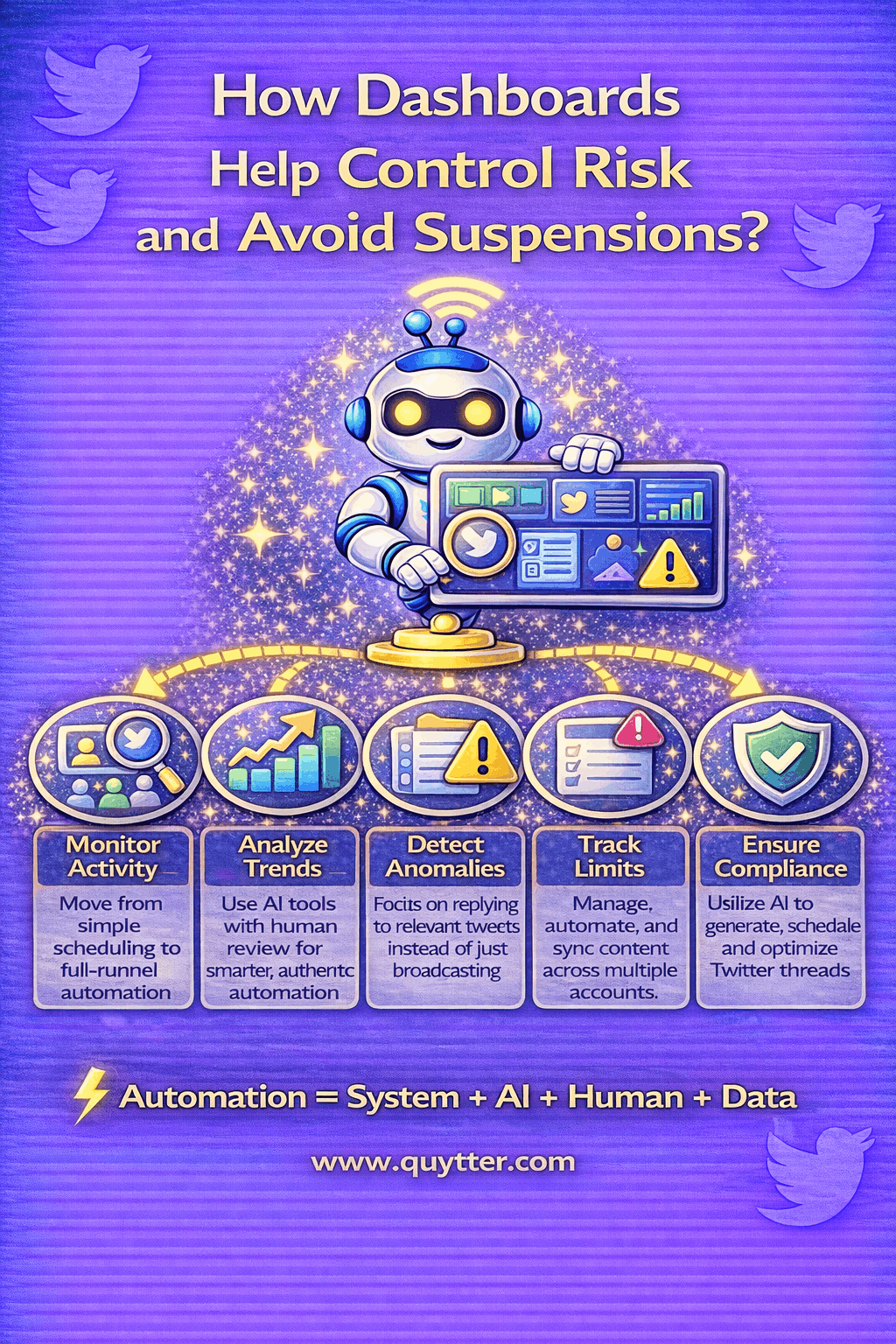
Risk management is the primary reason experienced users adopt dashboards. Platforms continuously update detection systems, making unmanaged automation increasingly dangerous.
Dashboards reduce risk by enforcing action limits automatically. Instead of relying on manual configuration, limits are embedded into the system, preventing bots from exceeding safe thresholds. This is critical for avoid Twitter bot suspension strategies.
Behavioral diversity is another risk control mechanism. Dashboards can randomize timing, vary action sequences, and prevent synchronized behavior across accounts. This makes bots appear less coordinated and more human like.
Early warning systems further enhance safety. When a bot exhibits abnormal behavior or receives restrictions, dashboards allow immediate intervention. Operators can pause activity, adjust settings, or isolate the account before damage spreads.
By centralizing control, dashboards shift automation from reactive to preventative risk management.
Managing Multiple Twitter Accounts at Scale
Scaling automation introduces challenges that do not exist at smaller volumes. Managing ten accounts manually may be inconvenient but manageable. Managing one hundred accounts without infrastructure is unsustainable.
At scale, organization becomes critical. Dashboards allow accounts to be segmented by campaign, behavior type, or risk level. This segmentation enables precise control over how different groups operate.
Resource allocation is another challenge. Larger bot networks require careful distribution of proxies, sessions, and action quotas. A dashboard ensures resources are assigned efficiently and consistently.
Scaling also demands performance measurement. Without analytics, operators cannot determine whether increased automation actually delivers value. Dashboards centralize metrics, making it easier to optimize campaigns over time.
These capabilities make dashboards essential for anyone serious about professional Twitter automation tools.
Using One Dashboard for Different Twitter Bot Campaigns
When automation moves beyond simple growth experiments, managing multiple campaigns simultaneously becomes unavoidable. Different Twitter bots often serve different purposes. Some are designed for engagement amplification, others focus on visibility, while certain accounts support customer interaction or brand awareness. Managing these diverse objectives without a centralized system quickly leads to confusion and operational overlap.
A unified dashboard allows marketers to separate campaigns while still controlling them from one environment. Each campaign can have its own automation logic, action frequency, and targeting rules. This separation is critical for maintaining ethical social media automation, as it prevents bots from performing irrelevant or repetitive actions that harm user experience.
For example, one campaign may focus on liking and retweeting niche content to increase topical authority, while another campaign prioritizes replying to relevant discussions. A dashboard makes it possible to define these behaviors independently while maintaining overall control. This approach supports responsible use of bots by aligning automation actions with clear campaign intent rather than blind engagement farming.
Campaign level dashboards also improve accountability. Performance metrics such as engagement rate, reach contribution, and account health can be tracked separately. This allows marketers to optimize strategies based on results rather than assumptions. Over time, this leads to more sustainable growth and less reliance on risky automation tactics.
Team Collaboration and Agency Use Cases
As automation scales, it often involves more than one person. Agencies, growth teams, and content managers frequently collaborate on the same automation infrastructure. Without a centralized dashboard, collaboration becomes a security and efficiency nightmare.
A professional Twitter bot management dashboard enables role based access control. Team members can be assigned specific permissions such as monitoring activity, adjusting schedules, or managing accounts. This structure reduces errors and prevents unauthorized changes that could compromise bot safety.
Collaboration also benefits from shared visibility. When everyone operates from the same dashboard, misunderstandings are reduced. Teams can see which bots are active, which campaigns are running, and which accounts require attention. This transparency supports ethical marketing bots practices by ensuring automation decisions are intentional and documented.
For agencies, dashboards are essential for managing multiple client projects. Each client can be segmented into its own workspace, ensuring data separation and operational clarity. This not only improves efficiency but also builds client trust. Agencies that demonstrate structured automation workflows are more likely to be perceived as professional and responsible partners.
Security, Data Protection, and Account Safety
Security is one of the most overlooked aspects of Twitter automation. Managing multiple bots means handling sensitive data such as login credentials, cookies, proxies, and session information. Without a secure system, this data becomes vulnerable to leaks or misuse.
Centralized dashboards improve security by standardizing how data is stored and accessed. Instead of spreading credentials across multiple tools or devices, all sensitive information is managed within a controlled environment. This reduces exposure and supports data privacy in social media automation.
Account safety also improves when dashboards enforce best practices automatically. Features like session isolation, proxy consistency, and controlled login behavior reduce the risk of triggering platform security systems. This is essential for maintaining brand trust when automation is part of a broader marketing strategy.
Moreover, dashboards provide audit trails. Every action taken by each bot is logged, making it easier to investigate issues or demonstrate compliance. This level of transparency aligns with ethical social media automation principles by ensuring accountability at every stage.
Manual Bot Management vs Dashboard Based Automation
Some marketers still attempt to manage bots manually, believing it offers greater control. While manual management may work at a very small scale, it becomes impractical and dangerous as complexity increases.
Manual workflows rely heavily on human memory and discipline. Tracking which bot performed which action, at what time, and under which conditions quickly becomes impossible. This leads to mistakes that increase the risk of detection and account loss.
In contrast, dashboard based automation centralizes logic and execution. Rules are defined once and applied consistently. This reduces human error and supports sustainable social media marketing practices.
Another key difference is adaptability. Dashboards allow rapid changes across multiple bots with minimal effort. Manual systems require repetitive updates that slow response times. In dynamic social environments, this lack of agility can severely limit campaign effectiveness.
Ultimately, dashboard based automation is not about removing human oversight but enhancing it. Humans define strategy while systems handle execution safely and efficiently.
How Quytter Supports Ethical and Scalable Twitter Growth?
For brands and marketers who want results without compromising ethics, Quytter offers a fundamentally different approach to Twitter growth. Instead of relying on aggressive or deceptive automation, Quytter focuses on transparent, controlled, and ethical engagement services that complement automation rather than replace authenticity.
Quytter helps users grow visibility and engagement through services designed to avoid manipulation and platform violations. Rather than simulating fake behavior, Quytter emphasizes real interaction signals that align with how Twitter evaluates content reach. This approach reduces the risks associated with traditional bot networks while still supporting scalable marketing goals.
Key ways Quytter supports ethical automation include:
- Controlled engagement delivery that avoids unnatural spikes
- Focus on visibility and social proof rather than spam actions
- Services aligned with platform expectations and user experience
- No need for users to manage risky bot infrastructures
For marketers managing multiple accounts or campaigns, Quytter acts as a safer alternative or supplement to bots. Instead of coordinating dozens of automated accounts, users can leverage Quytter to boost content performance without exposing their accounts to unnecessary risk.
By combining strategic automation with ethical growth services, brands can maintain long term engagement, protect brand trust, and avoid the reputational damage caused by unethical bot usage.
Conclusion
Managing multiple Twitter bots with one dashboard is no longer a luxury reserved for advanced users. It is a necessity for anyone who wants to scale automation responsibly. Centralized dashboards provide visibility, control, security, and structure that manual workflows simply cannot match.
However, automation alone is not enough. Ethical considerations must guide how bots are used, managed, and integrated into broader marketing strategies. Blind automation may deliver short term gains, but it often leads to long term damage.
By combining smart dashboard based management with ethical alternatives like Quytter, marketers can achieve sustainable growth without compromising trust or platform compliance. The future of social media marketing belongs to those who prioritize responsibility alongside performance.
If you want to scale Twitter marketing safely, ethically, and efficiently, aligning automation with services like Quytter is the most reliable path forward.