
For modern growth focused agencies, how agencies use bots to scale their Twitter networks is no longer a niche topic or experimental tactic. It has become a structural component of how large scale Twitter operations are executed. Agencies managing dozens or even hundreds of accounts face a reality where manual actions simply cannot keep pace with client demands, content velocity, and competitive pressure. Automation fills this gap by enabling agencies to amplify reach, distribute content, and maintain consistent engagement across an entire network of accounts without linear increases in manpower.
At the same time, automation introduces complexity and risk. Poorly implemented Twitter automation for agencies can lead to detectable behavior patterns, account suspensions, and reputational damage for clients. This is why professional agencies approach bots differently from solo marketers. They do not see bots as shortcuts, but as infrastructure.
This article explains how agencies actually build, manage, and scale Twitter bot networks in a controlled, systematic way. This guide breaks down real agency use cases, structural decisions, and the operational mindset required to scale Twitter networks responsibly.
Why Twitter Automation Matters for Agencies?
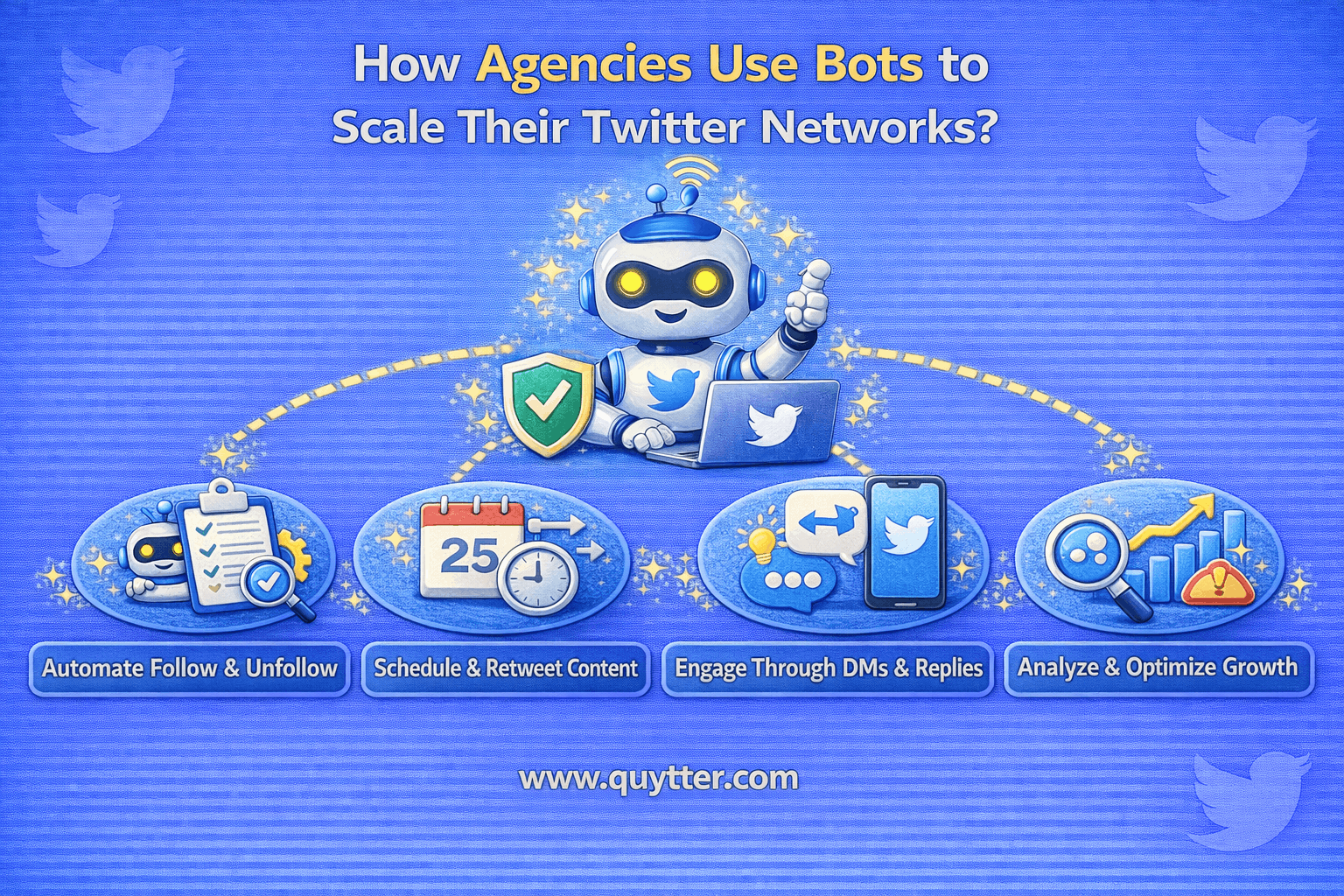
Agencies operate under constraints that individual marketers rarely face. They must deliver measurable results consistently across multiple client accounts, often within tight timelines and fixed budgets. Manual Twitter growth does not scale well under these conditions. Even a small engagement task multiplied across dozens of accounts quickly becomes operationally impossible. This is where multi account Twitter automation becomes essential rather than optional.
Automation allows agencies to decouple growth from headcount. Instead of hiring more community managers for repetitive tasks such as liking, retweeting, or initial engagement, agencies use bots to handle baseline activity. This frees human resources to focus on strategy, content quality, and client communication. In this context, bots act as force multipliers rather than replacements for human input.
Another reason automation matters is consistency. Agencies need predictable output. Bots can maintain steady engagement rhythms that would be difficult for humans to sustain over long periods. This is especially important for network based strategies where multiple accounts support each other through coordinated engagement. Without automation, maintaining this level of consistency becomes unrealistic.
However, agencies that succeed with automation understand that scale increases visibility to platform systems. This is why safe Twitter bot usage and risk aware implementation are central to agency workflows. Automation is valuable only when it can be sustained without burning accounts or damaging client trust.
Understanding Twitter Bot Networks in Agency Operations
A Twitter bot network in an agency context is fundamentally different from a single automated account. Agencies do not deploy bots in isolation. They design interconnected systems where each account plays a specific role within a larger ecosystem. Understanding this distinction is critical to grasping how agencies use bots to scale their Twitter networks effectively.
In agency operations, bot networks are often segmented by function. Some accounts act as content amplifiers, others as engagement warmers, and some as niche authority profiles. These accounts are not clones. Each has its own posting behavior, engagement patterns, and interaction scope. This diversity is intentional and necessary to avoid detection.
Agencies also think in terms of network effects. A single account engaging with content has limited impact. A coordinated group of accounts interacting in staggered, natural looking ways creates momentum that algorithms tend to reward. This is why Twitter bot networks are structured around timing, variation, and role separation rather than brute force automation.
Crucially, agencies manage these networks centrally. Bots are not allowed to operate independently without oversight. Network level monitoring allows agencies to detect anomalies early and adjust behavior before issues escalate. This systems based approach reflects a mature understanding of automation as infrastructure, not gimmick.
Common Agency Use Cases for Twitter Bots
Agencies deploy Twitter bots for specific, repeatable use cases that align with business objectives. One of the most common use cases is engagement amplification. Bots are used to provide initial likes and retweets that help client content gain early traction. This does not replace organic engagement, but it improves visibility during critical early moments.
Another common use case is content distribution. Agencies managing large volumes of content rely on bots to distribute posts across multiple accounts and niches. This ensures consistent exposure without requiring manual posting from every account. When implemented carefully, this supports scaling Twitter networks without overwhelming timelines or triggering spam signals.
Lead warming is another strategic application. Bots can engage with potential leads through light interactions such as likes or non intrusive replies. This familiarizes prospects with a brand before direct outreach occurs. Agencies use this technique to support downstream sales efforts while maintaining plausible human behavior.
Finally, bots support network maintenance. Dormant accounts are more likely to raise suspicion. Automation helps keep accounts active with minimal risk by maintaining baseline activity. These use cases demonstrate that agency bot usage is purpose driven rather than random.
How Agencies Structure and Segment Twitter Bot Networks?
Structure is the defining difference between amateur and professional automation. Agencies invest significant effort into segmenting their bot networks to minimize risk and maximize effectiveness. Accounts are rarely treated equally. Instead, they are categorized based on role, age, authority level, and risk tolerance.
For example, newer accounts may have very conservative automation limits, focusing only on light engagement. More established accounts with organic history may be allowed broader activity. This segmentation supports automation risk management by aligning behavior with account maturity.
Campaign separation is another structural principle. Agencies avoid running multiple campaigns through the same accounts simultaneously. Each network segment supports a specific client or objective. This prevents behavioral overlap that could create detectable patterns.
Agencies also vary behavior across segments. Timing, action types, and interaction targets differ between groups. This behavioral diversity is essential for avoiding platform detection systems and maintaining platform compliance at scale.
By designing networks with clear structure and segmentation, agencies turn automation into a controlled process rather than a liability.
Managing Risk When Scaling Multiple Twitter Accounts
When agencies scale Twitter bot networks, risk management becomes more important than raw growth. The bigger the network, the more visible it becomes to platform systems. Agencies that survive long term do not try to eliminate risk completely. Instead, they focus on controlling and distributing it intelligently.
One of the first risks agencies manage is pattern detection. When multiple accounts behave too similarly, platforms can identify coordinated activity. Agencies counter this by enforcing behavioral diversity across their networks. Each account operates with different timing windows, action frequencies, and interaction targets. Even when bots perform the same type of task, the execution is intentionally varied.
Another major risk is cascading failure. If one account is flagged, poorly designed networks allow that issue to spread. Professional agencies isolate accounts at the infrastructure level. Separate proxies, sessions, and automation rules prevent one compromised account from exposing others. This isolation is a core principle of safe Twitter bot usage.
Agencies also monitor account health continuously. Sudden drops in reach, temporary restrictions, or unusual engagement patterns are treated as early warning signals. Instead of pushing harder, agencies slow down, adjust automation parameters, or temporarily pause activity. This defensive mindset reflects an understanding that scaling Twitter networks is a marathon, not a sprint.
Tools and Dashboards Agencies Use to Control Bot Networks
As networks grow, agencies rely heavily on centralized tools to maintain control. Manual management simply cannot support the complexity of large scale automation. This is where centralized bot management systems become essential.
Dashboards allow agencies to oversee all accounts from a single interface. From one place, they can adjust action limits, schedule activities, and monitor performance. This unified view prevents blind spots that often lead to account loss.
Proxy and session management are also critical components. Agencies assign dedicated proxies to each account and ensure session data is never shared. Dashboards automate this process, reducing human error and maintaining consistency. This is especially important for multi account Twitter automation where manual proxy handling quickly becomes unmanageable.
Advanced dashboards also provide logging and alerts. Every action taken by a bot is recorded, creating transparency and accountability. When something goes wrong, agencies can trace the issue back to its source rather than guessing. These tools transform automation from a risky experiment into a controlled operational system.
Ethical and Sustainable Automation for Agencies
Agencies that rely on automation must balance efficiency with responsibility. While bots can scale engagement, unethical use damages both client trust and long term results. This is why leading agencies adopt ethical automation practices as part of their core philosophy.
Ethical automation starts with intent. Bots should support real marketing goals, not deceive users or manipulate perception. Agencies avoid tactics that create fake conversations or misleading signals. Instead, automation is used to amplify genuine content and assist human driven strategies.
Transparency is another ethical pillar. Agencies understand that platforms reward authentic interaction over time. Short term manipulation may deliver spikes, but it undermines brand trust and client credibility. Sustainable agencies prioritize longevity over quick wins.
By aligning automation with platform guidelines and user expectations, agencies protect their reputations. This approach supports sustainable social media marketing and ensures that automation remains a tool, not a liability.
How Agencies Reduce Risk While Scaling Engagement?
As platforms become more sophisticated, many agencies are rethinking how much responsibility they place on bot networks alone. Instead of relying exclusively on automation, agencies increasingly combine bots with safer, service based growth solutions. This is where platforms like Quytter play a strategic role.
Quytter allows agencies to scale visibility and engagement without exposing client accounts to the same level of risk as traditional bot networks. Rather than simulating behavior through large numbers of automated accounts, agencies can leverage controlled engagement services that align more closely with platform expectations.
This approach offers several advantages for agencies:
- Reduced infrastructure complexity with fewer automated accounts to manage
- Lower risk of coordinated behavior detection
- Faster onboarding for new client campaigns
- Easier compliance with platform policies
Agencies often use Quytter alongside light automation. Bots handle internal coordination and content distribution, while Quytter supports external visibility and engagement growth. This hybrid model allows agencies to maintain momentum without pushing bot networks beyond safe limits.
By integrating services like Quytter, agencies gain flexibility. They can scale campaigns confidently, protect client accounts, and focus more on strategy rather than constant risk mitigation.
Conclusion
Understanding how agencies use bots to scale their Twitter networks reveals a clear pattern. Successful agencies do not chase shortcuts. They build systems. Automation is treated as infrastructure, governed by rules, monitored continuously, and adjusted based on risk.
At the same time, agencies recognize that bots alone are not enough. Ethical considerations, platform compliance, and brand trust shape every decision. This is why modern agencies increasingly combine automation with safer alternatives that reduce exposure while preserving growth potential.
For agencies looking to scale Twitter networks responsibly, the path forward is clear. Use bots strategically, manage them through centralized systems, and complement automation with solutions like Quytter that support sustainable engagement. This balanced approach is what separates agencies that scale temporarily from those that scale professionally.