
The future of Twitter bot automation has become one of the most debated topics among marketers, agencies, and automation developers. For years, Twitter automation relied on relatively open API access, flexible rate limits, and a growing ecosystem of third party tools. Bots were able to like, retweet, follow, reply, and send messages at scale, enabling rapid growth strategies that shaped how networks were built and managed. That landscape has fundamentally changed. API updates introduced by X have reshaped what automation can and cannot do, forcing users to rethink long standing assumptions.
This guide explores how Twitter bot automation changes are redefining the entire automation ecosystem. This article explains why API updates altered the rules of the game, how automation worked before restrictions, and what those changes mean for bots and tools moving forward. Rather than focusing on shortcuts or loopholes, this analysis looks at structural shifts that determine whether automation remains viable, sustainable, and worth investing in.
Why X’s API Updates Changed Twitter Automation Forever?
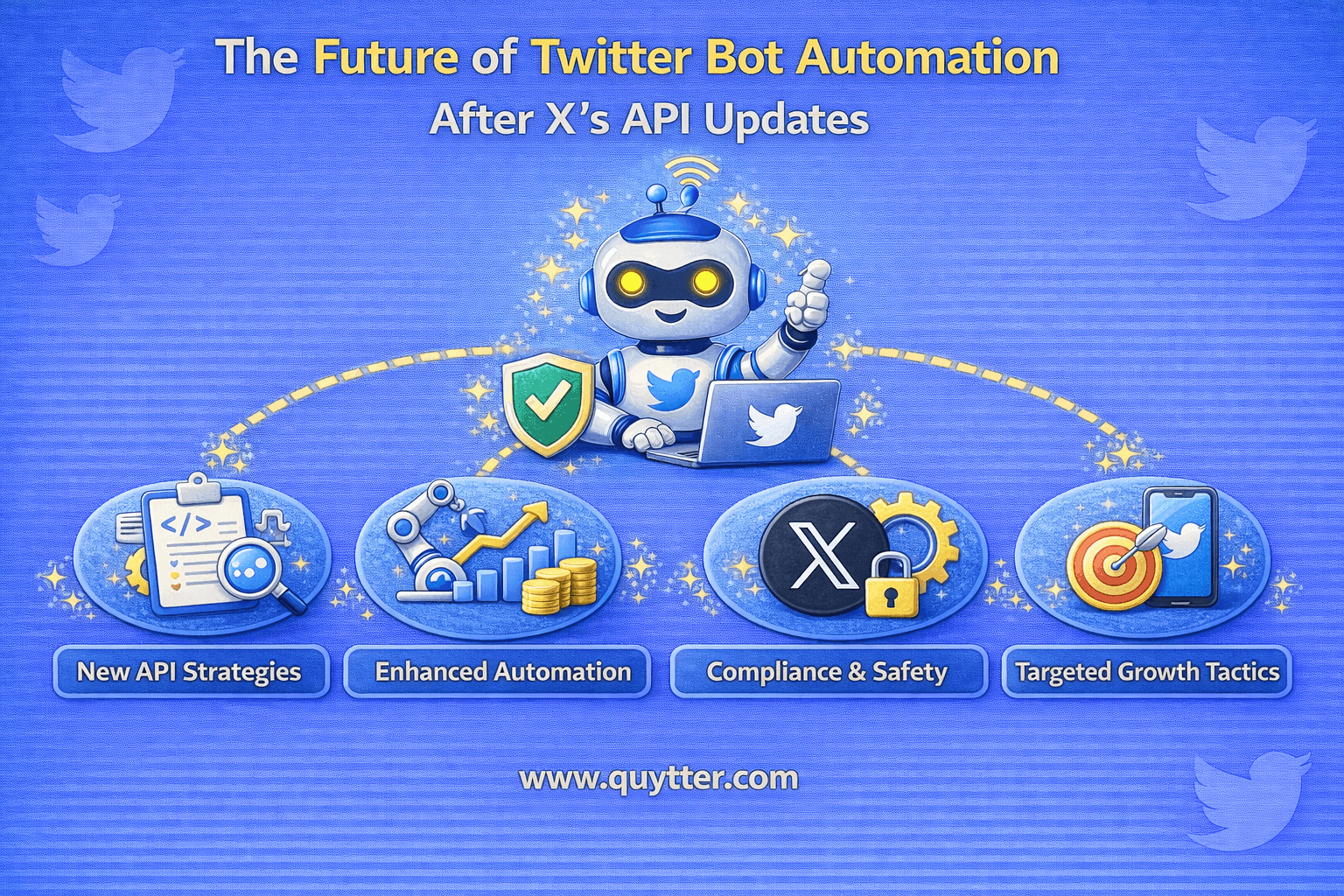
The introduction of stricter API controls marked a turning point in the Twitter automation future. Previously, automation thrived on relatively permissive access that allowed developers to build tools with broad functionality. Bots could interact with timelines, users, and content with minimal friction, as long as they stayed within loosely enforced limits. This environment enabled innovation but also abuse.
API updates fundamentally changed this dynamic by introducing tighter access control, clearer enforcement mechanisms, and a more explicit monetization model. Instead of treating API access as a developer convenience, X repositioned it as a gated resource. This shift impacted every layer of Twitter bot automation. Tools that relied on high volume interactions suddenly faced hard limits, while smaller developers struggled to justify rising access costs.
The reasoning behind these changes is not difficult to understand. Platforms have a vested interest in protecting user experience, data integrity, and advertising revenue. Unchecked automation often undermines these goals by flooding timelines with low quality interactions and artificial engagement. API updates act as a filter, reducing noise while giving the platform greater oversight.
For automation users, however, the effect is profound. The days of unlimited or low cost bot operations are over. Automation must now operate within tighter constraints, making scale more expensive and risk management more complex. This reality defines the future of Twitter bot automation as one where efficiency and selectivity matter more than brute force.
How Twitter Bot Automation Worked Before API Restrictions?
To understand the impact of API changes, it is important to examine how automation functioned before restrictions tightened. Traditional Twitter bot automation relied heavily on programmatic access to endpoints that allowed actions such as liking, retweeting, following, and replying. Developers could build scripts or dashboards that executed these actions at scale with relatively predictable outcomes.
Before major X API updates, rate limits were often generous enough to support continuous automation. Many tools operated under the assumption that as long as actions were spaced out and accounts appeared human like, automation would remain viable. This led to the rise of large bot networks, engagement pods, and automated outreach systems.
Automation tools also benefited from stable endpoints. When APIs remain unchanged for long periods, developers can optimize workflows and scale operations confidently. This stability encouraged agencies and growth teams to invest heavily in automation infrastructure.
However, this environment also created dependency. Many marketers built entire growth strategies around automation without considering long term platform shifts. When API access became restricted, these strategies collapsed overnight. The contrast between past and present highlights why understanding historical context is essential for predicting the future of Twitter bot automation.
What X’s API Updates Mean for Bots and Automation Tools?
The most immediate effect of API updates is reduced capability. Many endpoints that automation tools depended on now have stricter limits or require paid access. This directly affects third party automation tools, especially those designed for high volume interactions.
Rate limits are now more closely monitored and enforced. Bots that previously operated continuously must adapt to slower, more deliberate schedules. Paid API tiers introduce new cost considerations that change the economics of automation. For small scale users, the return on investment may no longer justify the expense.
Another significant change is increased accountability. API usage is more traceable, making it easier for the platform to identify abuse patterns. This raises the stakes for safe Twitter bot usage, as mistakes are less forgiving than before.
For automation tool developers, these updates force a strategic pivot. Some tools become obsolete, others evolve toward hybrid models that combine automation with manual or service based elements. The ecosystem is shrinking but also maturing, favoring quality and compliance over volume.
Which Types of Twitter Bots Are Most Affected?
Not all bots are impacted equally by API changes. High frequency interaction bots such as auto follow, auto like, and auto DM systems face the greatest disruption. These bots rely heavily on direct API access and high action volumes, making them vulnerable to rate limits and enforcement.
Engagement based bots that simulate conversations or replies are also affected. Automated replies often cross into spam territory, which platforms are actively targeting. As detection systems improve, these bots carry higher risk with diminishing returns.
On the other hand, bots focused on scheduling and content management are less impacted. These functions align more closely with legitimate use cases and require fewer interactions per unit of value. This distinction is crucial for understanding which automation strategies remain viable in the Twitter automation future.
What Still Works in Twitter Bot Automation After API Changes?
Despite stricter controls, Twitter bot automation is not dead. It has evolved. What still works today is not about volume or brute force actions, but about strategic, low footprint automation aligned with platform behavior. The future of Twitter bot automation favors precision, intent, and integration with human workflows.
One of the most resilient automation use cases is content scheduling and distribution. Scheduling tweets, threads, and reposts remains a legitimate function supported by the platform. These actions are predictable, low risk, and directly tied to content value rather than artificial engagement. Automation here enhances consistency, not deception.
Another area that still performs well is data driven monitoring. Bots that track mentions, keywords, competitors, or campaign performance operate primarily on read access rather than write actions. This significantly reduces risk while still delivering operational value. Agencies and growth teams increasingly rely on these bots for intelligence rather than engagement manipulation.
Limited interaction automation can also work when carefully constrained. For example, liking or retweeting a small number of highly relevant posts per day across aged accounts with real history remains feasible. The key difference is intent. Automation must support genuine engagement patterns instead of simulating mass behavior.
In short, safe Twitter automation now depends on three principles: low action frequency, contextual relevance, and human oversight. Bots that assist humans outperform bots that attempt to replace them.
Risks of Relying Only on Bots in the New Twitter Ecosystem
One of the biggest mistakes marketers make today is assuming automation alone can deliver sustainable growth. In the post API update environment, overreliance on Twitter bots introduces structural risks that compound over time.
First, account risk increases significantly. When automation is the sole growth driver, patterns become detectable. Even subtle repetition across multiple accounts can trigger enforcement systems. Losing accounts means losing historical trust, followers, and brand credibility.
Second, performance volatility becomes unavoidable. API rules can change without warning. Tools that function today may stop working tomorrow. Businesses that rely exclusively on bots have no buffer when automation pipelines fail.
Third, engagement quality deteriorates. Bots may generate impressions or surface level interactions, but they struggle to build relationships. Algorithms increasingly prioritize meaningful engagement, replies, and dwell time. Automation without human contribution rarely satisfies these signals.
A more sustainable approach treats automation as infrastructure, not strategy. Bots handle repetitive, low value tasks while humans focus on positioning, messaging, and relationship building. This balance defines the future of Twitter bot automation and separates durable growth from short term spikes.
Why Hybrid Automation Models Are Becoming the New Standard?
Hybrid automation combines bots, dashboards, and human decision making into a single workflow. This model has emerged as the dominant response to API constraints because it distributes risk and maximizes value.
In a hybrid system, bots handle scheduling, monitoring, and controlled interactions. Humans step in for replies, conversations, and strategic amplification. This structure reduces detectable patterns while increasing authenticity.
Hybrid models also scale better operationally. Instead of managing hundreds of autonomous bots, teams manage fewer, higher quality accounts with automation support. This reduces costs, simplifies compliance, and aligns with platform expectations.
Agencies adopting hybrid automation report more stable growth and lower account churn. The Twitter automation future clearly favors systems that enhance human capability rather than attempt to automate influence itself.
How Agencies Are Adapting Their Twitter Automation Strategy?
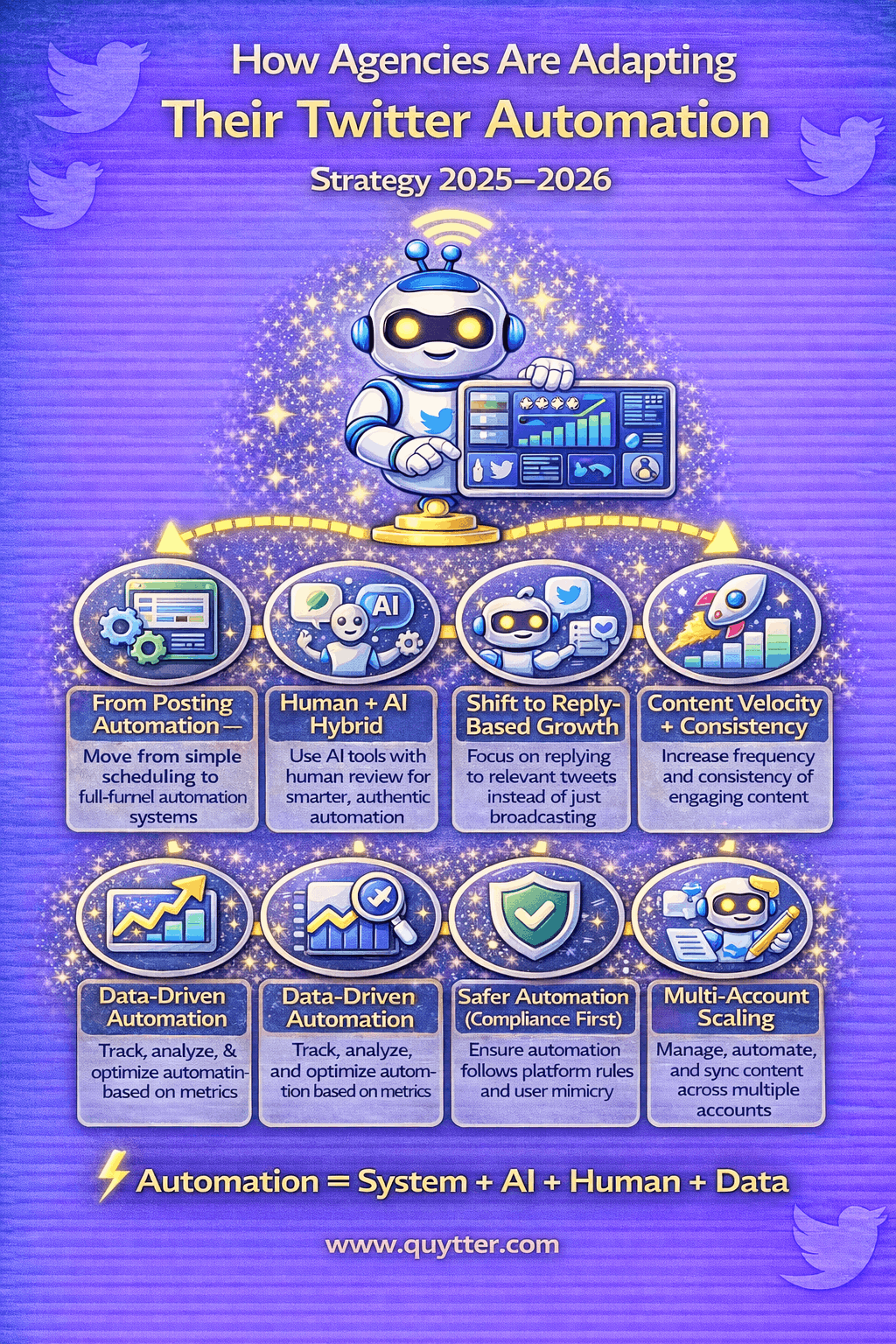
Professional agencies have been among the fastest to adapt to API changes. Their response offers valuable insight into where Twitter bot automation is heading.
Most agencies have reduced bot counts while increasing account quality. They invest in aged profiles, consistent content histories, and niche relevance. Automation is used sparingly, often capped at daily thresholds well below detection risk.
Agencies also centralize control. Instead of fragmented tools, they use unified dashboards to monitor actions, logs, and performance. This visibility allows rapid intervention if anomalies appear.
Finally, agencies prioritize compliance. Understanding API limits, platform policies, and automation ethics is now part of standard operating procedure. This professionalization signals that automation is no longer a hack, but a managed discipline.
Using Quytter to Navigate the New Era of Twitter Automation
As API changes reshape the automation landscape, tools must evolve beyond simple action bots. Quytter is designed specifically for this new environment, where control, safety, and scalability matter more than raw volume.
Quytter focuses on structured, compliant automation workflows rather than uncontrolled mass actions. Instead of pushing accounts to their limits, it emphasizes balanced activity patterns that align with real user behavior. This makes it suitable for businesses, agencies, and creators who value long term account health.
Key strengths of Quytter in the current Twitter automation future include centralized management, action pacing, and visibility into account behavior. These features help users avoid common automation pitfalls such as over engagement, pattern repetition, or silent rate limit violations.
More importantly, Quytter supports hybrid automation models. It integrates automation with manual oversight, allowing teams to intervene, adjust strategies, and maintain authenticity. This approach reflects how successful Twitter growth actually works today.
For organizations navigating API uncertainty, using a tool built around compliance and sustainability is no longer optional. It is the foundation of safe and effective automation.
Conclusion
The future of Twitter bot automation is not about doing more, faster, or cheaper. It is about doing less, smarter, and safer. API updates forced the industry to mature, exposing weak strategies while rewarding disciplined ones.
Automation still has a role, but it must operate within clear boundaries. Bots support systems, humans drive outcomes. Growth comes from relevance, trust, and consistency, not artificial signals.
Tools like Quytter demonstrate where automation is heading: controlled, transparent, and integrated with human strategy. For marketers and agencies willing to adapt, Twitter automation remains a powerful advantage. For those chasing shortcuts, it is an increasingly expensive liability.