
Engagement on Twitter (X) is easy to chase but hard to convert. Many accounts generate likes, replies, and impressions every day—yet sales remain flat. This disconnect happens because engagement alone does not equal intent, and Twitter does not automatically convert attention into action.
To turn engagement into sales, you must understand how Twitter’s algorithm distributes content, how users move from interaction to trust, and how buying intent is created inside timelines—not landing pages. This article explains how engagement becomes revenue, what most accounts do wrong, and how to build a repeatable Twitter-to-sales system.
Why Engagement Alone Does Not Create Sales?
Engagement is a signal, not a result.
Likes, replies, and retweets tell Twitter that content is interesting. They do not tell Twitter—or users—that a purchase should happen. Many accounts stall because they optimize for visible reactions instead of behavioral progression.
Common engagement traps include:
- Viral tweets with no relevance to the offer
- High reply counts but no authority positioning
- Entertainment content disconnected from buying intent
- Call-to-actions appearing too early
Twitter rewards interaction depth, but users only buy when they feel relevance, trust, and timing alignment. Engagement without direction creates attention without outcome.
Understanding the Twitter Sales Funnel
Sales on Twitter do not follow a straight line from post to purchase. They follow a behavioral funnel, shaped by repeated exposure, interaction, and trust-building over time. Twitter is not a checkout page — it is an environment where users decide whether to pay attention long before they decide to buy.
The real Twitter sales funnel looks like this:
- Exposure (Views)
Your content must first be seen. Without consistent exposure in relevant timelines, nothing else happens. Views are not value by themselves, but they create the opportunity for every downstream action. - Engagement (Replies, clicks, reading time)
Engagement is where Twitter — and users — start to care. Replies, profile clicks, and time spent reading signal that the content resonated. This is where attention turns into recognition. - Trust (Repeated interaction, familiarity)
Trust forms through repetition, not persuasion. Users see your name multiple times, recognize your perspective, and begin to associate you with a specific topic or problem. This stage is invisible but critical. - Intent (Problem–solution recognition)
At this point, users are no longer just consuming content. They recognize a problem they have and see you as someone who understands it. Intent often appears as DMs, saved tweets, or repeat profile visits. - Conversion (Click, DM, signup, purchase)
Conversion is the outcome, not the goal. It happens naturally when the earlier stages have been satisfied. Forcing this step early usually collapses the funnel.
Most accounts fail because they try to jump from engagement directly to conversion. They post once, get a few likes, then push a link or offer. Twitter does not reward this behavior, and users instinctively resist it. The platform amplifies accounts that move users through the funnel, not around it.
On Twitter, sales are earned through consistency, visibility, and behavioral trust, not persuasion tactics.
The Role of Replies in Creating Buying Intent
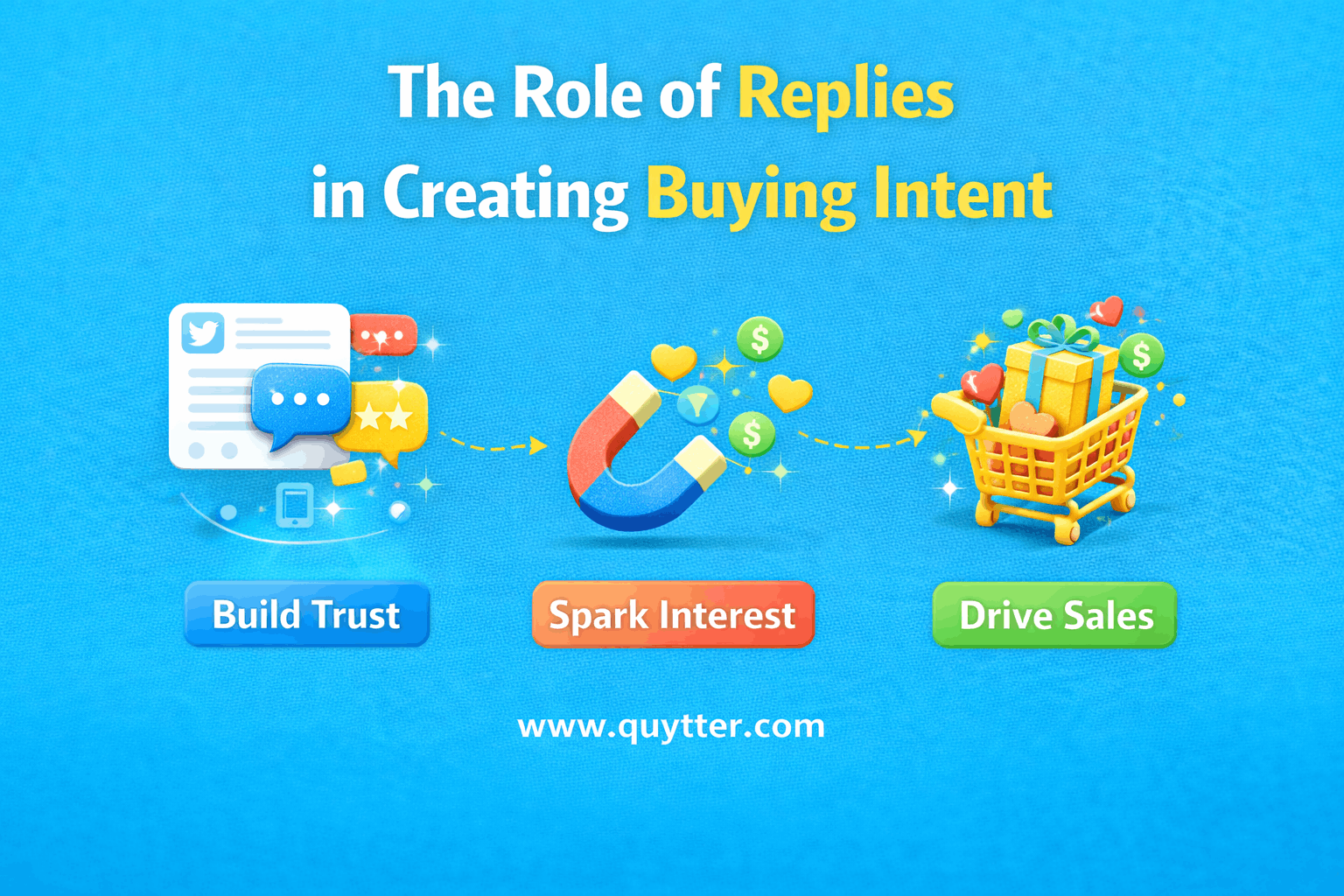
Replies are not vanity metrics. They are trust accelerators.
When users reply to your tweets, several things happen simultaneously:
- Twitter interprets the content as conversational and expands distribution
- Other users see social proof and contextual validation
- The author is positioned as accessible and knowledgeable
Replies create relational proximity. Sales rarely happen from one-way broadcasting. They happen after repeated conversational exposure.
Tweets that generate replies outperform like-heavy tweets in downstream actions such as:
- Profile visits
- Link clicks
- DM initiations
If your engagement strategy does not prioritize replies, it is unlikely to produce sales.
Why Most Promotional Tweets Fail?
Most promotional tweets fail because they break the flow of the timeline instead of fitting into it.
Twitter users are not scrolling with buying intent. They are scanning ideas, opinions, conversations, and insights. When a tweet suddenly switches tone into direct selling, it creates friction. Users scroll past not because the offer is bad, but because the context is wrong.
The most common failure points are structural:
- Selling before relevance is established
Tweets that promote products without prior interaction or topical alignment feel unearned. Users don’t trust offers from accounts that haven’t first delivered value. - Announcing offers to cold audiences
Exposure without familiarity rarely converts. If users don’t recognize the account or understand why it matters to them, promotional content is ignored. - Using generic or aggressive CTAs
Phrases like “Buy now,” “Check this out,” or “Don’t miss this” signal advertising, not conversation. These CTAs reduce replies and suppress early engagement signals. - Dropping links without narrative context
Links without framing force users to do cognitive work upfront. Twitter rewards tweets that create curiosity or insight before asking for action.
Twitter is not a marketplace feed. It is a conversation feed driven by behavioral signals. Promotional tweets that succeed do not feel like ads—they feel like the natural next step in an ongoing discussion.
Sales on Twitter happen when promotion follows relevance, not when it interrupts it.
Turning Engagement into Authority
Engagement only creates attention. Authority determines whether that attention turns into trust — and trust is what enables sales on Twitter.
On this platform, authority is never declared. It is inferred over time from behavioral patterns. Users do not decide to trust you because of one good tweet. They decide because your account consistently behaves like a reliable source within a specific domain.
Authority forms when engagement shows depth, not just activity. Replies that expand ideas, challenge assumptions, or add context signal expertise. Short agreement replies or emoji reactions do little to move perception. Twitter’s audience reads how you engage, not just that you engage.
Consistent topical focus is critical. When your engagement revolves around the same problems, themes, and questions, users begin to associate your account with that mental category. This makes future content easier to accept and recommendations easier to trust. Random engagement across unrelated topics weakens this association and resets perceived authority.
Authority also grows when your content reduces uncertainty. Tweets that explain why something works, anticipate objections, or clarify trade-offs signal competence. Sales-oriented accounts that convert well often educate long before they sell, answering questions users haven’t asked yet.
This is why accounts with modest follower counts can outperform larger ones in conversions. They have trained their audience to expect value, not promotion. By the time an offer appears, it feels like a logical next step — not an interruption.
On Twitter, engagement opens the door. Authority decides whether people walk through it with confidence.
Content That Converts vs Content That Performs
Not all high-performing content converts.
Content that converts usually has these traits:
- Problem-aware framing
- Specific audience language
- Clear positioning (“for who / not for who”)
- Soft directional CTAs
Content that performs but does not convert often includes:
- Broad motivational quotes
- Generic growth advice
- Humor unrelated to the offer
- Viral formats without context
If your best-performing tweets never lead to profile clicks or DMs, they are likely misaligned with your sales goal.
The Importance of Profile Optimization
On Twitter, your profile functions as a landing page, not a résumé.
After a user engages with your tweet, the next behavioral step is almost always the same: they click your profile. This is where most sales funnels silently break. Not because the offer is bad, but because the profile does not confirm what the tweet promised.
A conversion-ready profile does one job: reduce uncertainty. It tells the visitor, within seconds, that they are in the right place.
Effective profiles align four elements tightly:
- Clear one-line positioning
Users should instantly understand who you help and with what problem. Vague bios create hesitation, and hesitation kills conversions. - Audience-specific benefit
The bio should answer: “What do I get if I follow or trust this account?” Benefits outperform credentials. - Proof or credibility signal
This can be experience, results, social proof, or specificity. It doesn’t need to be loud, but it must be visible. - Simple next step
One clear action: link, DM prompt, or pinned tweet. Multiple options increase friction.
Tweets create interest. Profiles validate intent.
If your profile does not reinforce the narrative your content starts, users disengage without announcing it.
Using Soft CTAs Without Killing Engagement
Hard calls-to-action interrupt the timeline. Soft CTAs flow with it.
On Twitter, aggressive selling (“Buy now”, “Sign up today”) often suppresses engagement because it forces a decision before trust is established. The algorithm notices this drop in interaction and reduces distribution accordingly.
Soft CTAs work because they respect user readiness.
They invite curiosity instead of demanding action. They allow interested users to self-select, while uninterested users continue scrolling without reacting negatively.
Effective soft CTAs share three traits:
- They extend the conversation
Instead of ending the tweet with a command, they suggest continuation: more detail, deeper explanation, or context elsewhere. - They match the content’s intent
Educational tweets lead to guides. Insight threads lead to profiles. Problem-aware tweets lead to solutions—not checkout pages. - They avoid urgency language
No pressure, no countdowns, no forcing behavior. Calm confidence converts better on Twitter.
Examples of strong soft CTAs work because they feel optional, not intrusive:
- “I explained this step-by-step here →”
- “This is the framework I use. Full breakdown in bio.”
- “If you’re dealing with X, this matters.”
- “Wrote a full guide on this after seeing the replies.”
Soft CTAs preserve engagement velocity.
They allow Twitter to keep testing the tweet while quietly funneling high-intent users toward conversion.
On Twitter, momentum converts better than pressure.
Timing Sales Content Inside the Engagement Cycle
Sales content should follow engagement—not precede it.
Effective timing patterns:
- Reply-heavy tweet → follow-up tweet with offer
- Educational thread → soft CTA at the end
- Ongoing conversation → contextual product mention
Poor timing looks like:
- Cold sales tweets
- Repeated link drops
- Selling without conversational momentum
On Twitter, when you sell matters as much as what you sell.
Why Distribution Matters More Than Offer Quality?
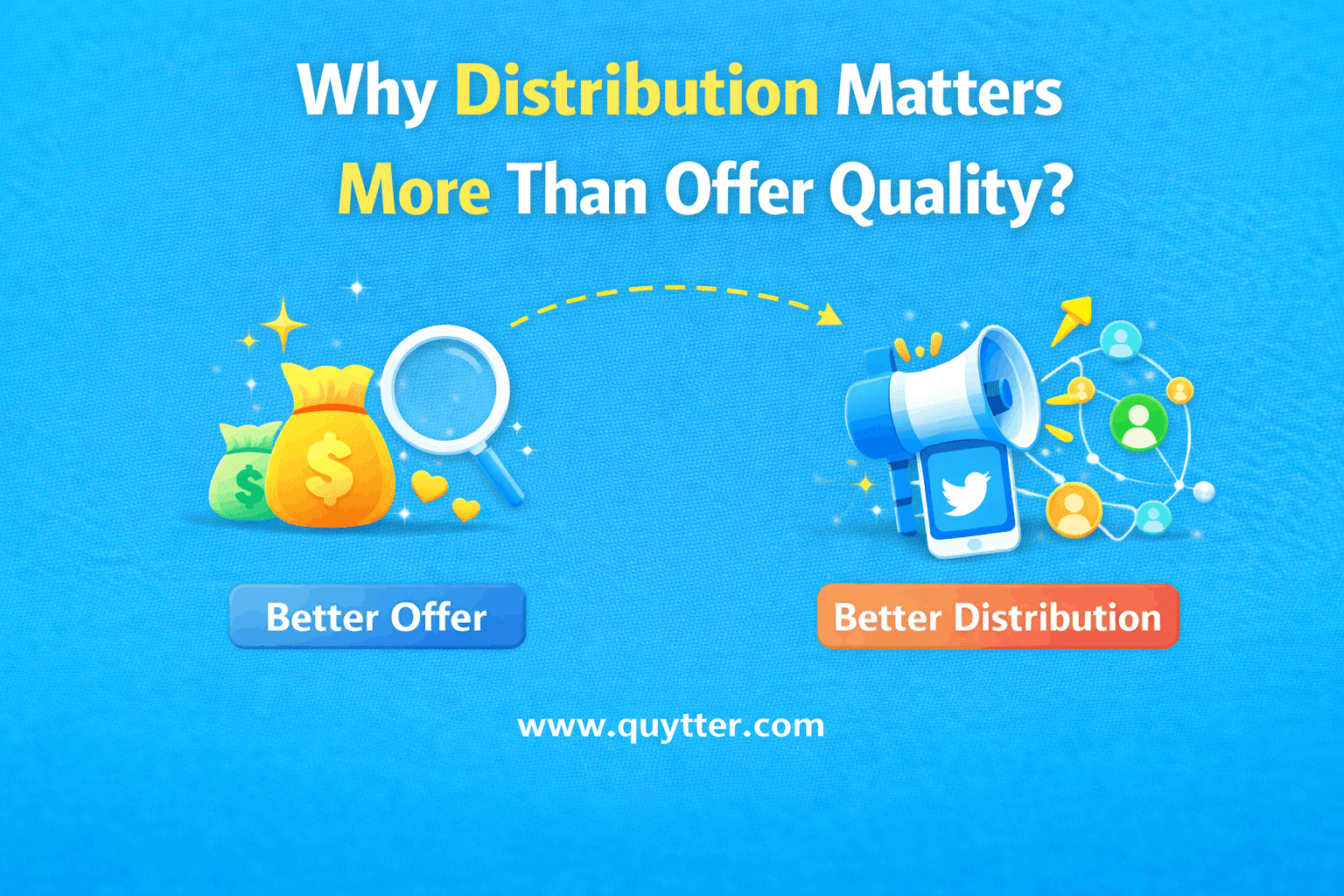
A strong offer means nothing if it never reaches the right people.
On Twitter, most failed sales are not caused by weak products or bad pricing. They happen because the message never enters the timelines of users who are already primed to care. No exposure means no consideration, regardless of how good the offer is.
Founders often misdiagnose this problem. When conversions are low, they assume the offer needs improvement. In reality, the offer was never tested properly because distribution was too limited. Twitter cannot evaluate intent if users never see the content in the first place.
This is why distribution support matters. Not to manufacture demand, and not to fake engagement—but to remove the visibility bottleneck. When real users actually see the message, Twitter can observe behavior, users can evaluate relevance, and conversion becomes possible.
On Twitter, offer quality determines what happens after exposure. Distribution determines whether exposure happens at all.
How Quytter Helps Turn Engagement Into Sales?
Quytter is built to strengthen the visibility and engagement layers of the Twitter sales funnel without corrupting behavioral signals.
Instead of inflating accounts with fake followers or scripted interactions, Quytter focuses on controlled exposure. Tweets receive real views from active Twitter users, delivered gradually so the algorithm can observe authentic behavior rather than artificial spikes.
Because Quytter does not force likes, replies, or follows, any engagement that occurs is voluntary. This is critical. Twitter treats voluntary replies and profile visits as trust signals, which directly influence future distribution and user perception.
By ensuring strong content is seen early by real users, Quytter increases the likelihood of:
- Meaningful replies
- Profile visits
- Repeated exposure
- Familiarity and trust formation
These are the conditions required for engagement to convert into sales.
Quytter does not sell on your behalf and does not manufacture intent. It removes the visibility bottleneck so your sales-capable content can perform naturally. When the right users see the right message at the right time, conversion becomes a behavioral outcome—not a forced action.
Measuring Whether Engagement Is Turning Into Sales
Engagement alone does not equal progress. What matters is whether engagement moves users closer to a buying decision.
Instead of celebrating likes or impressions, track actions that indicate intent. Profile visits per tweet show whether your content creates enough curiosity for users to learn more about you. Link clicks per impression reveal whether your message connects strongly enough to justify leaving the timeline. DMs initiated after threads are one of the clearest signals that trust is forming.
Timing matters as much as totals. If conversions happen days or weeks after repeated exposure, that is normal. Twitter sales are cumulative. If engagement increases but profile visits, clicks, or DMs stay flat, the problem is not reach—it is message–audience alignment.
Analytics should tell you whether engagement is advancing users through the funnel, not just inflating surface activity.
Common Mistakes That Block Conversion
Many accounts generate engagement but fail to convert because their actions break the trust-building sequence.
Chasing viral topics unrelated to your offer attracts the wrong audience and dilutes intent. Selling before authority is established creates resistance instead of interest. Ignoring replies after posting wastes the strongest conversion signal Twitter provides—direct conversation.
Optimizing for likes instead of intent encourages shallow interaction that rarely leads to sales. Treating Twitter like an ad platform leads to aggressive CTAs that disrupt the feed and push users away.
Conversions on Twitter come from consistency, relevance, and follow-through. Pressure kills sales. Presence builds them.
Conclusion
Engagement is not the goal on Twitter. It is the gateway.
Sales happen when engagement leads to trust, trust leads to intent, and intent meets the right moment. Accounts that convert do not shout louder. They guide users more clearly.
Understanding the mechanics explained in Twitter Growth Funnel: From Views to Followers to Conversions and strategies like Combining Paid Twitter Views with Organic Growth helps brands turn visibility into real opportunities.
Winning on Twitter means respecting behavior, pacing, and distribution logic. Visibility opens the door. Conversation builds trust. Alignment closes the sale within a well structured Twitter conversion focused growth strategy.
If you want engagement to stop being noise and start becoming revenue, you must design for conversion rather than hope for it.