
Hashtags on Twitter (X) have changed dramatically. What once acted as a discovery shortcut is now a misunderstood signal that can either support distribution—or quietly suppress it. Many accounts still treat hashtags as visibility boosters, adding them automatically to every tweet without understanding how the algorithm actually interprets them.
In 2026, hashtags are no longer about being “found.” They are about context alignment. Used correctly, they help Twitter understand where your tweet belongs. Used incorrectly, they confuse distribution, weaken early engagement, and reduce testing. This article explains how Twitter hashtags really work in 2026, when to use them, when to avoid them, and how to integrate hashtags into a modern, algorithm-aligned growth strategy.
How Twitter’s Hashtag System Works in 2026
Twitter no longer treats hashtags as simple search labels. They function as contextual classifiers.
When you include a hashtag, Twitter uses it to:
- Infer the topic of the tweet
- Match the tweet to interest graphs
- Decide which timelines and conversations the tweet should enter
Hashtags do not guarantee reach. They narrow interpretation.
This is a critical shift. A hashtag does not expand your audience by default. It tells Twitter, “This tweet belongs here.” If the system agrees—and user behavior confirms it—distribution can expand. If not, reach contracts.
In other words, hashtags are filters, not amplifiers.
Why Most Hashtag Strategies Fail?
Most Twitter hashtag strategies are outdated.
Common mistakes include:
- Adding hashtags to every tweet automatically
- Using trending hashtags unrelated to the content
- Stuffing multiple hashtags into short tweets
- Treating hashtags as a replacement for distribution
These tactics often backfire because they create context mismatch. When users see a hashtagged tweet that doesn’t align with their expectations, they scroll past. That early scroll behavior is a strong negative signal.
Twitter doesn’t penalize the hashtag. It penalizes the behavior that follows it.
The Role of Hashtags in Early Distribution
Every tweet starts with a test.
Twitter shows the tweet to a small group of users based on:
- Your past topical behavior
- Your audience’s interests
- Contextual signals (including hashtags)
Hashtags influence who sees the tweet first.
If that initial audience:
- Pauses
- Reads
- Replies
- Clicks
Distribution expands.
If they ignore it, testing stops.
This is why hashtags are dangerous when misused. They affect the first audience, not the final outcome.
Hashtags vs Interest Graphs: What Actually Matters More?
In 2026, interest graphs matter more than hashtags.
Twitter builds topic understanding from:
- What you tweet about consistently
- Who replies to you
- What your audience consumes
- How conversations cluster over time
Hashtags are a secondary signal layered on top of this graph.
If your account already has strong topical clarity, hashtags can reinforce it.
If your account jumps between topics, hashtags won’t save you—they amplify confusion.
Hashtags work best when they confirm what Twitter already believes about your content.
When Hashtags Help Performance?
Hashtags are not growth tools by default. They only help when they align with user intent and contextual relevance. In most cases, they narrow distribution rather than expand it, which is why they must be used selectively.
1. Niche, High-Intent Topics
Hashtags work best inside clearly defined communities where users actively search, follow, or monitor specific tags.
Examples include:
- Crypto sub-niches
- AI tooling
- Indie hacking
- SaaS founders
- Web3 protocols
In these environments, hashtags function as routing signals, not visibility boosters. They help Twitter classify the tweet and deliver it to users who already care about that topic.
The key point:
Hashtags do not create interest. They only help direct content when interest already exists.
2. Event-Based Conversations
Hashtags are effective during time-bound events where users intentionally follow a shared stream.
This includes:
- Conferences
- Product launches
- Live discussions
- Community campaigns
In these cases, hashtags help users track the conversation, not discover random content.
Critical condition:
Your tweet must contribute to the event narrative. Tweets that only mention the hashtag without adding insight often receive low engagement and weak behavioral signals.
3. Educational Threads
Hashtags can be useful at the end of long educational threads.
Placed correctly, they:
- Help Twitter classify the topic cluster
- Do not interrupt reading flow
- Support long-term discoverability
In this context, hashtags act as metadata, not engagement drivers. They assist topic modeling without forcing exposure.
Used sparingly, hashtags can support performance.
Used broadly or carelessly, they dilute signals and reduce reach.
When Hashtags Hurt Performance?
Hashtags can actively reduce reach when they interfere with how Twitter evaluates context and intent. This usually happens when hashtags conflict with the natural behavior Twitter expects from a tweet.
1. Short, Opinion-Based Tweets
Short takes depend on speed, emotion, and replies. Their job is to trigger an immediate reaction.
When you add hashtags to these tweets, you interrupt the conversational flow. The tweet stops feeling like a thought and starts feeling like a broadcast.
From the algorithm’s perspective, this changes expected behavior. Twitter expects replies on opinion tweets. Hashtags often reduce reply likelihood, which weakens early signals and causes testing to stop faster.
2. Broad or Trending Hashtags
Generic hashtags like #marketing, #business, or unrelated trending tags introduce audience mismatch.
Instead of helping discovery, they expose the tweet to users who are not contextually aligned. Those users scroll past, ignore, or disengage. Twitter interprets this as low relevance, not bad luck.
The result is weaker engagement quality, lower expansion confidence, and reduced overall distribution—even if the content itself is strong.
3. Multiple Hashtags in One Tweet
Using multiple hashtags creates competing audience signals.
Twitter’s system tries to determine who the tweet is for. When several hashtags point to different interest clusters, the algorithm cannot confidently select a testing audience. In response, it becomes conservative.
Conservative testing means fewer impressions, slower expansion, and limited reach. Instead of helping classification, multiple hashtags often confuse it.
In these cases, hashtags don’t just fail to help. They actively introduce friction into distribution and suppress performance.
How Many Hashtags Should You Use in 2026?
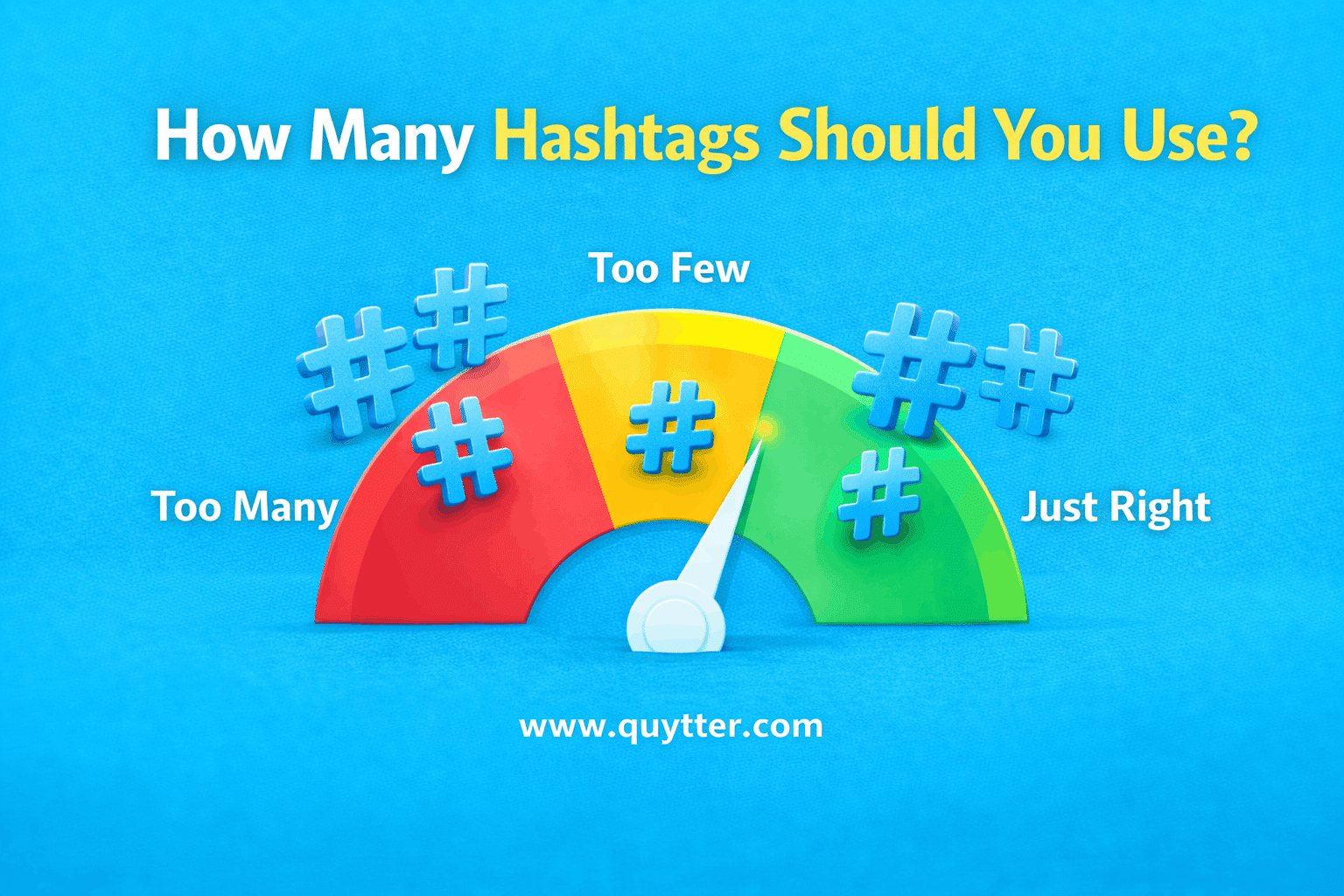
For most accounts in 2026, the optimal number of hashtags is simple:
Zero or one.
Twitter no longer relies on hashtags as a primary discovery mechanism. Topic modeling, interest graphs, and behavioral signals now do the heavy lifting. Hashtags are supplementary at best, and harmful when overused.
Practical guidelines:
- 0 hashtags for conversational, opinion-based, or reply-driven tweets
These tweets rely on emotion, timing, and interaction. Hashtags add visual friction and weaken conversational tone, which reduces replies—the most valuable signal. - 1 hashtag for niche, educational, or event-based content
In these cases, a single, highly specific hashtag helps classification without competing contexts. It should reinforce what the tweet is already about, not redefine it. - Never more than 2 hashtags
Multiple hashtags introduce ambiguity. Twitter must decide which topic graph to test against, and when signals conflict, distribution becomes conservative.
If you feel the need to add several hashtags, it usually indicates a deeper problem: the content itself lacks a clear audience or purpose. In 2026, clarity outperforms coverage. Fewer signals, when aligned, travel further than many signals pointing in different directions.
Hashtags should support intent—not compensate for it.
Placement: Where Hashtags Belong?
Placement matters because hashtags change how a tweet is read and how it is classified. When hashtags appear inside the main sentence, they interrupt reading flow and shift attention away from the idea you’re trying to provoke. This reduces replies, which are far more important than hashtag-based discovery. Tweets that feel conversational perform best when nothing breaks the rhythm of the thought.
From an algorithmic perspective, hashtags work best as metadata, not messaging. Twitter already analyzes text, replies, and audience behavior to understand topic relevance. A hashtag should simply confirm context after the message is delivered, not compete with it. When hashtags are placed at the end, they help classification without interfering with engagement signals.
For threads, placement becomes even more important. Adding hashtags to the first tweet can lower reply velocity, which weakens early signals for the entire thread. Placing hashtags only in the final tweet preserves conversational momentum while still giving Twitter a clean topical label for the thread as a whole.
Best practices recap:
- Place hashtags at the end of the tweet
- Never interrupt the main sentence with a hashtag
- Avoid embedding hashtags mid-thought or mid-hook
- For threads, place hashtags in the last tweet only
Used this way, hashtags support clarity without hurting interaction. When they start competing with the message, they stop helping and start suppressing reach.
Hashtags and Replies: An Important Relationship
Replies are one of the strongest behavioral signals on Twitter. They show intent, effort, and willingness to participate in a conversation. From the algorithm’s perspective, a reply means the tweet didn’t just get seen — it provoked thought. Hashtags, by contrast, are passive classification signals. When the two conflict, replies always matter more.
The problem arises when a hashtag routes your tweet into the wrong timelines. If users who see the tweet don’t feel context, relevance, or emotional connection, they won’t reply. Even if impressions increase slightly, the absence of replies sends a clear negative signal: the tweet reached people who didn’t care enough to engage. Twitter learns from that mismatch and becomes more conservative with future distribution.
This is why many hashtagged tweets feel “seen but ignored.” The hashtag may increase exposure, but it lowers conversational fit. Replies dry up, early engagement weakens, and the tweet fails its expansion tests.
A practical rule is simple:
If a hashtag lowers the probability of replies, it is harming performance.
Hashtags should only be used when they increase the chance that the right people respond, not just scroll past.
On Twitter, conversation drives distribution. Categorization is secondary. Conversation > categorization — always.
Measuring Hashtag Impact Using Twitter Analytics
Do not guess. Measure.
Track these metrics:
- Impressions with vs without hashtags
- Replies per impression
- Engagement timing (first hour)
- Profile clicks
Most accounts discover that hashtagged tweets:
- Get similar or fewer impressions
- Generate fewer replies
- Perform worse in early engagement
If analytics confirms this, remove hashtags entirely for most posts.
A Simple Hashtag Decision Framework
Before using a hashtag, ask:
- Does my audience actively follow this topic?
- Does this tweet clearly belong to that topic?
- Will this increase replies, not just impressions?
- Does my account already have topical clarity?
If any answer is “no,” skip the hashtag.
Common Hashtag Myths (And Why They’re Wrong)
Myth: Hashtags increase reach
Hashtags do not automatically expand distribution. In most cases, they narrow it. Twitter uses hashtags as topical filters, meaning your tweet is routed into a smaller, more specific pool rather than broadly tested across relevant timelines. If that pool does not engage strongly, distribution stalls faster.
Myth: Trending hashtags boost visibility
Trending hashtags rarely help unless your content already belongs inside that conversation. Injecting unrelated tweets into trending topics exposes content to users with no intent to engage. This creates fast scroll-past behavior, which weakens early signals and reduces further testing.
Myth: More hashtags = more discovery
Multiple hashtags do not stack visibility. They fragment context. When a tweet signals too many topics at once, Twitter’s system struggles to classify it cleanly, leading to diluted testing and weaker distribution. Clarity beats coverage.
Hashtags do not create demand. They only organize it. When demand is weak, hashtags amplify the wrong signals instead of fixing the problem.
How Hashtags Fit Into a Modern Twitter Growth Strategy?
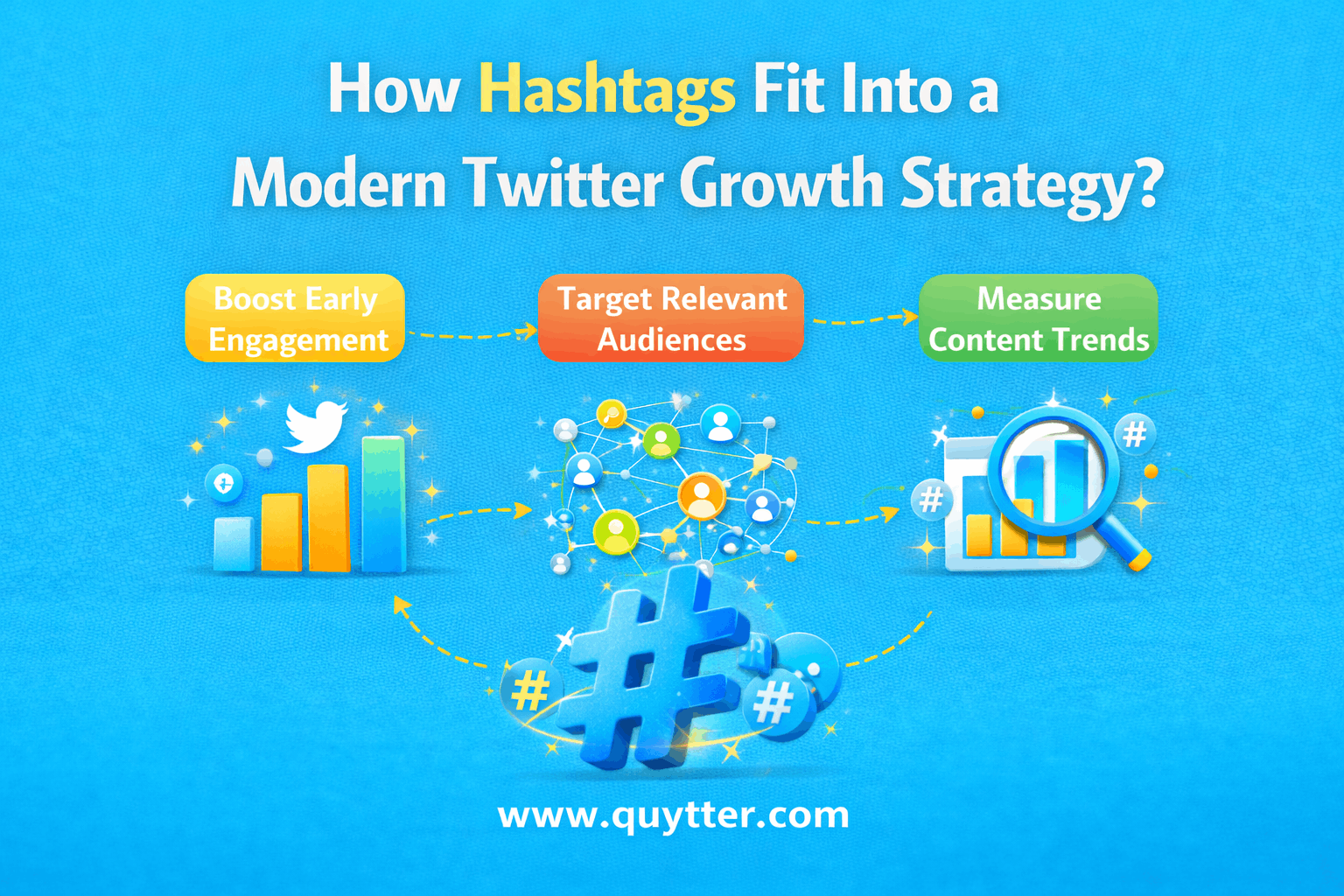
In 2026, Twitter growth is driven by behavior, not metadata. Hashtags no longer act as a primary discovery mechanism. They play a secondary, contextual role at best.
Modern growth comes from a small set of core factors:
- Strong hooks
Tweets must earn a pause. If the first line doesn’t stop the scroll, hashtags won’t save it. - Reply-driven content
Twitter prioritizes conversation. Tweets that invite replies generate deeper signals than tweets optimized for passive reach. - Early engagement
The first visibility window determines whether a tweet expands. Hashtags do not create engagement; users do. - Consistent topical focus
The algorithm builds interest graphs from behavior. Clear topics distribute better than scattered hashtag usage. - Controlled distribution
Who sees the tweet first matters more than which tags are attached to it.
Hashtags are optional because they do not generate behavioral depth. Distribution is not. Without the right users seeing a tweet early, hashtags have no leverage.
This is why most high-performing accounts either use hashtags sparingly or avoid them entirely. Their reach comes from relevance, timing, and interaction—not from keyword labels.
How Quytter Supports Hashtag-Free, Algorithm-Aligned Growth?
Quytter is built for how Twitter actually distributes content in 2026—not how it used to work years ago. Instead of depending on hashtags to force visibility, Quytter supports discovery at the algorithmic level, where behavior matters more than metadata.
Rather than pushing tweets into generic hashtag feeds, Quytter focuses on real early exposure. Tweets receive views from active Twitter users who are already relevant to the topic, allowing the algorithm to test content naturally through pause time, replies, and downstream interaction. This gives Twitter real behavioral data instead of surface-level signals.
Delivery is gradual and paced, which is critical. Sudden spikes from hashtag abuse or artificial promotion often create unstable patterns. Quytter aligns exposure speed with what Twitter expects from organic distribution, reducing friction and preserving account trust.
Importantly, Quytter does not force engagement. There are no bundled likes, replies, or scripted actions designed to simulate interest. This allows Twitter to observe what users choose to do after seeing the tweet. When engagement happens voluntarily, signals stay clean and distribution expands without distortion.
By removing the need to rely on hashtags as a visibility crutch, Quytter lets content succeed or fail based on real user response. When the right users see a tweet early, replies and sharing emerge naturally—making hashtags optional rather than necessary.
Quytter supports clarity, pacing, and signal integrity. In a system driven by behavior, this is what allows growth to compound without relying on outdated hashtag tactics.
Conclusion
Hashtags are no longer growth hacks. They are contextual tools.
Used carefully, they help Twitter understand where your content belongs. Used carelessly, they suppress reach by confusing early distribution. Understanding principles discussed in How Twitter’s Algorithm Works and How to Build a Viral Tweet Strategy makes it clear why behavior and early engagement now matter far more than metadata.
Most accounts do not need hashtags to grow. They need stronger hooks, better conversation triggers, and cleaner distribution signals that support a consistent behavior driven Twitter growth strategy.
Hashtags do not make tweets viral. Behavior does. If your strategy still relies on hashtags for reach, the platform has already moved beyond that model.