
The debate around twitter auto like bot vs twitter auto retweet bot has become increasingly intense as automation continues to shape how engagement works on Twitter. Many marketers, creators, and brands want faster growth, higher visibility, and stronger social proof without spending endless hours manually interacting with content. This demand has pushed automation tools into the spotlight, especially bots that can like or retweet content at scale. However, while both options promise engagement, they operate very differently within the platform’s ecosystem, and misunderstanding those differences can quietly destroy reach, credibility, and long term account health.
At first glance, auto likes and auto retweets seem similar because both inflate engagement metrics. In reality, they send very different behavioral signals to the algorithm, trigger different detection patterns, and carry different levels of risk. Choosing the wrong approach can lead to shadow suppression, reduced distribution, or even account limitations. That is why understanding how these tools actually work matters far more than chasing surface level numbers.
This guide breaks down the real differences between twitter auto like bot vs twitter auto retweet bot, not from a hype driven perspective, but through experience, platform behavior analysis, and real marketing use cases. This article explains how each bot functions, how they influence engagement signals, what risks they introduce, and why many growth strategies fail when automation is used without context or control.
What Is a Twitter Auto Like Bot?
A twitter auto like bot is an automation tool designed to automatically like tweets based on predefined rules such as hashtags, keywords, accounts, or timelines. Instead of manually engaging with content, the bot simulates liking behavior at scale, creating the appearance of activity and interest from an account. On the surface, this seems harmless because likes are often considered the lowest effort form of engagement on Twitter.
From a behavioral standpoint, likes function as lightweight engagement signals. They tell the algorithm that a tweet is receiving attention, but they do not redistribute the content into new timelines the way retweets do. This distinction is critical. Auto like bots primarily aim to boost engagement rate, increase visibility within existing networks, and create social proof without aggressively expanding reach.
Most twitter automation tools that focus on likes operate using one or more of the following mechanisms:
- Liking tweets containing specific hashtags
- Liking tweets from accounts within a niche
- Liking recent tweets matching keyword filters
- Liking content from followers or followed accounts
When configured conservatively, auto like bots can simulate natural browsing behavior. However, problems arise when automation becomes excessive, repetitive, or poorly targeted.
From an algorithmic perspective, likes contribute to automated twitter engagement signals that help tweets perform better within limited circles. They can increase the chance that a tweet appears in replies ranking or secondary timelines, but they rarely generate meaningful discovery on their own. This is why likes are often used as a supporting tactic rather than a primary growth engine.
There are situations where a twitter auto like bot makes sense. For example, creators trying to maintain consistent engagement with niche communities may use likes to stay visible without overwhelming their workflow. Brands may also use likes to reinforce relationships with customers or partners. However, the effectiveness of this tactic depends entirely on moderation and relevance.
The risks begin when likes are deployed indiscriminately. Over liking unrelated content, liking hundreds of tweets per hour, or engaging with spammy accounts sends abnormal signals. These patterns are easily detected by bot detection systems, especially when combined with other automation behaviors.
Another overlooked limitation is that likes do not amplify content distribution. A tweet with many likes but few retweets often stalls quickly. This is why marketers focused solely on likes may see engagement numbers increase while reach and impressions remain flat.
In summary, a twitter auto like bot operates as a subtle engagement amplifier. It influences perception more than distribution. When used carefully, it can support growth. When abused, it becomes a silent liability.
What Is a Twitter Auto Retweet Bot?
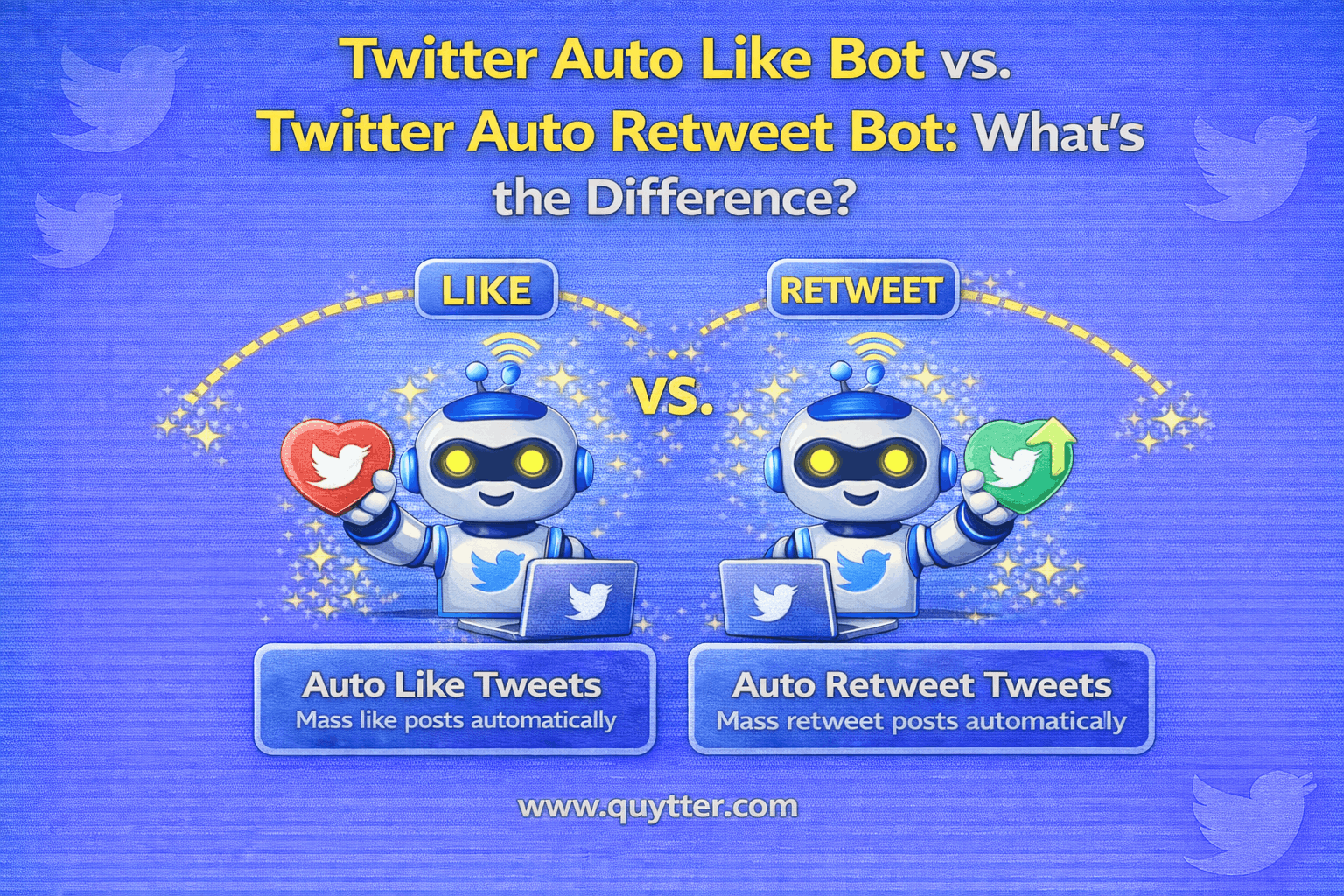
A twitter auto retweet bot automates the process of retweeting content based on specific triggers such as keywords, hashtags, mentions, or selected accounts. Unlike likes, retweets actively redistribute content into the retweeter’s follower network, making them one of the strongest engagement signals available on Twitter.
From a platform mechanics standpoint, retweets function as amplification events. Each retweet gives a tweet a new chance to appear in timelines, recommendation feeds, and search results. This is why many users see auto retweet bots as a shortcut to rapid growth and exposure.
Most twitter engagement bots designed for retweeting follow patterns such as:
- Retweeting tweets that mention certain keywords
- Retweeting content from selected influencer accounts
- Retweeting posts within a defined hashtag stream
- Retweeting tweets that meet engagement thresholds
Because retweets actively push content outward, they interact much more aggressively with the algorithm. A retweet is interpreted as endorsement, relevance, and distribution combined. This makes auto retweet bots far more powerful than auto like bots, but also far more dangerous.
The biggest advantage of a twitter auto retweet bot is its ability to increase twitter reach and impressions quickly. Retweets place content directly into the timelines of new users, potentially triggering secondary engagement loops. For campaigns, launches, or announcements, this can look extremely attractive.
However, this power comes with significant downsides. Retweets leave a visible footprint on an account’s timeline. When an account retweets irrelevant, low quality, or spammy content, it damages credibility. More importantly, aggressive retweet automation is one of the fastest ways to trigger twitter automation rules enforcement.
From an algorithmic perspective, Twitter monitors retweet velocity, content relevance, and network alignment. When an account retweets too frequently, retweets unrelated topics, or amplifies low trust sources, it raises red flags. This often results in reduced distribution, temporary suppression, or long term trust degradation.
Unlike likes, retweets are harder to hide. Followers see them. The platform measures them. And when automation patterns repeat across multiple accounts, detection becomes easier.
In practice, many users experience a paradox with auto retweet bots. Engagement spikes initially, but over time reach collapses. This happens because the algorithm deprioritizes accounts that behave like distribution farms rather than genuine participants.
In short, a twitter auto retweet bot is a high impact, high risk tool. It can accelerate growth in the short term but often undermines sustainability when used without strategic control.
Twitter Auto Like Bot vs Twitter Auto Retweet Bot: Core Differences
Understanding the real differences between twitter auto like bot vs twitter auto retweet bot requires moving beyond surface metrics and looking at how each action is interpreted by the platform.
Likes and retweets serve different algorithmic purposes. Likes function as lightweight validation signals. Retweets function as content distribution mechanisms. This single distinction explains why their risks and rewards differ so dramatically.
From an engagement signal perspective, likes indicate interest without commitment. They suggest that content resonated with someone scrolling. Retweets, on the other hand, indicate endorsement and willingness to share content with others. This makes retweets far more valuable but also far more scrutinized.
In terms of increase twitter engagement, likes primarily boost engagement rate calculations, while retweets influence reach, impressions, and secondary interactions. A tweet with many likes but few retweets often stays confined to a limited audience. A tweet with retweets can travel far beyond the original network.
Risk exposure is another major difference. Auto likes are relatively low risk when throttled properly. Auto retweets are one of the most common triggers for account suspension risk when abused. This is because retweets directly manipulate content distribution.
There is also a branding consideration. An account that auto likes content maintains a clean timeline. An account that auto retweets fills its feed with content it may not fully control. This affects perceived authenticity and trust.
From a marketing strategy standpoint, likes support relationship building and visibility within niches. Retweets support content amplification and campaign scaling. Each has its place, but they should not be treated as interchangeable.
One critical insight many marketers miss is that automation effectiveness is contextual. The same tool can produce wildly different outcomes depending on audience alignment, frequency, and intent. This is why blanket advice about bots often fails.
Which Bot Is More Effective for Twitter Growth?
The question of which tool drives better growth cannot be answered without defining the goal. Growth on Twitter is not a single metric. It includes visibility, follower quality, engagement depth, and long term account trust.
For organic twitter growth, auto like bots tend to be safer and more sustainable when used in moderation. They help maintain consistent interaction without overwhelming the algorithm. They are especially useful for creators who want to stay visible within conversations without aggressively pushing content outward.
Auto retweet bots are more effective for short term exposure. They can rapidly increase boost tweet visibility during campaigns, announcements, or trend based moments. However, their effectiveness declines quickly when overused.
Audience quality also matters. Likes often come from users already aligned with the niche. Retweets may expose content to broader but less targeted audiences. This can inflate impressions while lowering engagement quality.
There is also the issue of diminishing returns. The more automation an account uses, the less impact each action has. This is especially true for retweets, where repeated patterns are quickly deprioritized.
In practice, sustainable growth rarely comes from choosing one bot over the other. It comes from understanding how each behavior fits into a larger twitter marketing strategy. Automation should support human intent, not replace it.
Risks of Using Auto Like and Auto Retweet Bots at Scale
When comparing twitter auto like bot vs twitter auto retweet bot, the biggest mistake marketers make is assuming that risk only appears when accounts get suspended. In reality, the most damaging consequences of automation happen long before any visible penalty occurs. These risks are subtle, cumulative, and often irreversible once triggered.
The first major risk is behavioral pattern detection. Twitter does not judge actions in isolation. It evaluates rhythm, repetition, and consistency across time. Auto like bots often fail when they interact with content at uniform intervals, like every 30 seconds or every minute, regardless of topic relevance. Auto retweet bots fail even faster because retweets carry heavier weight and are monitored more aggressively.
Another major risk is contextual mismatch. When bots like or retweet content outside the account’s historical niche, it sends conflicting signals to the algorithm. For example, an account that normally engages with marketing content but suddenly retweets crypto giveaways or political threads creates trust degradation. Over time, this reduces content distribution even for legitimate posts.
There is also network contamination risk. Bots frequently interact with low quality or spam accounts. When an account repeatedly engages with flagged profiles, it inherits some of that risk profile. This is one of the fastest ways accounts lose visibility without receiving any notification.
Retweet automation introduces an additional layer of danger: distribution abuse. Auto retweet bots can unintentionally amplify harmful, misleading, or low trust content. Even if no rules are technically broken, the account becomes algorithmically deprioritized as a content amplifier rather than a trusted participant.
From an E E A T perspective, the long term cost is credibility. Automation that feels artificial damages perceived authenticity. Followers stop engaging. Real users stop responding. Engagement becomes hollow metrics without conversion value.
In short, the danger of automation is not suspension. It is silent decay. Accounts continue posting, but reach shrinks, impressions fall, and growth stalls. This is why blindly deploying bots, especially retweet bots, is one of the most common causes of failed Twitter growth strategies.
Why Most Twitter Automation Strategies Fail Over Time?
Most automation strategies fail because they are built around actions, not intent. Tools execute tasks, but platforms evaluate behavior. This disconnect explains why many users see early success followed by sudden stagnation.
One common failure pattern is over optimization. Users configure bots to maximize daily actions under perceived limits. Even when limits are respected, the behavior lacks natural variability. Humans do not like 300 tweets per day every day. Humans slow down, change interests, and react to context. Bots that do not mimic this variability stand out.
Another major reason for failure is metric obsession. Many strategies prioritize likes, retweets, or follower counts without considering engagement quality. Auto retweet bots inflate impressions but often reduce reply depth. Auto like bots inflate engagement rate but rarely drive conversations. Over time, the algorithm learns that the engagement does not lead to meaningful interaction.
There is also a misunderstanding of trust accumulation. Trust on Twitter is not reset daily. It is cumulative. Every automated action contributes to a long term profile. When automation is layered on top of automation, risk compounds even if no single action violates a rule.
A critical but overlooked issue is automation dependency. Accounts that rely heavily on bots often stop producing high quality content or genuine interaction. When automation is paused, performance collapses because no real audience relationship was built.
From experience, the most successful accounts use automation sparingly, strategically, and invisibly. Automation supports human activity instead of replacing it. Bots that attempt to fully simulate growth almost always fail in the long run.
When Auto Like Bots Make Sense and When They Do Not?
A twitter auto like bot can be effective when its role is clearly defined and limited. Likes work best as a visibility reinforcement tool, not a growth engine.
Auto likes make sense when:
- Supporting niche engagement within a clearly defined topic
- Reinforcing relationships with existing followers
- Maintaining baseline activity during low posting periods
- Complementing manual replies and conversations
In these scenarios, likes act as social signals that keep the account present without overwhelming the algorithm. They help maintain familiarity rather than manufacture popularity.
Auto likes fail when they are used to:
- Target trending topics unrelated to the account
- Engage with large volumes of random accounts
- Replace real interaction entirely
- Chase engagement metrics without strategy
When auto likes lose relevance, they become noise. The algorithm learns to discount them, and the account gains no meaningful benefit. This is why auto like bots should always operate under strict targeting and conservative frequency.
When Auto Retweet Bots Are Especially Dangerous?
A twitter auto retweet bot becomes dangerous the moment it operates without human oversight. Retweets are endorsements in the eyes of both users and the platform.
Auto retweets are risky when:
- Retweeting content outside the account’s niche
- Retweeting too frequently within short timeframes
- Retweeting low trust or spammy sources
- Retweeting purely based on keywords without context
Unlike likes, retweets permanently alter an account’s public feed. Followers judge credibility based on what appears there. Even a short period of poor retweet automation can damage brand perception.
Algorithmically, retweet abuse accelerates trust decay. Accounts that act like distribution hubs rather than genuine participants are gradually removed from recommendation systems. This often looks like shadow suppression, even when no penalty is officially applied.
Auto retweets should only be used in extremely controlled environments, such as temporary campaign amplification with carefully curated sources. Outside of that, they introduce more risk than reward.
A Safer Alternative to Bots: Strategic Engagement Services
At this point, a critical question emerges. If bots are risky, but growth still requires visibility, what is the alternative?
The answer lies in controlled engagement systems rather than raw automation. This is where many users misunderstand the difference between bots and engagement services.
Bots simulate behavior blindly. Strategic services execute actions within safe parameters, with human level pacing, relevance filters, and risk controls. The goal is not to fake engagement, but to accelerate exposure without triggering algorithmic penalties.
This distinction matters because platforms reward authentic looking interaction, not mechanical repetition. Systems built around safety, pacing, and relevance consistently outperform bots over time.
How Quytter Helps You Grow Without Bot Risks?
Unlike traditional twitter automation bots, Quytter is designed to solve the exact problems that cause automation strategies to fail. Instead of simulating fake behavior, Quytter focuses on controlled, high quality engagement delivery that aligns with how Twitter evaluates trust and relevance.
Quytter does not auto like or auto retweet randomly. Its services help users:
- Increase tweet visibility through real engagement signals
- Build social proof without aggressive automation
- Avoid repetitive behavioral patterns that trigger detection
- Maintain account credibility while scaling reach
For example, instead of relying on an auto retweet bot that floods timelines, Quytter helps amplify content through targeted engagement flows that look natural and diversified. Instead of mass liking irrelevant tweets, Quytter supports engagement where it actually matters, on your content.
This approach reduces account suspension risk, protects long term reach, and supports sustainable growth. It is especially effective for brands, creators, and marketers who need results without gambling their accounts.
By removing blind automation and replacing it with strategic delivery, Quytter bridges the gap between growth and safety. It allows users to scale engagement without sacrificing trust.
Conclusion
The debate between twitter auto like bot vs twitter auto retweet bot is not about which tool is better. It is about understanding how different actions affect trust, visibility, and long term performance.
Auto like bots offer subtle reinforcement but limited growth. Auto retweet bots offer rapid amplification but significant risk. Both can fail when used without strategy, moderation, and context.
True growth does not come from automation volume. It comes from alignment. Alignment between content, audience, behavior, and platform expectations. Tools should support this alignment, not undermine it.
For users who want growth without risking suppression or credibility, the safest path is moving away from raw bots and toward controlled engagement solutions. This is exactly where Quytter fits. It provides the visibility boost marketers want while preserving the trust signals the platform demands.
If long term growth matters more than short term spikes, the choice becomes clear.